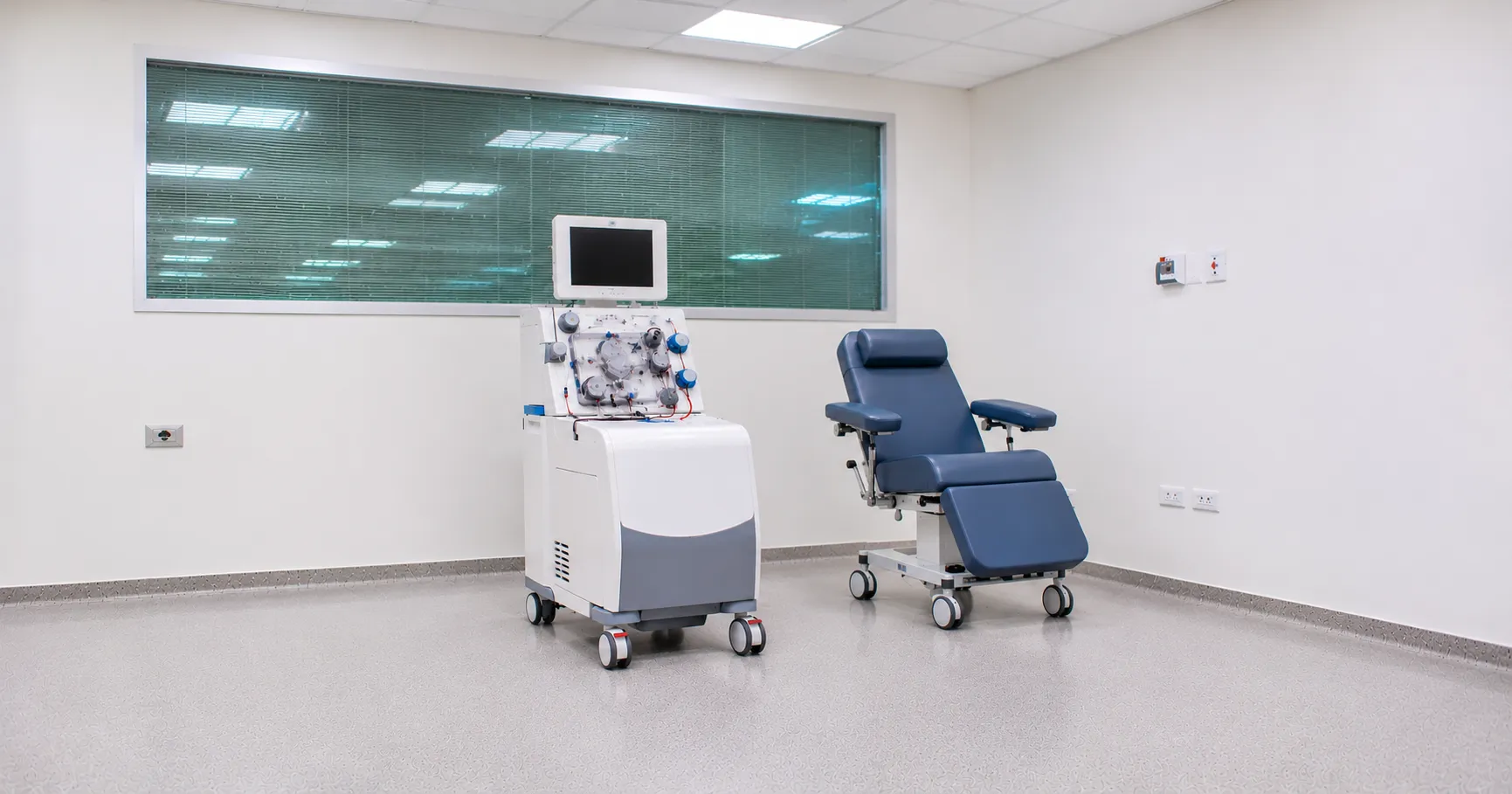
An apheresis machine is an automated device that draws whole blood from a donor or patient, separates it into its components inside a sealed single-use set, keeps the wanted fraction — typically platelets, plasma, red cells or white cells — and returns everything else to the person through an extracorporeal circuit. The term comes from the Greek for “to take away”, and that is exactly what it does: selective removal of one part of the blood while the remainder is given straight back. For a blood service or hospital buyer the machine is judged on separation quality, procedure time, donor safety features and the running cost of its disposable kits.
Two collection principles dominate: spinning the blood in a centrifuge to sort components by density, and passing it across a filter membrane to sieve plasma from cells. The choice shapes which components a site can collect and how the machine fits its workflow.
How Component Separation Works
Whole blood is a suspension of cells of different densities in plasma. Red cells are heaviest, plasma is lightest, and platelets and white cells sit in between in the thin buffy-coat layer. An apheresis machine exploits those differences, either by centrifugal force or by membrane pore size, to divert the target fraction into a collection bag while pumps return the balance to the donor. The whole path the blood travels — needle, tubing, separation chamber and bags — is a closed, sterile, single-use consumable, so the donor's blood never contacts the machine itself.
Centrifugal separation
Most component-collection platforms use centrifugal separation. Blood is anticoagulated as it leaves the vein and spun in a rotating chamber or belt; the components stratify into layers by density, and optical or interface sensors detect the boundary between layers so the machine can harvest the correct band. Centrifugal systems can collect platelets, plasma, red cells, granulocytes and mononuclear cells for stem-cell work, which makes them the versatile workhorse of a blood centre.
Membrane separation
Membrane (or filtration) apheresis passes blood tangentially across a microporous membrane that lets plasma pass while retaining cells. It is used chiefly for plasmapheresis — collecting plasma or performing therapeutic plasma exchange — and is valued where a clean cell-free plasma product is the goal. Membrane devices are generally simpler mechanically but are limited to plasma-type procedures rather than cellular components.
The Main Collection Modes
A single platform often supports several procedures selected by protocol and disposable set:
-
Plateletpheresis — collects a therapeutic dose of platelets (often equivalent to several whole-blood units) from one donor, leaving red cells and most plasma returned.
-
Plasmapheresis — collects plasma for transfusion or fractionation, or removes and replaces plasma in therapeutic exchange.
-
Red cell apheresis — collects one or two units of red cells with automated volume and haematocrit control.
-
Multicomponent collection — harvests, for example, platelets plus plasma or a double red-cell dose in one sitting.
-
Leukapheresis and stem-cell collection — collects white cells or peripheral blood stem cells, used in transplant and cellular-therapy programmes.
The Extracorporeal Circuit and Anticoagulation
Because blood clots on contact with tubing, an anticoagulant is metered into the draw line continuously. Apheresis almost universally uses citrate (ACD-A), which works by binding ionised calcium; it is short-acting, so once the blood is returned the donor's calcium normalises quickly. The trade-off is transient citrate effect — tingling or a metallic taste from a fall in ionised calcium — which the machine manages by controlling the infusion ratio and return rate. Well-designed platforms monitor draw and return pressures, detect air, and pace the citrate dose to donor weight and procedure to keep reactions minimal.
Continuous Versus Intermittent Flow
Continuous-flow systems use two venous access points (or a dual-lumen line) so blood is drawn and returned at the same time, giving faster procedures and a smaller extracorporeal volume held outside the body at any moment. Intermittent-flow systems use a single access point, alternating draw and return cycles; they need only one venepuncture but hold a larger volume per cycle and take longer. The distinction matters for donor comfort, procedure time and which donors are eligible.
Single-Use Sets and the Closed System
Every procedure uses a sterile, single-use collection set matched to the machine and the protocol. The set defines the sterile fluid path and is the single largest recurring cost, so kit price and availability weigh heavily in any purchase. A functionally closed system with sterile-docked connections preserves the shelf life of the components collected; an open step shortens it. Confirm the set range covers every procedure you intend to run and that anticoagulant and any replacement fluids are compatible.
Key Specifications Buyers Should Check
Compare platforms on collection efficiency (how much of the target component is captured), procedure time, extracorporeal volume, the breadth of protocols supported, and the footprint against the space in your donor session or apheresis suite. Automated features — interface detection, pressure and air monitoring, citrate management, guided setup and barcoded set loading — reduce operator error and training burden. Data connectivity to the blood-establishment computer system matters for traceability and vein-to-vein records. Consider also the noise level in a busy donor room, the ease of cleaning between donors, and how quickly staff can load a set and start a procedure, since setup time multiplied across a session shapes real throughput as much as the headline procedure time does.
Standards, Regulation and Safety
An apheresis machine is an active medical device that must carry UKCA or CE marking, and its electrical safety follows the IEC 60601-1 family for medical electrical equipment. In the UK, blood establishments operate under the Blood Safety and Quality Regulations, overseen by the MHRA, which also regulates the device itself. Guidelines for donor selection and component specifications sit within national transfusion guidance. Buyers should verify service arrangements, alarm and safety-interlock behaviour, and the manufacturer's validation documentation before commissioning.
Where Apheresis Machines Are Used
In blood-service donor sessions the priority is throughput and donor experience for platelet and plasma collection. In a hospital therapeutic apheresis unit the same technology removes pathological components — plasma exchange for certain neurological or haematological conditions, or red-cell exchange in sickle cell disease — so the machine must handle patients as well as healthy donors. Transplant and cellular-therapy services use apheresis for stem-cell and mononuclear-cell harvests. Match the platform's protocol range and patient-mode capability to the services you actually run.
Procurement Checklist
Before choosing an apheresis platform, confirm the following:
- Procedures supported — platelet, plasma, red cell, multicomponent, leukapheresis or stem-cell collection as you require.
- Separation principle — centrifugal for cellular versatility or membrane for plasma-focused work.
- Disposable set cost, range and lead times, since kits dominate the running cost.
- Donor-safety monitoring — pressure, air detection and automated citrate management.
- Continuous or intermittent flow and the venous access it demands.
- Connectivity to your blood-establishment or transfusion IT for full traceability.
- UKCA or CE marking and IEC 60601 compliance, with a clear service and spares plan.
- Training, footprint and warranty suited to your donor session or apheresis suite.
Total Cost of Ownership
The purchase price of the instrument is usually the smaller part of the lifetime cost; the single-use sets and anticoagulant consumed on every procedure dominate the budget, followed by service contracts and staff time. Weigh the per-procedure consumable cost, collection efficiency and reliability rather than the headline hardware price. To compare apheresis platforms and the disposables that fit them, our team can help you scope a purchase through MediGear buyer services.
Conclusion
An apheresis machine automates the separation of blood into components, keeping the fraction you need and returning the rest safely to the donor or patient. Choose on the procedures you run, the separation principle, disposable cost and donor-safety features, and confirm UKCA or CE marking and IEC 60601 compliance. To specify the right platform and consumables for your service, contact MediGear.
Disclaimer
This article is for informational purposes only. It is published by MediGear (medigear.uk) for general information and procurement guidance, and is not clinical, diagnostic, treatment, technical, engineering, legal or regulatory advice, nor a product endorsement, guarantee or substitute for professional assessment. MediGear does not provide medical consultations. Buyers should consult their clinical, biomedical, estates and regulatory contacts, and the manufacturer's documentation, and independently verify all specifications, certifications, compatibility and suitability before purchase. Specifications, certifications and availability are correct at the time of publication and may change without notice. MediGear is a medical-equipment distributor and does not sell medicines or pharmaceutical products.