
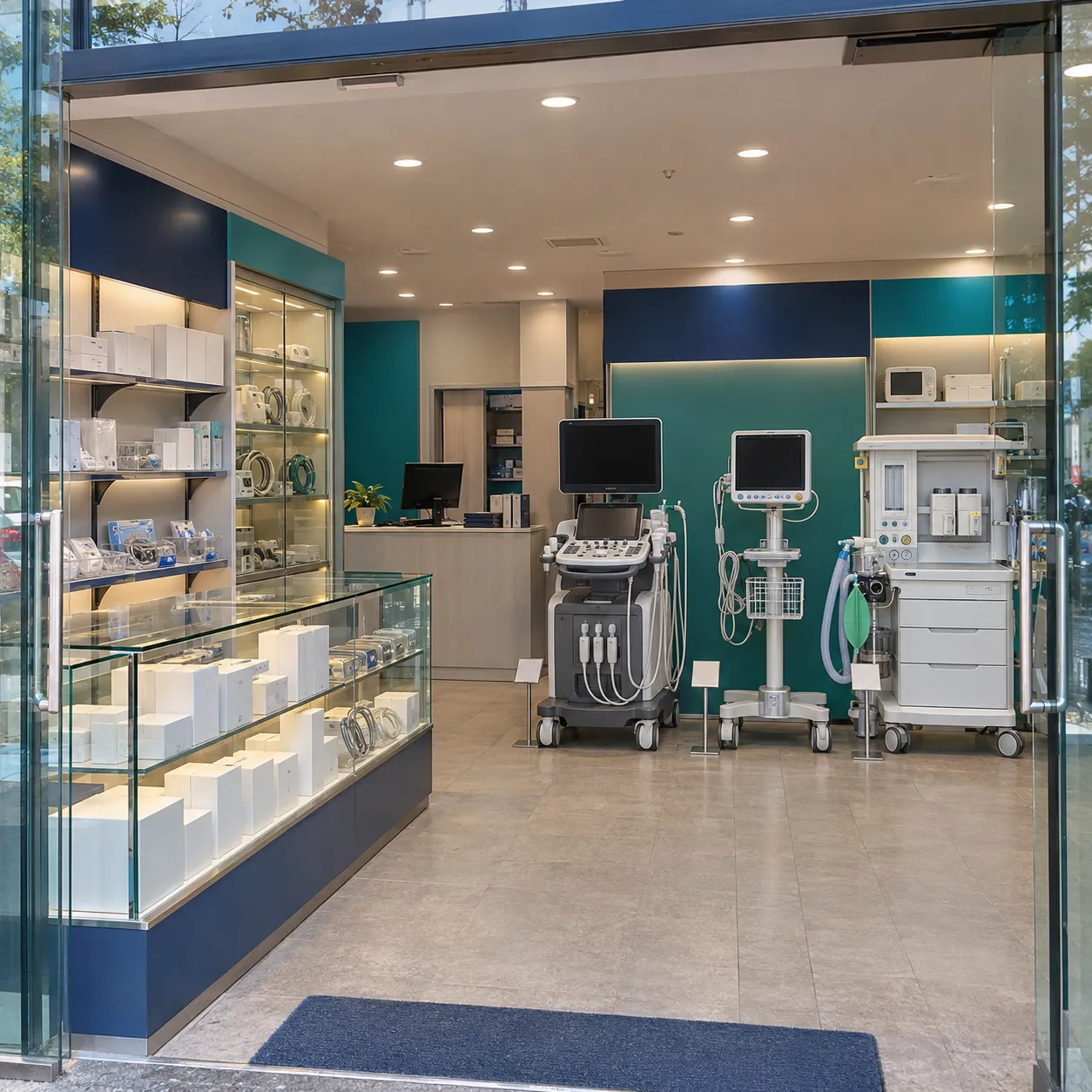
EDE approval before import or sale
In the United Arab Emirates, Federal Decree-Law No. 38 of 2024, in force since 2 January 2025, makes the Emirates Drug Establishment (EDE) the regulator for medical products, equipment included. No one may import, distribute, sell, re-market or use a medical product without EDE marketing approval, and only an EDE-licensed medical warehouse or marketing office can apply. Each marketing rights holder must appoint at least two EDE-licensed importers. So a quote for the UAE starts with the model's approval status.
Whichever emirate you are in, requests come to us at MediGear, a distributor of medical equipment with a company registered in England and Wales. Quotes, export documents and freight are the work we do for healthcare buyers in more than 80 countries. For UAE diagnostic imaging equipment, such as CT, X-ray and ultrasound, we look for verified makers whose model holds EDE approval, or whose local agent can obtain it. Only when the points below are settled does the quote go to your biomedical engineers. Requests start on thebuyer'ss page, and no account is required.
SEHA, Dubai Health, EHS and private groups
Across the seven emirates, we quote for:
- Government hospitals in Abu Dhabi, such as SEHA's Sheikh Khalifa Medical City and Tawam
- Dubai Health, including Al Jalila Children's Hospital
- Emirates Health Services in the northern emirates
- Private groups such as Burjeel and Cleveland Clinic Abu Dhabi, and day surgery theatres
- SSMC and the other PureHealth hospitals
- Clinics in the free zones, including Dubai Healthcare City
- EDE-licensed medical warehouses and marketing offices
Federal entities buy from suppliers on the Ministry of Finance's Federal Supplier Register, which foreign companies may join, and Abu Dhabi uses its Government Procurement Gate. PureHealth buys centrally for its hospitals through its purchasing arm. In Dubai Healthcare City, providers need DHA licences as well as permits from the city's own authority. One unit for a single clinic is quoted like any larger order. If your list covers medical and laboratory equipment, say so in the first email, and we will confirm which lines we can quote.
EDE marketing approval and local agents
EDE's device marketing authorisation requires the holding company and the manufacturing sites to be registered with EDE. The file includes a free sale or registration certificate attested by the UAE embassy, EC, 510(k) or PMA evidence and, for Class III and IV, safety and efficacy data. The service takes 45 working days, and approval lasts five years. Each shipment then needs an import permit; MOHAP must still list the service, and only the local agent named in the approval may import.
Leaflets must use at least Arabic and English, and DHA-licensed facilities must have their equipment registered. Free-zone establishments fall under the same law, so trading medical supplies there requires the same EDE approval. This UAE medical devices distribution guide is short, so it names who does what and not the full rules. The agent, importer and warehouse roles belong to licensed UAE firms, not to us. We give no regulatory advice, though each quote does list the unit's certificates.
FANR licences, import permits and medical physics checks
The Federal Authority for Nuclear Regulation (FANR) requires a licence for activities involving ionising radiation, and businesses in free zones are covered too. A licence lasts three years, and lower-risk activities may need only registration. FANR must review and approve new installations of radiation equipment before commissioning, and the licensee notifies FANR before any radiation generator is received or transferred. An import permit is needed before each import and is filed by the licensee or a local supplier holding the end user's purchase order. It is valid for 60 days.
Under FANR's basic safety regulation, a medical physicist checks radiological equipment at acceptance and commissioning before clinical use, periodically after that and after major maintenance. DHA's equipment standard adds safety, QC, and calibration tests at installation and requires medical physics approval before an imaging unit is used. The DOH regulates health care in Abu Dhabi but does not have its own equipment testing rules, so we ask the site what applies. Installing or repairing X-ray equipment is a technical service that needs FANR registration or a licence, so we confirm who will fit the unit.
230 V, type G plugs and bilingual leaflets
Four things are checked with the manufacturer up front:
- Plug type G. Mains here is 230 V and 50 Hz, with D and G plugs listed for the UAE by the IEC, and we match the lead and power module to that.
- Arabic and English. The internal leaflet must be in at least Arabic and English, so we check what the manufacturer supplies in both.
- FANR-registered fitter. Installation and repair need FANR registration or a licence, and spare parts and consumables can travel with the unit.
- Ownership update. DHA updates the unit's ownership in FANR's system after purchase, so the quote gives the serial number and the maker's certificate.
Open points are put to the manufacturer in writing before quoting, because the EDE file and the FANR permit name the same unit.
Business codes, clearing agents and wood packing
Importing medical devices runs through ICP and the local customs bodies of Abu Dhabi, Dubai, and Sharjah, and restricted goods need prior approval from the relevant authority. In Dubai, the importer registers for a customs business code, and licensed clearing agents may clear goods on its behalf. Importing and exporting medical devices are separate matters, so this page does not cover exporting medical devices in the UAE. Each UAE shipment carries:
- An invoice and packing list the agent can declare from
- A certificate of origin for the shipment
- Air waybill or bill of lading copies for the agent
- HS codes set against each item
- The EDE approval and the maker's certificates
Agricultural consignments may enter only with a health certificate under the federal agricultural quarantine law, which has no clause on wood packaging, and the UAE's IPPC entry lists no ISPM 15 report. Heat-treated, stamped crates are the safe choice, so we ask medical equipment manufacturers for them.
Jebel Ali, Khor Fakkan, Fujairah and DXB
- Model and approval. Send the model, quantity, and site via RFQ form or email, along with the name of your EDE-licensed importer.
- Quote and permit timing. A catalogue quote usually follows within 48 hours, covering certification, lead time, the route and the FANR permit window for X-ray.
- Confirmation. We place the order with the maker once you confirm the quote in writing.
- Gulf or east-coast port. Sea freight can go into Jebel Ali or Khalifa Port, or into Khor Fakkan and Fujairah on the east coast, and air freight into Dubai or Abu Dhabi.
Once the unit reaches the port or airport you choose, your clearing agent or broker files the customs declaration with the local customs authority, and Dubai Customs provides online filing guidance. We confirm the port and route at quote time.
Single units, free zones and pre-owned units
Most catalogue lines are quoted one unit at a time, so a clinic in Sharjah can ask for a single ultrasound scanner, and so can medical equipment suppliers in Dubai that hold an EDE licence. For tendered work, see government tender, and skin clinics can browse Dermatology and Aesthetics. The parts of the 2024 decree-law we could read, and the EDE and import permit pages, say nothing about used and refurbished medical equipment. So we quote our refurbished range for the UAE only after your EDE-licensed importer has confirmed with EDE, and with FANR for X-ray, that the unit can be approved and imported.
Disclaimer
Several UAE official pages could not be opened, so treat this page as general background and confirm the current rules with EDE, FANR and your emirate's authorities before ordering. Read it as orientation rather than an offer to supply, and take legal, regulatory and customs advice in the UAE. Quotes reflect what makers can supply, and we place an order only after both sides agree in writing. Your importer and clearing agent handle the EDE, FANR and customs steps, since we hold no UAE licence.
Has FANR issued the import permit?
FANR requires an import permit, valid for 60 days, before each shipment of an X-ray or CT unit, filed by the licensee or a local supplier holding the end user's order. Share the model and site, and the quote will set the lead time against that window.
Frequently Asked Questions
Yes. Hospitals anywhere in the Emirates can email connect@medigear.uk or use the RFQ form. A model number or specification is enough, with no sign-up. We quote for government hospitals in the UAE, such as SEHA, Dubai Health, and EHS; private groups and free-zone clinics; and medical equipment suppliers in Abu Dhabi that hold an EDE licence.
Only an EDE-licensed medical warehouse, local manufacturer, or marketing office, with the holding company and manufacturing sites registered with EDE. The service takes 45 working days, and the approval lasts five years. Under the 2024 law, each marketing rights holder must appoint at least two EDE-licensed importers.
At least Arabic and English, under Article 38 of the 2024 decree-law, and pack information must match the annex to the marketing approval. The law also refers to EDE labelling guidelines, so we check the maker's texts in both languages before quoting.
Before each import of an X-ray or CT unit, the licensee or a local supplier holding the end user's purchase order applies; the permit is valid for 60 days, and MOHAP's import permit card for radiological devices also requires it.
A medical physicist checks them at acceptance and commissioning, before clinical use, then periodically and after major maintenance, under FANR's basic safety regulation. In DHA-licensed facilities, safety, QC, and calibration tests also run on installation, and medical physics approves imaging units before use.
Sea freight is quoted to Jebel Ali or Khalifa Port in the Gulf, or to Khor Fakkan and Fujairah on the east coast. Air cargo lands at Dubai or Abu Dhabi. The quote names the port and route, as both are confirmed at the time of quoting.
Yes. Catalogue lines, including hospital medical equipment, are normally quoted unit by unit, and any minimum the maker applies shows up in the first reply. The model still needs EDE approval and an EDE-licensed importer, and we confirm both with you before the quote goes out.
Usually, approvals: EDE marketing approval, the per-shipment import permit and, for X-ray and CT diagnostic imaging devices, the FANR licence and its 60-day import permit. The quote confirms the lead time and the shipment route.