
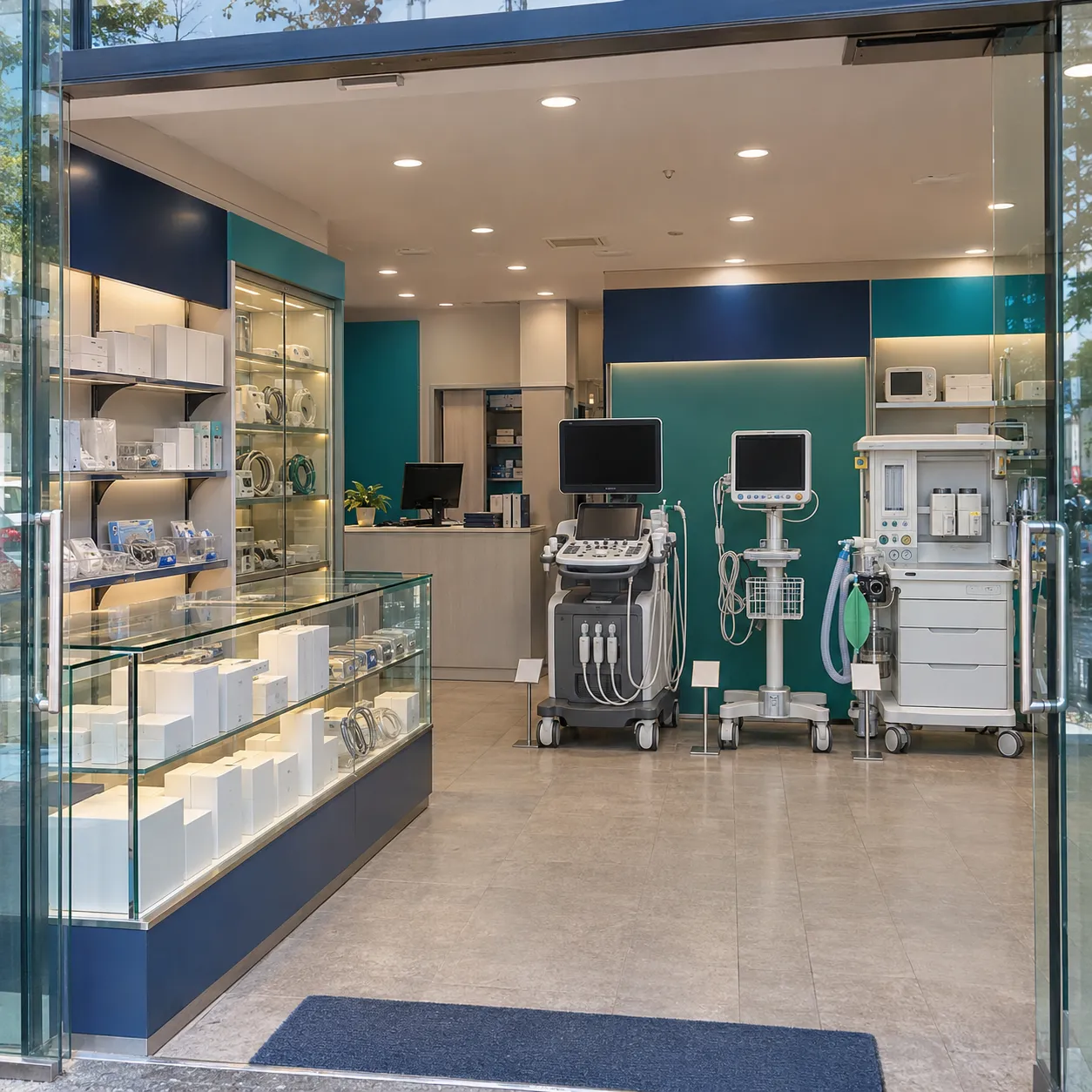
MFDS licences and Korean labels first
In South Korea, the Ministry of Food and Drug Safety (MFDS) regulates medical devices under the Medical Devices Act, and more changes to that act are due by the end of 2027. Devices fall into four classes: class I is notified and class II is certified, though some class II devices need approval, and classes III and IV need MFDS approval. To import devices as a business, a firm needs an MFDS import licence, and applicants must already hold at least one product licence. The firm then needs the right licence, certification, or notification for each device it brings in. So a quote for South Korea starts with your importer's product licence.
Our company is registered in England and Wales, and we use the MediGear name as a medical equipment distributor and marketplace for healthcare buyers in more than 80 countries. We handle quotes, export papers and freight. Korean labels and the MFDS licence decide which verified medical device maker we approach for each Korean order. The points below come first, and the quote follows for your engineers. Requests come in through the buyers page, which asks for no account.
University hospitals, medical corporations and PPS buyers
One public insurer, the NHIS, covers care at every medical institution, from the public hospital system to small clinics, and we quote for:
- Seoul National University Hospital and its branches
- Asan Medical Centre and Severance Hospital in Seoul
- The National Medical Centre and the National Cancer Centre
- Medical corporations and clinics, and endoscopy suites
- Dental clinics with X-ray or dental CT units
- Vets, who follow their own X-ray rules
- Licensed Korean importers and dealers
Public buying runs through the Public Procurement Service (PPS) and KONEPS, its e-procurement system. Agencies must use KONEPS when they ask PPS to contract. PPS also has a Foreign Equipment Division that buys medical equipment from abroad, with bids in English. Only licensed practitioners such as doctors and dentists, the state, medical corporations, non-profits, local governments and named public bodies may open a hospital or clinic. The public hospitals range from national university hospitals to regional medical centres. The NHIS covers every Medical Service Act institution nationwide, so health care in Seoul has the same insurer as everywhere else, and a clinic that wants one unit is quoted the same way. A licensed importer, or a distributor in South Korea that is a registered dealer, can send us a specification.
Import licences, UDI codes and Korean labels
Under MFDS's approval process, a firm must hold at least one product licence to get its import licence, which regional MFDS offices issue. No one may repair, sell, lease, give or use a device that lacks its product licence. Labels must be in Korean and show the importer's name and address, the manufacturer and its country of manufacture, the licence number and the MFDS standard code, which is Korea's UDI.
Manufacturers and importers register the standard code in MFDS's integrated device information system, and importers report their supplies to medical institutions and dealers. The law we read gives a foreign manufacturer no way to hold a Korean product licence itself, so the licence sits with your importer. That role is not ours, and the Korean Medical Devices Act gives it to a Korean importer, which may be one of the medical equipment suppliers in South Korea. For health care equipment of any class, we list the unit's certificates in each quote and leave regulatory advice to your advisers.
X-ray reports, three-yearly checks and special equipment
In South Korea, diagnostic X-ray is reported, not licensed, under the Medical Service Act and the rules on diagnostic radiation generators, which the health ministry and the KDCA run. The hospital or clinic reports a new X-ray or CT unit to the local city, county or district head at least three days before first use. The unit is inspected before use and then every three years by a registered inspection body. Shielding is also inspected before use, and a radiation safety manager must be named and trained within a year.
Three kinds of diagnostic imaging devices, CT, MRI and mammography, count as special medical equipment, which the hospital registers with the local authority. Quality-control inspections include an annual document review and an on-site check every three years, plus a precise inspection at installation. Equipment that fails must not be used. Medical diagnostic X-ray sits outside the nuclear-safety regime. For an X-ray machine, we found nothing in the radiation rules that sellers or installers must do, as those tasks fall to the hospital or clinic.
220 V at 60 Hz, Korean inserts and test reports
Before quoting, we confirm these with the manufacturer:
- 60 Hz supply. By law, the supply is 220 V ±22 V and 60 Hz ±0.2 Hz, and the IEC lists C and F plugs, so we confirm that the unit runs at 60 Hz.
- Korean labelling. Labels and inserts must be in Korean, and the importer checks them, so we ask the manufacturer what it supplies for Korea.
- Test report. The pre-use X-ray inspection can be skipped if a testing institution covered the required items at the MFDS licence stage, so we ask for that report, and spare parts and consumables can ship with the unit.
- Used units. For a pre-owned unit, your importer tests it against the tests in its product standard, so the quote includes those test details.
We get the manufacturer's answers in writing before the quote goes out, because your importer's licence and the local report both name the model.
KCS declarations, KMDIA pre-reports and APQA wood checks
Declarations to the Korea Customs Service are made in the name of the cargo owner or a licensed customs broker, through UNI-PASS. For medical devices, customs checks a standard pre-report from the Korea Medical Devices Industry Association. For a Korean shipment, we prepare:
- The invoice and packing list
- The carrier's transport document
- A certificate of origin for customs
- HS codes item by item
- The maker's certificates and test reports
Under the APQA notice, wood packaging, pallets, crates, and dunnage on imported cargo must be treated and marked to ISPM 15, and the importer declares the wood online. Wood with no mark, or with bark left on, is ordered destroyed or sent back, so we specify treated and marked crates when ordering.
Busan, Incheon and the typhoon season
- Model and licence holder. Send the model, quantity and site by RFQ form or email, and name the Korean importer that will hold the licence.
- Written quote. Most catalogue requests receive a written quote within 48 hours, including certification, lead time, and the route.
- Confirmation. Your written confirmation of the quote lets us place the order with the manufacturer.
- Sailings and flights. Sea freight goes into Busan, which handled a record 22.75 million TEU in 2023, or into Incheon or Gwangyang; air freight goes into Incheon International Airport.
Our part ends at the Korean port or airport, and your customs broker then lodges the import declaration with the KCS. Typhoons hit Korea mainly from July to September, peaking in August, so that summer sailings can slip.
Single scanners, PPS tenders and used devices
Per-unit quotes mean a Daegu clinic can ask for a single ultrasound scanner, and so can a Busan health care provider. For PPS work, see government tenders, and dentists can browse Dental and Oral Care Equipment. Used devices, such as refurbished medical imaging devices, may be imported with conditions, so our refurbished range can serve South Korea. The importer tests a used device against the tests in its product standard and releases it only with an inspection certificate. It keeps the records for two years, and we found no general exemption from the product licence.
Disclaimer
Use this page as a guide for Korean buyers only. You will find no offer to supply here, and no legal, regulatory or customs advice either. Quotes follow the manufacturer's stock and lead times, and orders are fixed only when both sides agree in writing. Devices need your importer's MFDS licence and Korean labels, and X-ray units need the local report and checks before use. Clearance, the MFDS licence and the radiation reports stay with you, your importer and your broker. The MFDS licence and the importer's role are not ours.
Has your importer licensed the model?
In South Korea, no one may sell or use a medical device without its MFDS permit, certification or notification, held by the licensed importer. With your importer's name, the model and site, we can ask the maker for Korean texts and quote the route.
Frequently Asked Questions
Yes. The RFQ form on the buyers page accepts a model number or specification, and so does connect@medigear.uk; replies come by email without an account. We quote Seoul healthcare providers and others nationwide, from university hospitals to clinics, plus dental and veterinary practices, licensed Korean importers, and other medical device companies in South Korea.
The Korean importer. To import devices as a business, a firm needs an MFDS import licence, and a permit, certification or notification for each device. The provisions we read give a foreign maker no route to hold these itself, so your importer holds them.
Yes. Label, outer-package and insert particulars must be written accurately in Korean, in terms that are easy to understand. They include the importer's name and address, the country of manufacture, the licence number, a nd the MFDS standard code, so we ask the maker for the Korean text
A new diagnostic X-ray or CT unit is reported to the local city, county or district head at least three days before first use. It is inspected before use and every three years by a registered body, and the institution appoints a radiation safety manager.
As special medical equipment, they are registered with the local authority. Quality-control inspection means a document check every year and an on-site check every three years, plus a precise inspection at installation, and equipment that fails may not be used.
Yes, under conditions. The importer must test a used device against its product's test specifications, release it only with an inspection certificate attached and keep records for two years. We found no exemption from the product licence for used devices, so we treat refurbished medical equipment as needing one.
Yes. We quote most catalogue lines one unit at a time and mention any maker's minimum order in the first reply. The model still needs your importer's MFDS licence, which we confirm with you before the quote goes out.
In summer. Typhoons hit Korea mainly from July to September, peaking in August, so allow some slack for sea freight into Busan, Incheon or Gwangyang in those months. Air freight into Incheon International Airport is quoted separately where it suits the order.