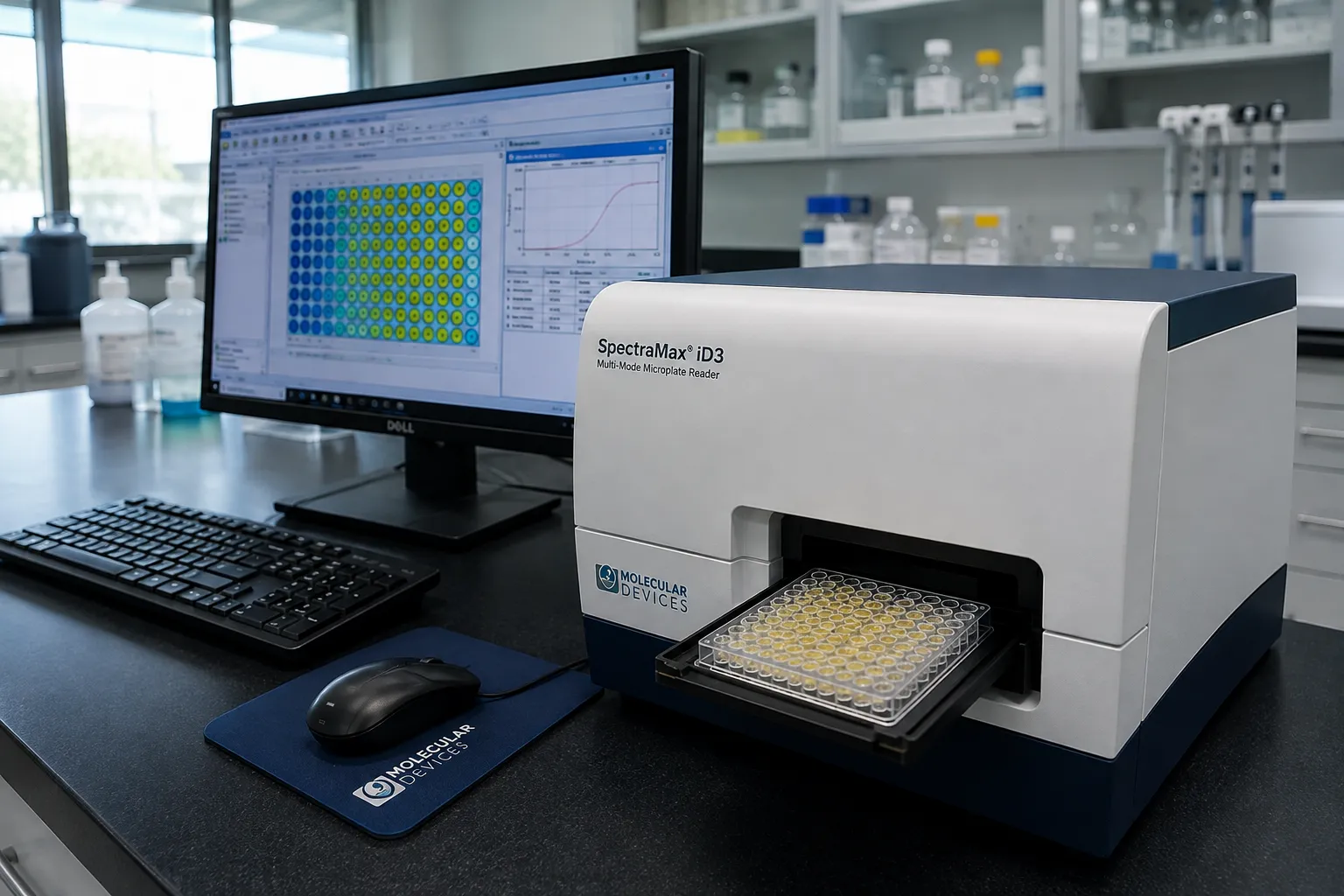
A microplate reader is a laboratory instrument that measures an optical signal from each well of a microtitre plate, most often the ninety-six-well format, to quantify the result of an assay such as an ELISA. It moves the plate under a detection head, reads absorbance, fluorescence, or luminescence from every well, and reports the values as a grid; the software then converts them into concentrations against a standard curve, so a whole plate of samples is measured in seconds to a few minutes.
This guide is for laboratory managers and scientists specifying microplate readers for ELISA and related plate-based assays. It explains the three detection modes, how they map onto assay types, and the plate handling, software, standards and running costs a buyer should weigh before purchase.
How a Microplate Reader Works With ELISA
An ELISA, the enzyme-linked immunosorbent assay, uses antibodies to capture a target analyte in each well and an enzyme label that generates a measurable signal proportional to how much analyte is present. In the common colour-based format, the enzyme converts a substrate to a coloured product, and the reader measures absorbance, the fraction of light of a set wavelength absorbed as it passes through each well. The reader itself does not run the assay; it quantifies the endpoint. Its job is to measure every well accurately and consistently so the software can fit a standard curve and read unknown samples from it.
Absorbance and Luminescence
Readers are specified by the detection modes they support. Absorbance, also called optical density, suits colourimetric and many other assays and needs a light source and selectable wavelengths. Fluorescence detection excites a fluorophore at one wavelength and measures emission at a longer one, offering greater sensitivity and wider dynamic range for fluorescent assays. Luminescence measures light produced by a chemical reaction with no excitation source, which gives very low background and high sensitivity for assays such as chemiluminescent ELISAs. A single-mode reader does one of these; a multi-mode reader combines them, adding flexibility at a higher cost. Match the modes to the assays on your menu now and realistically next, rather than paying for detection you will not use.
Filters, Monochromators and Wavelengths
How a reader selects wavelengths affects both flexibility and performance. Filter-based systems use optical filters for fixed wavelengths and tend to be sensitive and robust. In contrast,nochromator-based systems let the user tune to any wavelength, which suits laboratories running varied or developing assays. For a bench that mostly runs established colourimetric assays at standard wavelengths, a filter reader is often ideal; for method development across many dyes, tunable selection earns its place. Confirm the wavelength range and that the specific wavelengths your kits require are available.
Plate Formats, Handling and Throughput
Most ELISA work uses the ninety-six-well plate, but readers commonly also support 384-well and sometimes higher-density formats for scaled-up work, so confirm the formats you need are supported. Throughput depends on read speed and, for busy laboratories, on automation: onboard shaking for incubation steps, temperature control, and stacker or robotic plate loading for unattended batches. Many laboratories pair the reader with an automated plate washer, since consistent washing is critical to ELISA reproducibility. Consider how the reader fits your wider workflow rather than judging it on read speed alone.
Software, Data Handling and Curve Fitting
The software is as important as the optics. It must support the curve-fitting models your assays require, for example, four-parameter logistic fits common in ELISA, flag values outside the standard range, and export or transfer results into the laboratory record. For regulated or accredited work, look for user access control, audit trails and validated data handling. Assess the software hands-on during evaluation, because awkward plate mapping or limited curve fitting will slow every run regardless of how good the detector is.
Standards, Regulation and Quality
Where plate assays support clinical diagnosis, the laboratory works to ISO 15189, validating each assay and running internal quality control with external quality assessment where available. Readers used with IVD assay kits, and the kits themselves, carry UKCA or CE marking and are regulated by the MHRA and IVDR. The regulation (IVDR) affects the classification and availability of ELISA kits, so confirm the regulatory status of every kit you plan to run and whether an assay is IVD-labelled or research-use-only. Many readers are sold as general laboratory instruments, so the regulatory responsibility often sits with the assay and its validation rather than the reader, which buyers should clarify. Keep calibration and QC records aligned with UK accreditation expectations.
Running Costs and Total Cost of Ownership
A microplate reader has modest consumables of its own, mainly optical filters, occasional lamp replacement on some designs, and verification plates for performance checks, but the assay consumables around it dominate: ELISA kits, plates, substrates, wash buffers and pipette tips. When comparing readers, weigh the reader's reliability and software efficiency against the far larger recurring spend on kits and the labour of running plates. A reader that integrates washing, shaking and stacking can cut hands-on time enough to justify its price in a high-throughput laboratory.
Procurement Checklist
-
Confirm the detection modes needed: absorbance, fluorescence, luminescence or a multi-mode combination.
-
Check the wavelength range and filters or monochromator suit your ELISA kits.
-
Verify supported plate formats, onboard shaking, temperature control and any stacker automation.
-
Assess curve-fitting software, audit trails, access control and LIS or data export.
-
Confirm UKCA or CE marking and MHRA and IVDR status of the assay kits you will run.
-
Clarify whether the reader is a general instrument and where regulatory responsibility sits.
-
Cost kits, plates, buffers, filters and verification plates across realistic throughput.
-
Agree service cover, performance verification, spares and application support.
Service, Connectivity and Support
Microplate readers are generally reliable, but performance should be verified periodically with reference plates, so confirm how the vendor supports verification and calibration and what a service visit covers. For laboratories reporting results into clinical systems, check how the reader's software connects to the LIS or middleware to avoid manual transcription. Good application support for assay setup, curve fitting and troubleshooting adds real value, especially in laboratories developing or transferring ELISA methods, so weigh it alongside warranty and response times.
Endpoint, Kinetic and Temperature-Controlled Reads
Not every plate assay is a single endpoint read. Many colourimetric assays read once after the stop solution is added, but enzyme-k. Still, enzyme-kinetic assays need the reader to take repeated measurements over time and calculate a rate, which demands stable timing and often incubation at a controlled temperature. Readers offering onboard temperature control and shaking let a laboratory run these assays without moving plates between instruments, reducing handling error. If your menu includes kinetic enzyme assays, cell viability tests or reporter-gene assays alongside standard ELISA, confirm the reader supports timed multi-read protocols and temperature control across the range those assays require.
Assays Beyond the Standard ELISA
The same reader typically serves a wide plate-assay menu, so it is worth mapping current and likely future work. Beyond colourimetric ELISAs, run protein quantitation assays, nucleic-acid concentration checks, fluorescent binding assays and luminescent reporter or ATP assays, each favouring a particular detection mode. A multi-mode reader consolidates these onto one instrument and one software environment, which can simplify training, servicing and bench space. Weigh that consolidation against the higher price and against whether a dedicated single-mode reader would in fact serve your real workload more economically.
Conclusion
A microplate reader is specified based on the modes and wavelengths your ELISA and plate assays need, its plate handling and automation fit, and the quality of its curve-fitting software. Match the modes to your assay menu, integrate washing and stacking where throughput justifies it, and confirm the regulatory status of the kits you run under ISO 15189. To compare microplate readers, washers, and consumables, or to arrange a laboratory quote, contact MediGear or open a buyer account.
Disclaimer
This article is for informational purposes only. It is provided (medigear.uk) for general information and procurement guidance, and it does not provide medical, diagnostic, treatment, technical, engineering, legal, or regulatory advice, nor a product endorsement, guarantee, or substitute for professional assessment. MediGear does not provide medical consultations. Buyers should consult their clinical, biomedical, estates and regulatory contacts, and the manufacturer's documentation, and independently verify all specifications, certifications, compatibility and suitability before purchase. Specifications, certifications and availability are correct at the time of publication and may change without notice. MediGear is a medical-equipment distributor and does not sell medicines or pharmaceutical products.