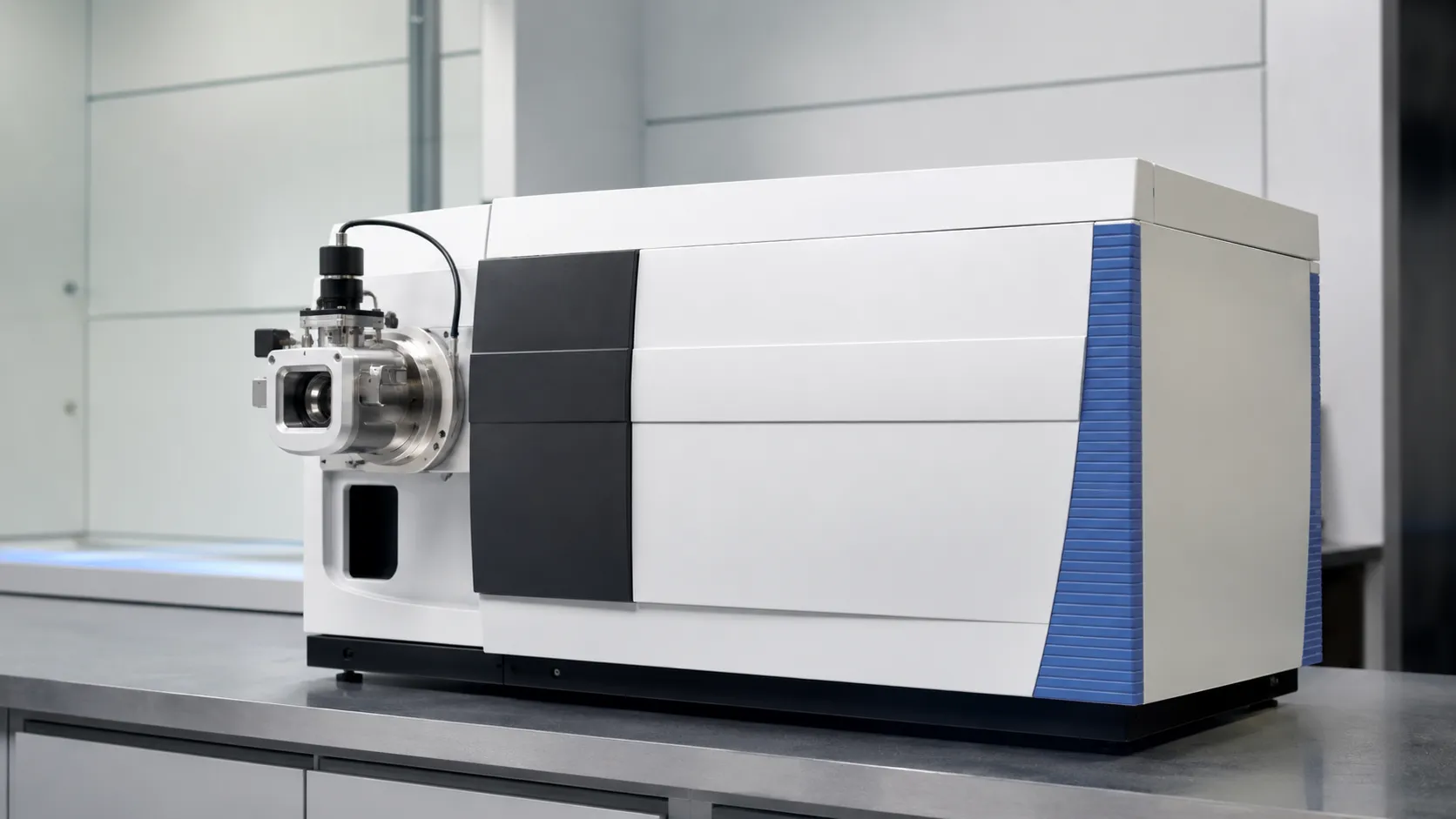
Mass spectrometry is an analytical technique that identifies and quantifies compounds by measuring the mass-to-charge ratio of ions produced from a sample. The instrument converts molecules into charged ions, separates those ions according to their mass-to-charge ratio, and counts them, producing a spectrum that acts as a chemical fingerprint from which a laboratory can identify and measure how much is present, often at very low concentrations.
This guide is for laboratory managers and biomedical scientists evaluating mass spectrometry, most often coupled to liquid chromatography as LC-MS/MS, for clinical or toxicology testing. It explains ionisation, mass analysis, and the tandem approach; it also covers the standards, staffing, and costs a buyer should weigh.
How a Mass Spectrometer Finds a Compound
Three stages describe every mass spectrometer: ionisation, mass analysis and detection. First, the sample molecules are turned into gas-phase ions, because only charged particles can be steered by electric and magnetic fields. The ions then enter a mass analyser that separates them by mass-to-charge ratio, and a detector records the abundance at each ratio. The resulting spectrum, a plot of abundance against mass-to-charge, lets the laboratory identify compounds by their characteristic ions and quantify them against calibrated standards.
Ionisation Methods
How molecules are ionised shapes what the instrument can measure. In clinical work coupled to liquid chromatography, electrospray ionisation is common: the liquid eluent is sprayed through a charged nozzle so that fine droplets shed solvent and leave charged analyte ions, a gentle process suited to many drugs, hormones and metabolites. Atmospheric-pressure chemical ionisation suits some less polar compounds. Both are soft techniques that keep the molecule largely intact, which is what allows reliable identification. Matching the ionisation source to the analyte class is a key part of method development rather than a fixed instrument feature.
Tandem Mass Spectrometry and LC-MS/MS
Clinical laboratories most often use tandem mass spectrometry, written MS/MS, usually with a triple quadrupole and liquid chromatography. Chromatography separates the sample over time so compounds arrive at the mass spectrometer one group at a time, reducing ion suppression. The tandem instrument selects a precursor ion in the first stage, fragments it in a collision cell, and measures specific product ions in the second stage. This precursor-to-product transition is highly specific, so LC-MS/MS can distinguish a target compound from a complex matrix such as serum or urine and quantify it accurately at low concentration, which is why it has become a reference approach for many assays.
Where Mass Spectrometry Earns Its Place
Mass spectrometry is chosen where specificity and sensitivity beyond routine immunoassay are needed. Typical clinical and toxicology uses include therapeutic drug monitoring, screening and confirmation of drugs of abuse, measurement of steroids and other hormones where immunoassay cross-reactivity is a problem, some vitamin and metabolite assays, and newborn screening. Its strength is resolving compounds that immunoassays confuse, and quantifying several analytes in one run. The trade-offs are higher capital cost, more involved sample preparation, longer method development and validation, and a need for skilled staff, so it complements rather than replaces automated immunoassay and chemistry platforms.
Sample Preparation and Method Validation
Results are only as good as the front-end work. Samples usually need preparation such as protein precipitation, solid-phase or liquid-liquid extraction, to clean the matrix and concentrate the analyte, and stable isotopes. Stable-isotope labels correct for losses and ion suppression. Because most clinical mass spectrometry uses laboratory-developed methods, each assay must be validated for accuracy, precision, linearity, recovery, matrix effects and carryover, and kept under ongoing quality control. This method-development burden is real and should be resourced properly, because it is where the technique's reliability is won or lost.
Standards, Regulation and Quality
Clinical mass spectrometry sits within an ISO 15189 quality system, with validated methods, internal quality control and external quality assessment where schemes exist. Instruments and any commercial IVD assay kits carry UKCA or CE marking and are regulated by the MHRA, while labo. In contrast, developed tests carry their own validation and governance obligations under the in-vitro diagnostic regulation (IVDR) framework, so establish clearly which of your assays are IVD-labelled kits and which are in-house methods. Data integrity, audit trails and controlled software access are part of accreditation and of UK information-governance expectations.
Running Costs, Gases and Staffing
Ownership cost extends well beyond the instrument. Budget for chromatography columns and mobile-phase solvents of suitable purity, calibrators and isotope-labelled internal standards, nitrogen and collision gases or a nitrogen generator, vacuum-pump maintenance, and consumables such as vials and extraction cartridges. Just as important is skilled staffing: mass spectrometry needs scientists competent in method development, troubleshooting and data review, which is a recurring investment. When comparing the technique with an immunoassay alternative, weigh this whole picture, not just the per-sample reagent cost, against the analytical benefit gained.
Procurement Checklist
-
Confirm UKCA or CE marking and MHRA status of the instrument and any IVD assay kits.
-
Clarify which assays are IVD-labelled kits and which are laboratory-developed under IVDR.
-
Match the ionisation source and analyser configuration to your analyte classes.
-
Confirm LC-MS/MS specificity and sensitivity suit your target concentrations and matrices.
-
Resource sample preparation, internal standards and full method validation.
-
Budget columns, solvents, gases or a nitrogen generator, vacuum service and vials.
-
Confirm data-system audit trails, secure access and LIS connectivity.
-
Assess staff expertise and vendor application support and training.
Service, LIS Connectivity and Support
A mass spectrometer is a complex instrument with pumps, ion optics and a vacuum system, so the service contract matters. Compare preventive-maintenance schedules, response and fix times, the cost of major parts, and access to specialist field engineers, since downtime on a single-instrument assay can halt a service. Confirm how validated results connect to the LIS or a middleware layer, because manual transcription undermines both speed and traceability. Strong vendor application support for method development and troubleshooting is often the difference between a platform that delivers and one that sits underused, so weigh it heavily at purchase.
Chromatography and the Role of Separation
In clinical LC-MS/MS, chromatographychromatography is not an accessory; it is half the method. The liquid chromatograph separates the extracted sample over a column so that compounds, including ones that share the same mass transition, arrive at the mass spectrometer at different retention times. This separation reduces co-elution and ion suppression, where competing molecules entering the source together blunt the signal. Column choice, mobile-phase composition and gradient all shape the separation, and small changes can shift retention times, so methods are locked down and monitored. Buyers evaluating a system should look at the whole LC-MS/MS chain, including pump reliability, autosampler carryover and column lifetime, not the mass spectrometer alone.
Triple-Quadrupole Versus High-Resolution Instruments
Most quantitative clinical assays use triple-quadrupole instruments, which excel at sensitive, targeted quantitation of known compounds through selected precursor-to-product transitions. High-resolution mass spectrometers, such as time-of-flight or Orbitrap-type analysers, instead measure mass very accurately across a wide range, which suits untargeted screening and identifying unknown compounds, as in broad toxicology screens. The two approaches answer different questions, so match the analyser type to whether your work is mainly targeted quantitation or open screening; some laboratories run both for complementary reasons.
Conclusion
Mass spectrometry identifies and quantifies compounds by the mass-to-charge ratio of their ions, and as LC-MS/MS. It offers specificity and sensitivity that routine immunoassays cannot. Justify it where cross-reactivity or low-level quantitation demands it, resource the method development and skilled staffing it needs, and account for the cost of gases and service alongside the instrument. To compare laboratory platforms and consumables or arrange a quote, contact MediGear or open a buyer account.
Disclaimer
This article is for informational purposes only. It is publisdigear.uk) for general publishes it information and procurement guidance, and is not; itical, diagnostic, treatment, technical, engineering, legal or regulato,ry advice, nor a product endorsement, guarantee or substitu, te for professional assessment. MediGear does not provide medical consultations. Buyers should consult their clinical, biomedical, estates and regulatory contacts, and the manufacturer's documentation, and independently verify all specifications, certifications, compatibility and suitability before purchase. Specifications, certifications and availability are correct at the time of publication and may change without notice. MediGear is a medical-equipment distributor and does not sell medicines or pharmaceutical products.