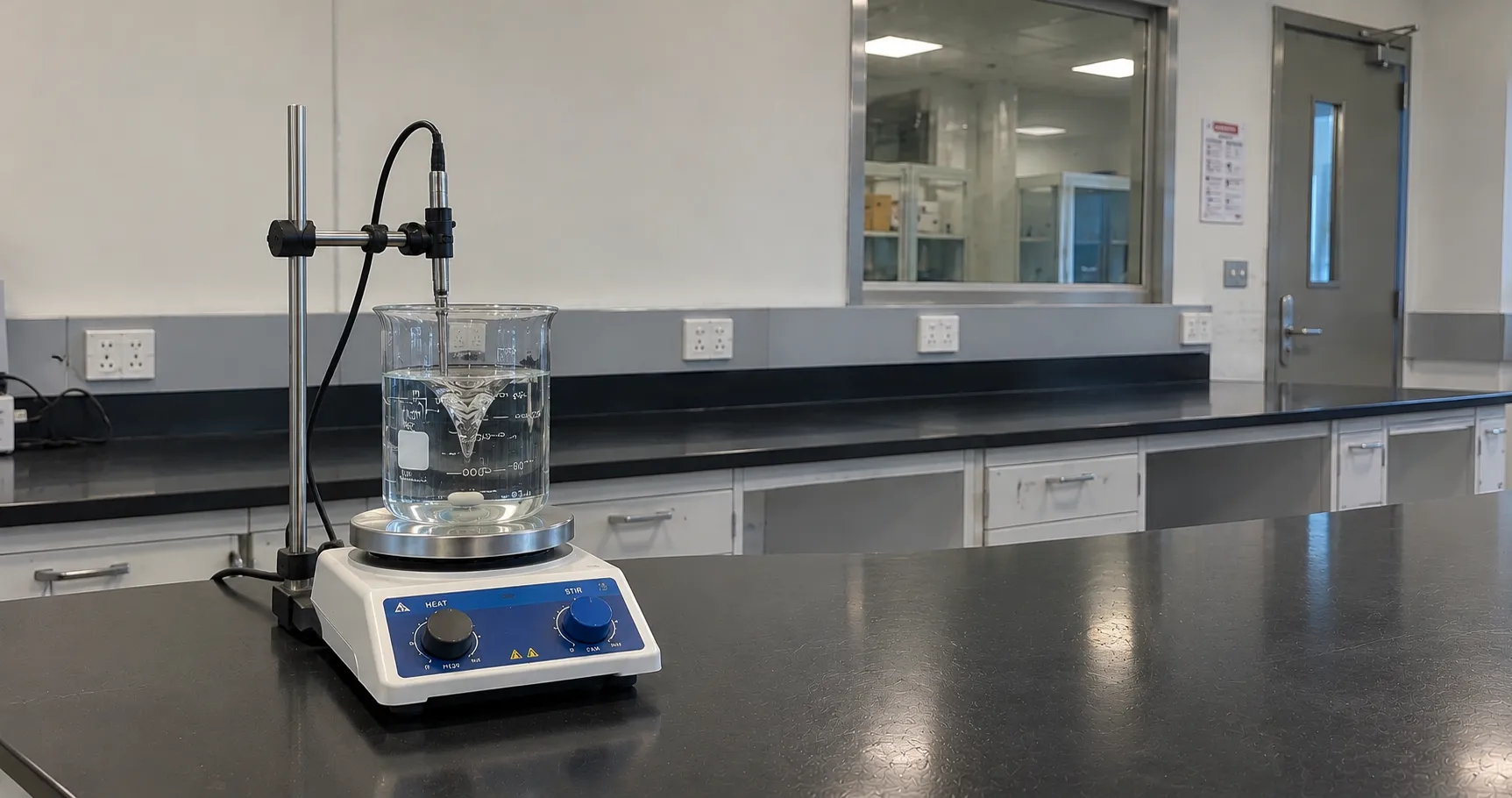
A magnetic stirrer mixes a liquid by spinning a small magnetic bar inside the vessel using a rotating magnetic field beneath the plate, so a solution can be blended continuously without any moving part touching it from above. It is the everyday workhorse for dissolving reagents, preparing buffers, mixing culture media and holding titration samples in motion. For a laboratory buyer, the decisions are whether you need heating in addition to stirring, how much volume and viscosity you must handle, and how many positions you want to run at once.
This article stays on magnetic stirring specifically. Where a sample is too thick or too large for a spinning bar to couple reliably, an overhead paddle stirrer is the right tool, and that is a separate purchase covered elsewhere.
How Magnetic Stirring Works
Under the work surface sits a motor-driven magnet, either a rotating bar magnet or an array of electromagnets. It creates a moving field that grips a magnetic stir bar dropped into the vessel, dragging it around and whipping the liquid into a vortex. Because the drive and the bar never physically connect, the vessel stays sealed, and nothing needs cleaning between the motor and the sample. The maximum speed at which the bar can follow the field before it loses grip and starts to skip is the instrument's practical limit, and it falls as viscosity and volume rise.
Stir Bars: Material, Shape and Size
Stir bars, often called fleas, are a permanent magnet sealed in an inert jacket. PTFE is the usual coating because it resists most acids, alkalis and solvents and releases cleanly; glass-encapsulated bars are used where PTFE would be attacked or where the highest chemical purity is needed. Shape matters: plain cylindrical bars suit flat-bottomed beakers, octagonal bars with a pivot ring spin more stably, egg-shaped bars self-centre in round-bottomed flasks, and cross-shaped bars give strong mixing in wide vessels. Match bar length to roughly 70 to 80 per cent of the vessel base so it turns freely without climbing the walls, and keep a magnetic retriever rod to lift bars out without contaminating the solution.
Plain Stirrers Versus Hotplate Stirrers
A plain magnetic stirrer only mixes. A hotplate stirrer adds a heated top plate, so you can dissolve stubborn reagents, keep a reaction warm, or prepare agar. If you buy heating, check the top-plate material and maximum temperature: aluminium plates heat and cool quickly and spread heat evenly. In contrast, ceramic-coated plates tolerate higher temperatures, resist chemical spills and are easier to wipe down. Hotplate stirrers commonly reach around 300 to 550°C depending on plate type. A model that accepts an external temperature probe controls the liquid temperature rather than the plate temperature, which is far more accurate for temperature-sensitive preparations.
Speed, Torque and Viscosity Limits
Two figures govern mixing performance: the speed range, typically from around 100 up to 1,500 rpm, and the torque, which decides whether the bar keeps turning as the mixture thickens. A cheap stirrer will happily spin water but will decouple, the bar losing sync and rattling, as soon as the medium becomes viscous or the volume is large. If you prepare gels, glycerol solutions, high-percentage agar or several litres at a time, specify a high-torque unit and check the manufacturer's stated maximum stirring quantity in litres of water. Beyond a certain viscosity, no magnetic stirrer will cope, and you need an overhead stirrer.
Capacity, Footprint and Multi-Position Units
Stirrers are rated for a maximum stirring volume, from a few hundred millilitres on compact units to 20 litres or more on large-plate models. Consider your largest routine vessel, not the average. Where a lab prepares many small samples, a multi-position stirrer with four, six, ten or fifteen points lets several beakers run from one footprint, which is efficient for media preparation and dissolution testing. Compact battery-powered or submersible stirrers exist for cold rooms, incubators and anaerobic cabinets where a mains hotplate cannot go.
Standards, Safety and Certification
Laboratory stirrers should be built to IEC 61010-1, the general safety standard for electrical laboratory equipment; heated models additionally fall under IEC 61010-2-010 for equipment that heats materials. Insist on UKCA or CE marking and confirm the unit is sold with a declaration of conformity. For heated plates, look for a hot-surface warning indicator that stays lit while the plate is dangerous to touch, and an over-temperature cut-out. Where flammable solvents are handled, remember a standard hotplate is an ignition source and is not suitable for use inside a flammable atmosphere without appropriate controls; the Health and Safety Executive publishes general guidance on managing such risks.
Calibration and Routine Maintenance
The stirring speed display indicates speed rather than providing a metrological measurement. Still, heated models benefit from periodic checks of plate or probe temperature against a reference thermometer, and biomedical or estates teams often add stirrers to a scheduled checklist. Wipe spills promptly, because dried reagent under a stir bar causes chattering and uneven coupling, and inspect stir bars for cracked coatings that can shed PTFE or leach the magnet into the sample. Keep the top plate clear of ferromagnetic clutter that distorts the field.
Where Stirrers Are Used
Solution-preparation and media rooms are the obvious home, but magnetic stirrers appear across pathology, microbiology, water testing, education and veterinary laboratories. In titration, they hold a sample under a burette or an automatic titrator; in dissolution and Workup, multi-position units run standardised tests; in cell culture support labs, low-speed stirring keeps media homogeneous. Matching the stirrer to the setting, whether a benchtop hotplate model or a submersible unit for an incubator, avoids buying more or less capability than the task needs.
Procurement Checklist
Before ordering a magnetic stirrer, confirm the following:
-
Heating required or not, and if so, the top-plate material, maximum temperature and probe control option.
-
Maximum stirring volume in litres matched to your largest routine vessel, not the average.
-
Torque and speed range adequate for the viscosity you actually mix, to avoid bar decoupling.
-
Number of positions if you prepare many samples at once, versus a single high-capacity unit.
-
Chemical compatibility of plate coating and stir bars with your reagents and solvents.
-
Safety features and standards, including IEC 61010 conformity, hot-surface warning and over-temperature cut-out.
-
Consumables and spares, a stock of correctly sized stir bars and a retriever rod.
Consumables and Total Cost of Ownership
The instrument itself is inexpensive, so lifetime cost is driven by reliability and by the small consumables. Stir bars are cheap but easily lost down sinks or seized in vessels, so budget a rolling stock in the sizes and shapes your vessels need. A robust motor and a chemically resistant plate reduce downtime in a busy media room far more than a low headline price. A sealed, easy-clean housing that resists spills also extends service life, since reagent ingress is a common cause of premature failure. Standardising on one supplier for stirrers and bars simplifies replacement, keeps spares interchangeable across benches and makes it easier to negotiate a warranty and servicing package.
Conclusion
A magnetic stirrer earns its place by mixing solutions cleanly and continuously, with heated models doubling as a controlled hotplate for dissolution and media work. Choose based on stirring volume, torque, heating, and the number of positions; check IEC 61010 conformity and hot-surface safety; and keep the right stir bars on hand. To compare plain and hotplate stirrers, multi-position units and consumables, or arrange servicing, contact the MediGear team or register your requirements through our buyer services.
Disclaimer
This article is for informational purposes only. It is published by MediGear (medigear.uk) for general information and procurement guidance. It is not clinical, diagnostic, treatment, technical, engineering, legal or regulatory advice, nor a product endorsement, guarantee or substitute for professional assessment. MediGear does not provide medical consultations. Buyers should consult their clinical, biomedical, estates and regulatory contacts, and the manufacturer's documentation, and independently verify all specifications, certifications, compatibility and suitability before purchase. Specifications, certifications and availability are correct at the time of publication and may change without notice. MediGear is a medical-equipment distributor and does not sell medicines or pharmaceutical products.