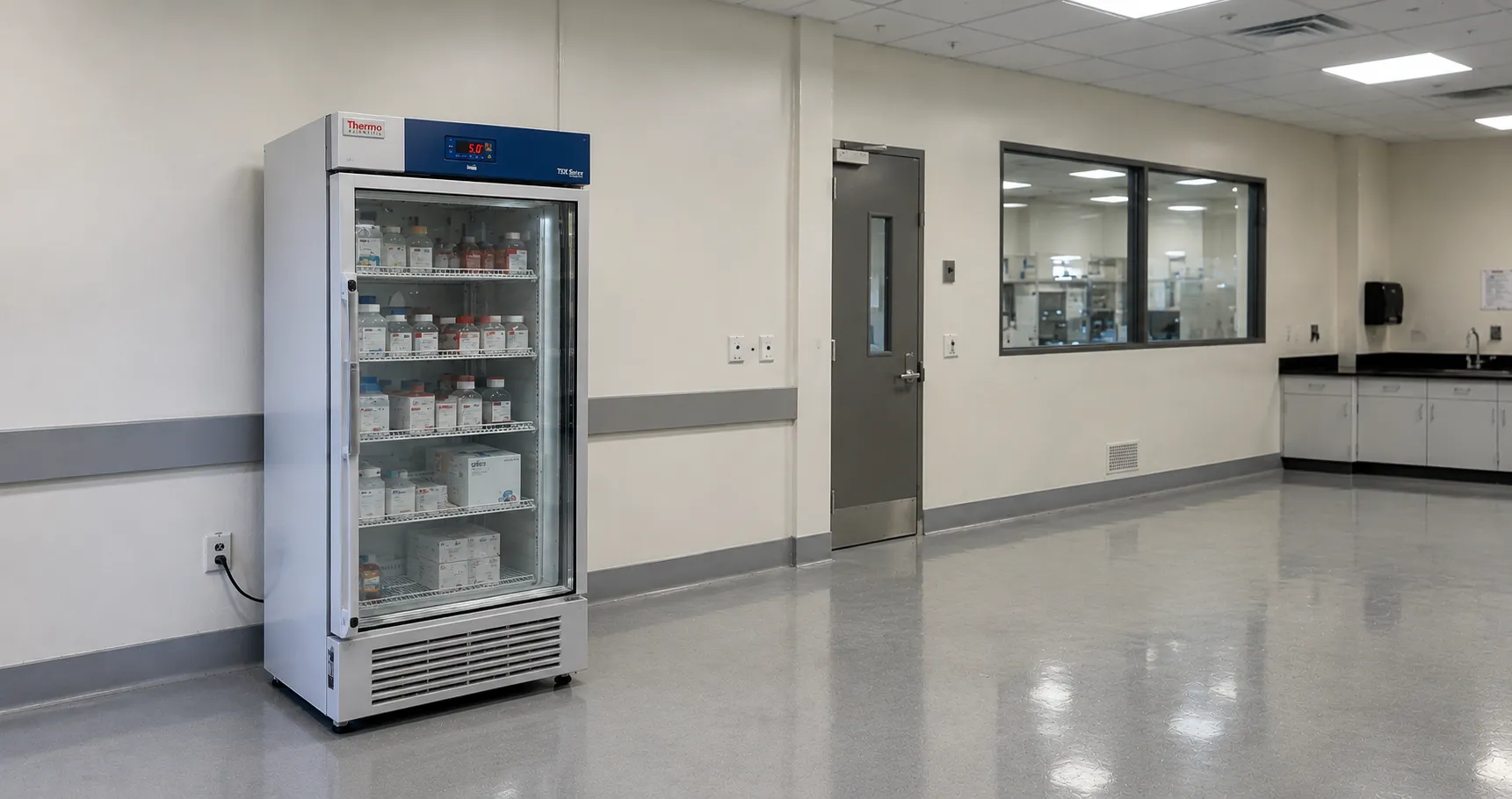
A laboratory refrigerator is a purpose-built cold cabinet that holds reagents, samples and pharmaceuticals within a tight, verified band — most commonly +2°C to +8°C — with far better stability, uniformity and alarming than any domestic fridge. For a reagent store, that controlled band is the whole point: enzymes, antibodies, calibrators, controls and diagnostic kits lose potency or degrade outside their labelled range, and a single unnoticed excursion can invalidate a run.
This article stays in the +2°C to +8°C chilled range and the spark-free and pharmacy-grade variants around it. Storage at −80°C and cryogenic preservation are covered in sibling articles, so the focus here is holding chilled stock reliably and proving it stayed in range.
Why a Domestic Fridge Will Not Do
A household refrigerator cools by cycling a compressor against one crude thermostat, letting the air drift several degrees between cycles and creating cold spots near the evaporator that can freeze reagents. It rarely logs temperature, seldom alarms, and its auto-defrost cycle drives warm air through the cabinet. A laboratory refrigerator uses forced-air circulation, a dedicated control probe and usually a microprocessor controller to hold the setpoint within roughly ±1 to 3°C across the whole usable volume. That difference is what keeps a control serum or vaccine inside its labelled window shift after shift.
Uniformity and Recovery Matter More Than the Setpoint
The headline number matters less than uniformity — how evenly the temperature holds from top shelf to bottom, front to back — and recovery, how fast the cabinet returns to range after the door opens. Forced-air (fan-assisted) cooling offers the best uniformity and quick recovery, which suits busy stores that open dozens of times a day. Static natural-convection cooling is gentler and suits items sensitive to air movement, but recovers more slowly. Ask for the maker's temperature-mapping data, ideally at more than one load and ambient, rather than trusting the single figure on the display.
Pharmacy-Grade and Vaccine Refrigerators
Pharmacy-grade (medical) refrigerators are specified for medicines and vaccines, and typically include a calibrated digital display, min/max memory, audible and visual high--, low-, and door-open alarms, and a lock. In the UK, vaccine storage follows the Green Book and the Good Distribution Practice principles overseen by the MHRA, both of which expect continuous monitoring and a documented response to any excursion. Glass doors let staff check stock without opening, though a solid door gives better thermal stability; for a mixed store, weigh visibility against how often the door is opened.
Spark-Free Refrigerators for Flammable Reagents
Solvents such as ethanol, acetone and methanol give off vapour that an electrical spark can ignite. An ordinary fridge puts relays, thermostats and lamp switches inside or beside the storage space. A spark-free (flammable-material storage) refrigerator relocates or seals every internal ignition source so vapour inside the cabinet cannot be ignited. An explosion-proof (hazardous-location) unit protects external components too, for storing flammables in a room where a flammable atmosphere can form. Match the grade to the risk: spark-free interior for flammable contents, explosion-proof for a flammable environment. Storing solvents in a standard reagent fridge is a recognised fire risk under HSE guidance.
Monitoring, Alarms and Data Logging
A reagent fridge is only as trustworthy as its temperature record. Look for an independent calibrated sensor separate from the control probe, continuous data logging with downloadable records, and a volt-free alarm contact for connection to a building-management system. Battery-backed alarms keep warning through a power cut. Many laboratories add a separate calibrated min/max thermometer as an independent daily check and log the reading as evidence of cold-chain integrity for audit and for accreditation under ISO 15189. Placing the reference probe in a glycol or glass-bead bottle damps out door-opening spikes so the record reflects product temperature, not brief air swings.
Construction, Capacity and Ambient Rating
Cabinets range from undercounter units of around 100–150 litres to large uprights over 1,500 litres, with adjustable shelves or pull-out drawers, a lockable door, castors, and a door heater to prevent condensation on glass. Check the ambient class: a unit rated to a maximum room temperature of, say, 32°C may struggle to hold +8°C in a hot instrument room, and the condenser will run hot and shorten compressor life. Confirm the refrigerant is a low-GWP hydrocarbon such as R600a where possible, and that the condenser is easy to reach for cleaning.
Blood-Bank Refrigerators: A Related but Separate Class
Refrigerators for stored blood are a distinct category held closer to +4°C with very tight tolerances, a continuous chart or electronic recorder, and stringent alarm requirements, because red-cell viability is unforgiving of warming. Do not substitute a general reagent fridge for blood storage; specify a validated blood-bank unit where blood or components are held.
Installation, Mapping and Validation
A reagent or vaccine fridge is fit for use only after validation in its actual location. Temperature mapping places multiple calibrated sensors throughout the loaded cabinet over 24 hours or more to confirm every shelf stays in range under real ambient and door-use conditions, and to identify the warmest and coldest positions so the reference probe and stock are placed sensibly. Formal qualification — installation, operational and performance qualification — documents this for regulated stores and for ISO 15189 accreditation. Re-mapping after relocation, repair or a change in loading keeps the evidence current. Do not assume factory data reflects a fridge crammed into a warm corner of a busy laboratory.
Cooling Discipline and Loading
How you use a fridge affects performance as much as its design. Overloading blocks air circulation and creates warm pockets; leaving gaps for airflow keeps the cabinet uniform. Storing water bottles in space adds thermal mass that steadies temperature during door openings and power blips. Staff should keep doors closed, decant quickly and never store food or place hot items inside. Simple habits — a stock rotation system, labelled shelves and a rule against blocking the fan — protect the cold chain as much as the hardware does.
Servicing, Calibration and Total Cost of Ownership
Budget for annual sensor calibration traceable to national standards, planned condenser cleaning, door-seal checks and a service contract with defined response times, because a failed reagent fridge is an urgent problem. Energy use varies widely between models and, over a ten-year life, running cost can exceed purchase price, so compare quoted consumption. Standardising on one or two models across a site simplifies spares, training and validation, and makes it easier to keep a validated spare fridge on standby for emergencies. Confirm a warranty that covers the compressor for several years, since it is the costliest component to replace.
Procurement Checklist
Before specifying a laboratory refrigerator, confirm the following:
-
Verified temperature range and tolerance (typically +2 to +8°C) with manufacturer temperature-mapping data.
-
Forced-air versus static cooling matched to how often the door is opened and how air-sensitive the contents are.
-
Pharmacy-grade features: calibrated display, min/max memory, high/low/door alarms and a lock, if storing medicines or vaccines.
-
Spark-free or explosion-proof rating if any flammable reagents are stored, matched to contents versus environment.
-
Independent monitoring: calibrated reference probe, data logging, volt-free BMS contact and battery-backed alarms.
-
Ambient class and refrigerant suited to the actual room, with an accessible condenser.
-
Calibration and service support, quoted energy consumption and spares availability across a realistic ten-year life.
Conclusion
A laboratory refrigerator earns its place by holding reagents in a tight, documented +2 to +8°C band, recovering fast after each door opening and alarming before an excursion spoils stock. Choose on uniformity, monitoring and the correct pharmacy-grade or spark-free specification rather than headline volume alone. To compare pharmacy-grade, spark-free, and general laboratory refrigerators, or to arrange calibration and servicing, contact the MediGear team or register your requirements through our buyer services.
Disclaimer
This article is for informational purposes only. MediGear (medigear.uk)publishes it for general information and procurement guidance. It is not clinical, diagnostic, treatment, technical, engineering, legal or regulatory advice, nor a product endorsement, guarantee or substitute for professional assessment. MediGear does not provide medical consultations. Buyers should consult their clinical, biomedical, estates and regulatory contacts, and the manufacturer's documentation, and independently verify all specifications, certifications, compatibility and suitability before purchase. Specifications, certifications and availability are correct at the time of publication and may change without notice. MediGear is a medical-equipment distributor and does not sell medicines or pharmaceutical products.