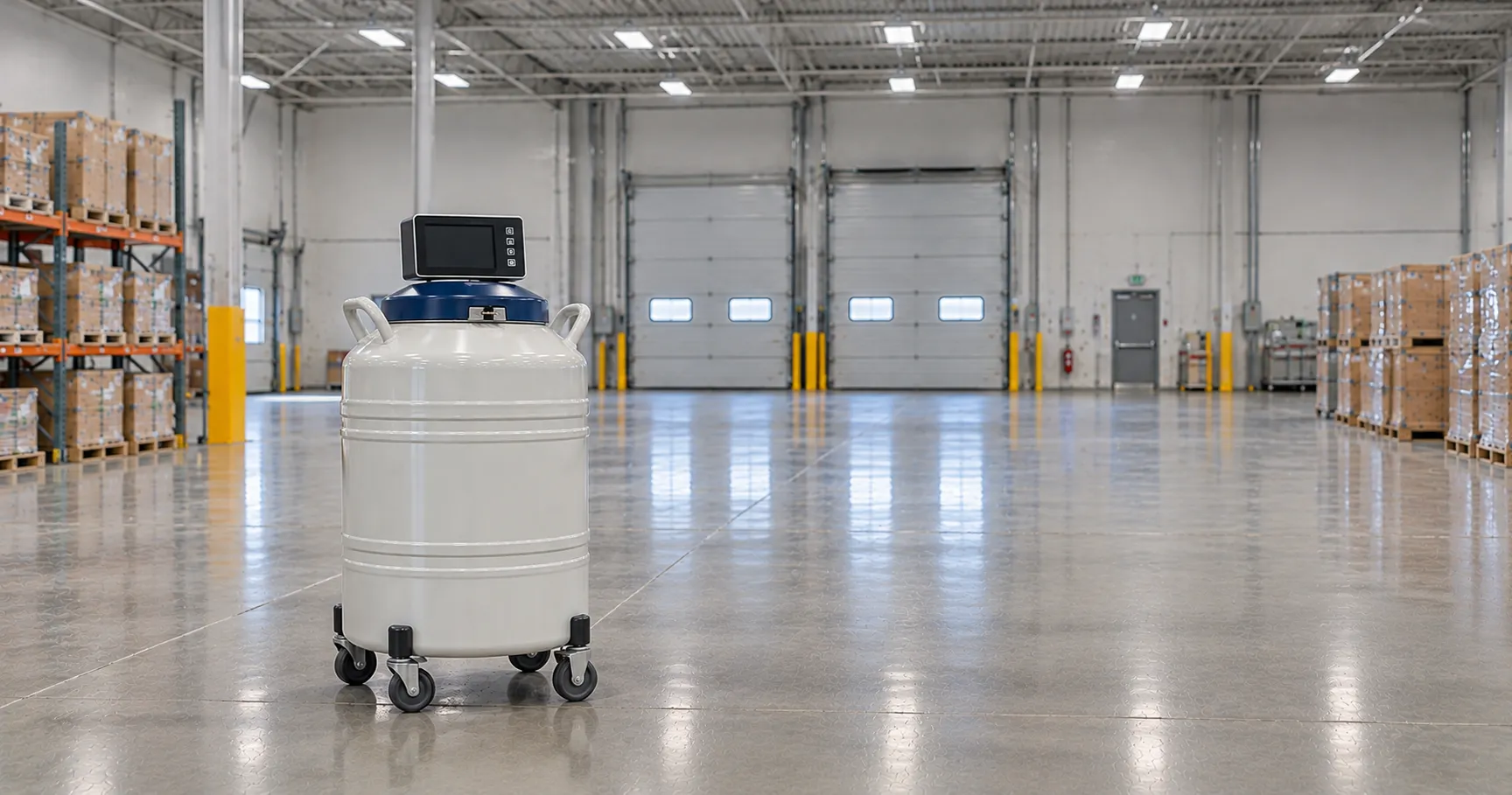
A liquid nitrogen dewar is a double-walled, vacuum-insulated vessel designed to hold liquid nitrogen (LN2) at −196°C with minimal boil-off, preserving cells and other biological material at cryogenic temperatures. It is a portable, self-contained vessel—distinct from a large plumbed biobank tank—and is equipped with a neck tube that limits heat and vapour loss, a measurable static holding time, and a slow, unavoidable evaporation rate. Inside, cells in cryovials or straws sit on canes and in canisters, cooled far below the point at which biological activity stops.
This article covers the dewar vessel itself: its construction, holding time, evaporation, and how it is used to preserve cells. Large bulk biobank tanks are covered separately in a sibling article.
How a Dewar Is Built
A dewar has an inner vessel and an outer shell separated by a high vacuum, usually with multiple layers of reflective insulation (superinsulation) in the gap to block radiant heat. The vacuum stops conduction and convection; the reflective layers cut radiation. The neck tube connecting the inner to outer vessel is deliberately long and narrow, made of low-conductivity material, because it is the main path for heat to enter and for vapour to escape. A narrow neck gives a long holding time but a small opening; a wide neck eases sample access but loses nitrogen faster. Choosing a dewar often comes down to this trade-off.
Static Holding Time and Evaporation Rate
Two figures define a storage dewar. The static evaporation rate is how much LN2 the vessel loses per day when closed and undisturbed, quoted in litres per day. The static holding time is how many days a full dewar keeps samples cold before the LN2 runs too low, derived from the evaporation rate and capacity. These are ideal figures: opening the dewar, inserting canisters, a knocked or ageing vacuum, and frost around the neck all raise real losses. Actual (working) holding time is always shorter than the static figure, so refill schedules should be safe, never at the theoretical limit.
Storage, Transport and Dry-Shipper Dewars
Storage dewars are narrow-necked vessels optimised for the longest holding time, and are used to keep cells cold in the laboratory. Wide-neck dewars trade holding time for easy access and are used where samples are handled often or where liquid nitrogen is dispensed. Dry shippers are a special type for transport: the LN2 is fully absorbed into a porous liner so there is no free liquid to spill, letting samples travel at cryogenic temperature by road or air without being classed as dangerous liquid nitrogen for shipping. A dry shipper protects cells in transit for days while meeting transport rules; choose the type to match storage, dispensing or shipping.
How Cells Are Preserved Inside
Cells are not simply dropped into a dewar. They are first suspended in a medium with a cryoprotectant such as DMSO or glycerol, which limits the ice-crystal formation that would otherwise rupture cell membranes. They are then cooled slowly, typically at about one degree per minute, using a controlled-rate freezer or a passive cooling container, before being plunged into the dewar for long-term storage. Recovery reverses the process with rapid, careful thawing. The dewar holds cryogenic temperatures stably for months or years; the freezing protocol, done by hand, determines whether cells survive.
Vapour-Phase Use and Cross-Contamination
Samples can be held immersed in the liquid or in the cold vapour above it. Vapour-phase storage in a dewar avoids direct liquid contact, reducing the risk of cross-contamination between samples and of vials cracking when LN2 seeps in and expands on warming. It does require keeping the sample zone cold enough as the liquid level falls, so vapour-phase use shortens the safe interval between refills. Sealed cryovials with reliable closures are important either way.
Capacity, Canisters and Inventory
A storage dewar is specified both by its d-nitrogen capacity in litres and by how many samples it holds. Inside, canisters hang from the neck and hold canes of straws or boxes of cryovials; a small laboratory dewar may hold a few hundred vials, a larger one several thousand. As with any cryogenic store, each sample needs a recorded address—dewar, canister, cane, position—so it can be found quickly and the neck is exposed for the shortest time. Choose a canister and cane arrangement that suits your vial or straw format, and check the canisters are easy to lift clear of the liquid for access.
Matching the Dewar to Your Throughput
Size the vessel to how you use the samples, not just how many there are. A rarely opened archive suits a narrow-neck, long-hold storage dewar refilled infrequently. A dewar opened many times a day for deposits and withdrawals loses nitrogen faster, so a slightly larger capacity or a shorter refill interval is realistic. If samples travel between sites, a dry shipper rather than a liquid-filled dewar avoids spill hazards and shipping restrictions. Getting this match right keeps both running cost and handling risk down.
Safety in Use
A liquid nitrogen Dewar carries real hazards. LN2 causes severe cold burns, and as it boils it expands roughly 700-fold, so in a poorly ventilated room it can displace oxygen and cause asphyxiation. Use dewars in ventilated spaces, ideally with an oxygen-depletion monitor, wear cryogenic gloves and a face shield when handling liquid or samples, and never seal a dewar in a way that lets pressure build. Move large dewars on their dedicated trolley. These precautions follow HSE guidance on cryogenic liquids.
Maintenance, Vacuum and Service Life
A dewar's performance depends entirely on its vacuum. A sudden jump in evaporation, heavy external frosting or sweating on the outer shell signals a failing vacuum, and the vessel should be taken out of service before it warms its contents. Keep the neck plug in place to limit loss and prevent ice buildup; handle vessels gently to protect the vacuum, and log LN2 top-ups so you can catch a rising consumption trend with care. Keeping a simple log of top-up volumes and dates turns a vague impression into hard evidence of a failing vacuum, and lets you retire a vessel on schedule rather than after a loss.
Procurement Checklist
Before buying a liquid nitrogen dewar, confirm the following:
-
Static evaporation rate and holding time, with a realistic refill margin for working losses.
-
Neck diameter balancing holding time against ease of sample access.
-
Type: storage, wide-neck dispensing or dry shipper, matched to whether you store, dispense or transport.
-
Capacity and inventory: LN2 litres plus the number of canisters, canes and vials, with a clear indexing system.
-
Vapour-phase suitability if avoiding liquid contact, and reliable sealed cryovials.
-
Safety provision: oxygen-depletion monitoring, ventilation, cryogenic PPE and a transport trolley.
-
Warranty on the vacuum, plus LN2 supply arrangements and consumption logging.
Conclusion
A liquid nitrogen dewar preserves cells by holding them at −196°C in a vacuum-insulated vessel whose narrow neck provides a finite holding time. Choose on evaporation rate, neck design and type — storage, dispensing or dry shipper — and always plan refills with a safe margin and proper cryogenic safety. To compare storage dewars, dry shippers, and cryogenic accessories, or arrange LN2 supply, contact MediGear or set out your needs through our buyer services.
Disclaimer
This article is for informational purposes only. It is published by MediGear (medigear.uk) for general information and procurement guidance. It is not clinical, diagnostic, treatment, technical, engineering, legal or regulatory advice, nor a product endorsement, guarantee or substitute for professional assessment. MediGear does not provide medical consultations. Buyers should consult their clinical, biomedical, estates, and regulatory contacts and the manufacturer's documentation, and independently verify all specifications, certifications, compatibility, and suitability before purchase. Specifications, certifications and availability are correct at the time of publication and may change without notice. MediGear is a medical-equipment distributor and does not sell medicines or pharmaceutical products.