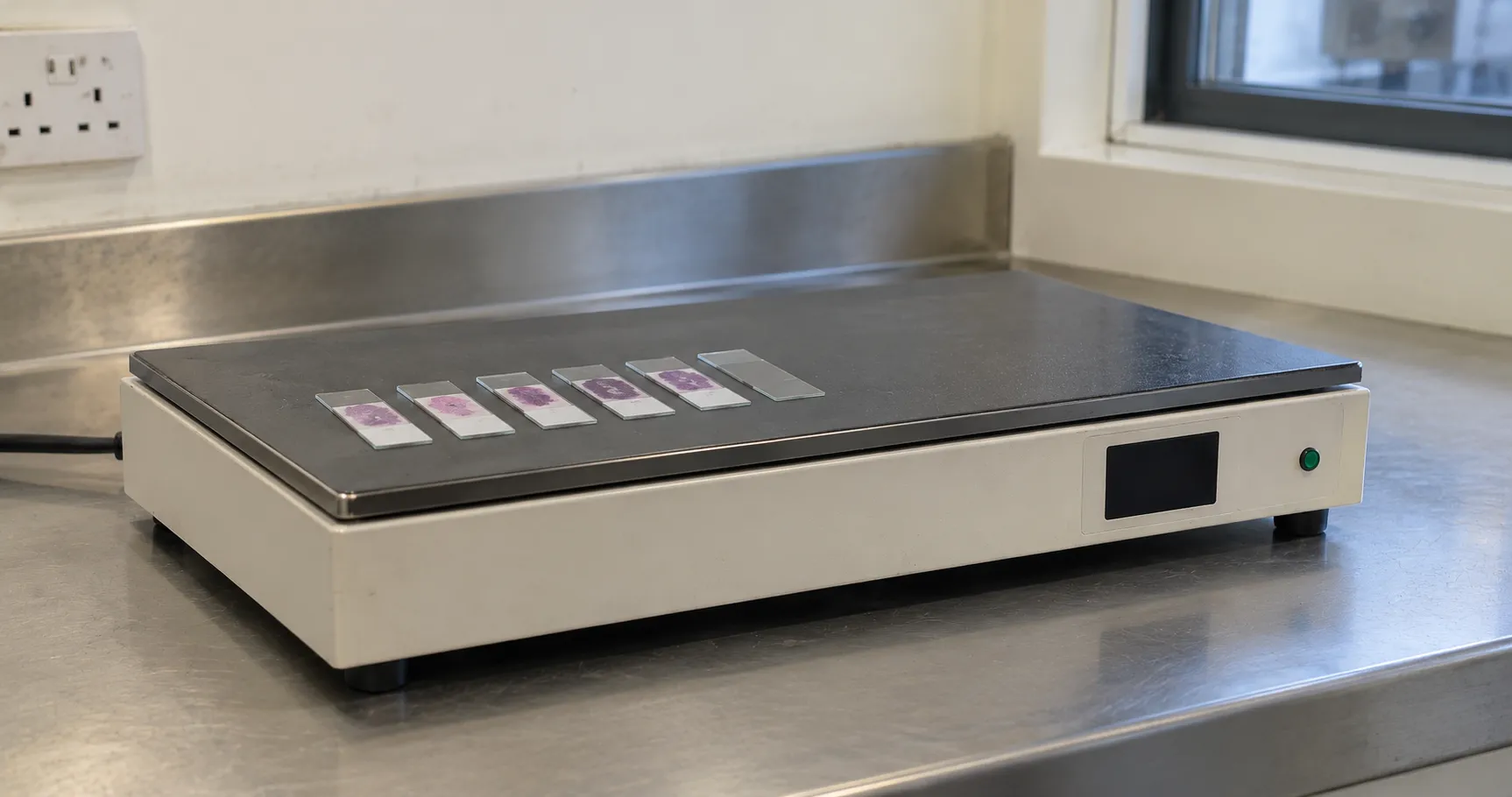
A slide warmer is a flat, thermostatically heated plate that holds microscope slides at a set temperature to dry tissue sections onto the glass and to help melt and remove wax before staining. In a histology laboratory, it does two everyday jobs: drying freshly cut paraffin sections and softening the paraffin for deparaffinisation. This helps them adhere firmly to the slide and warms the slide to soften paraffin as part of deparaffinisation before the staining run. For a laboratory buyer, the key qualities are the temperature range, how evenly it holds temperature across the whole surface, and slide capacity that matches your throughput.
The device is simple, but its performance decides section quality. Uneven heat, an inaccurate set point, or a slow-to-recover plate can cause sections to lift, fold, or stain unevenly, so uniformity and control separate a good slide warmer from a basic hotplate.
Drying and Section Adhesion
After a microtome cuts a paraffin ribbon and the section is floated out flat on a warm water bath, it is picked up onto a slide and must be dried so it bonds to the glass before it can survive the aqueous and solvent steps of staining. The slide warmer holds the slide at a controlled warm temperature to drive off residual water and firmly attach the section. Drying too cool leaves sections loosely attached and prone to washing off; too hot can overheat the tissue and cause artefact, so a controlled, uniform temperature matters.
Deparaffinisation Support
Paraffin must be removed before most stains can penetrate tissue. Warming slides softens and begins to melt the wax so it clears more readily in the solvent steps that follow, giving cleaner, more even staining. The slide warmer therefore supports the front end of the staining workflow, whether staining is manual or on an automated platform. A companion article covers automated staining machines; here the focus is the heated stage that prepares slides before that step.
Temperature Range and Set Point
Typical slide warmers cover roughly 25–80°C, with everyday histology drying often around 37–45°C for gentle overnight drying and higher settings, commonly toward 60°C, for faster drying or to help melt wax near paraffin's melting range of about 56–58°C. The exact set point depends on tissue type and local protocol. A digital thermostat with a clear display and fine adjustment is preferable to a vague dial, because reproducible temperature is what keeps section quality consistent between batches and operators.
Temperature Uniformity
Uniformity across the plate is the specification that most affects results and is easy to overlook. A good slide warmer holds every slide position within a tight band — ideally a degree or two — so slides at the edges dry the same as those in the centre. Cheaper plates run hot in the middle and cool at the edges, producing inconsistent adhesion and staining. Look for a stated uniformity figure and a plate designed for even heat distribution, usually a thick, well-conducting aluminium surface with distributed heating.
Capacity, Surface and Construction
Capacity depends on plate area and how many slides it holds in a batch, from small bench units for a handful of slides to large surfaces holding dozens for high-throughput laboratories. The working surface is typically anodised aluminium: a good thermal conductor that spreads heat evenly and wipes clean. A raised lip or grid helps position slides and contain any spills. Consider the footprint against limited bench space, and whether the surface tolerates the reagents and cleaning agents your laboratory uses.
Control, Calibration and Safety
Look for closed-loop (PID or equivalent) control that reaches and holds the set point quickly and recovers fast after slides are loaded. The temperature reading should be verifiable: laboratories periodically check the plate against a traceable thermometer or surface probe and record it, because an out-of-calibration warmer silently spoils sections. Safety features matter too — an over-temperature cut-out, a clear power indicator and stable, non-slip feet. You can set up regular slide-warmer replacements through our buyer services.
Standards and Regulation
A slide warmer is a heating laboratory apparatus, so electrical safety should follow IEC 61010-1 (general requirements) and IEC 61010-2-010 (particular requirements for laboratory equipment used to heat materials), and the unit should carry UKCA or CE marking. In use, it falls under the laboratory's portable-appliance testing and equipment-safety regime, and hot surfaces are a burn risk covered by local risk assessment. The Health and Safety Executive publishes general workplace safety guidance, and the MHR publishes device-regulation guidance.
Where Slide Warmers Fit
The slide warmer works alongside the tissue flotation (water) bath, the microtome and the stainer, and should not be confused with any of them. The water bath floats and flattens sections; the slide warmer dries and adheres them and helps soften wax. In smaller laboratories, one warmer may support drying and deparaffinisation; higher-throughput sites run dedicated drying ovens or larger warmers to keep pace. Match the device to where the bottleneck sits in your workflow rather than buying capacity you will not use.
Slide Warmer, Drying Oven or Hotplate
Several heated devices overlap, and choosing the right one avoids over- or under-buying. A slide warmer is an open, flat plate for drying and holding slides at the bench, ideal where operators load and check slides frequently. A drying oven is an enclosed cabinet that dries larger batches at a set temperature with better isolation from draughts, suited to high-throughput histology where slides dry unattended. A laboratory hotplate is a general heater not optimised for even slide contact. Match the device to volume and workflow: a bench warmer for routine flow, an oven where batch drying dominates, and often both in a larger department.
Throughput Across Different Laboratories
Requirements scale with the setting. A small GP-linked or veterinary laboratory processing a modest slide load may need only a compact warmer holding a few slides, set and left. A district hospital histopathology department cutting hundreds of blocks a day needs large-area warmers or dedicated ovens to keep drying from becoming the bottleneck ahead of automated staining. Research and teaching laboratories value a simple, robust bench unit with a clear display. Sizing the plate and number of units to realistic daily throughput, with a little headroom for peaks, prevents slides queuing and keeps turnaround predictable.
Procurement Checklist
Before choosing a slide warmer, confirm the following:
-
A temperature range that covers your drying and wax-softening set points, typically up to around 70–80°C.
-
Uniformity specification across the whole plate, ideally within a degree or two.
-
Slide capacity and plate area matched to your batch sizes and bench space.
-
Digital thermostat with an accurate, verifiable readout and fine adjustment.
-
Fast warm-up and recovery under closed-loop control after loading cold slides.
-
Cleanable, reagent-tolerant surface, usually anodised aluminium with a locating lip.
-
Safety features including an over-temperature cut-out and power indicator.
-
IEC 61010 compliance and UKCA or CE marking, with warranty and servicing.
Total Cost of Ownership
Slide warmers are inexpensive to buy and run, draw modest power, and need no consumables beyond cleaning. The real cost of a poor choice is spoiled sections and repeat work from uneven or inaccurate heating. Hence, the value lies in uniformity, reliable control and durability rather than the lowest price. Buy a plate sized to realistic throughput, keep a calibration check schedule, and standardise settings across the department so results stay consistent. To compare slide warmers and related histology equipment, talk to the MediGear team.
Conclusion
A slide warmer holds slides at a controlled, uniform temperature to dry sections onto the glass and often paraffin before staining, so section adhesion and staining quality depend on it. Choose on temperature range, plate uniformity, capacity and verifiable control, and confirm IEC 61010 compliance and marking. To specify the right slide warmer for your histology workflow, contact MediGear.
Disclaimer
This article is for informational purposes only. It is published by MediGear (medigear.uk) for general information and procurement guidance. It is not clinical, diagnostic, treatment, technical, engineering, legal, or regulatory advice, nor a product endorsement, guarantee, or substitute for professional assessment. MediGear does not provide medical consultations. Buyers should consult their clinical, biomedical, estate, and regulatory contacts, and the manufacturer's documentation, and independently verify all specifications, certifications, compatibility, and suitability before purchase. Specifications, certifications and availability are correct at the time of publication and may change without notice. MediGear is a medical-equipment distributor and does not sell medicines or pharmaceutical products.