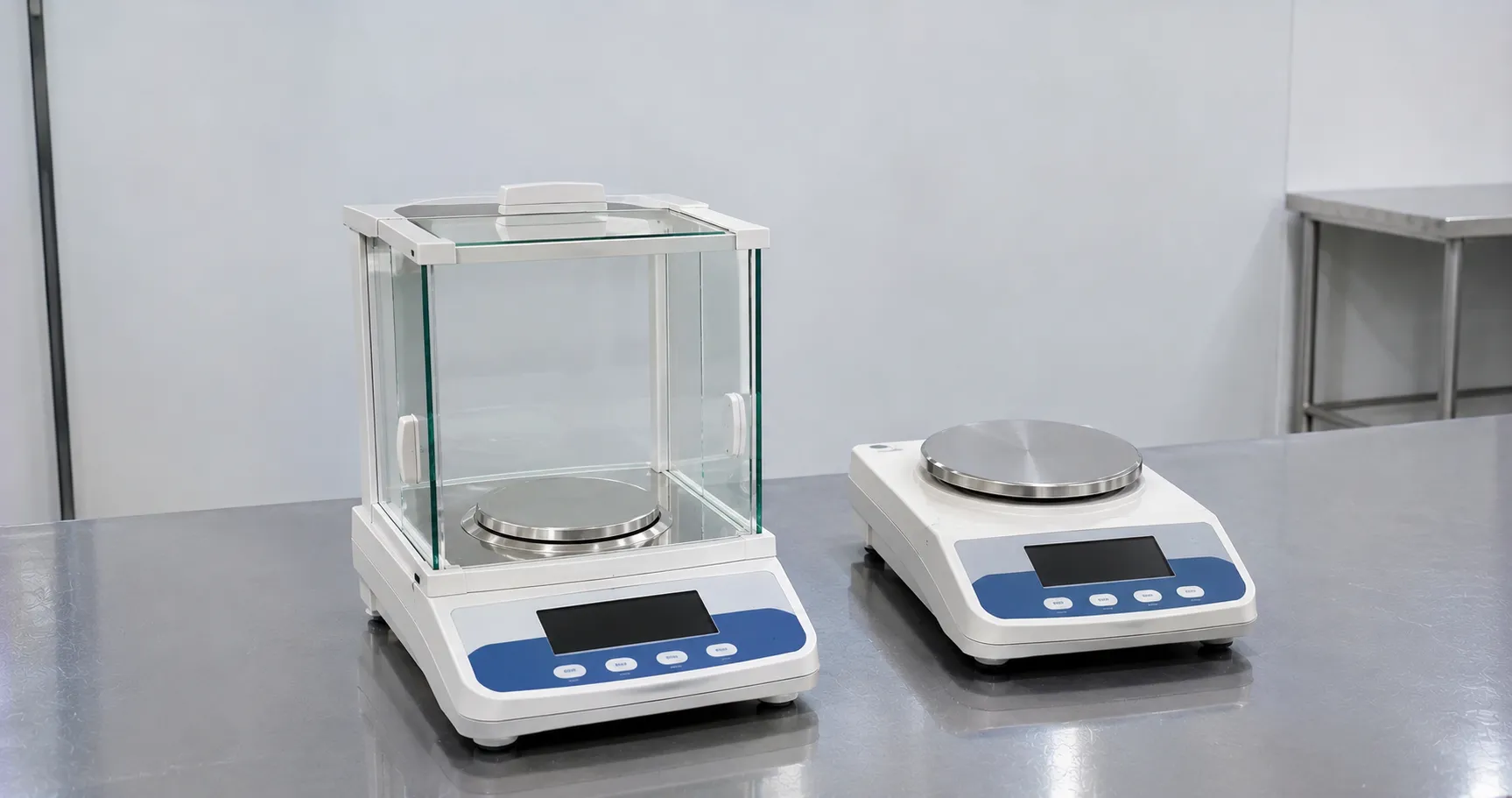
An analytical balance is a precision laboratory scale that weighs small masses to a readability of 0.1 mg (0.0001 g) or finer, inside a draught shield that protects the pan from air currents. It is used for preparing standards, weighing reagents for a defined concentration, or gravimetric analysis where the fourth decimal place changes the result. For a buyer, the questions are the readability and capacity you need, how the balance is calibrated, and how well the installation environment is controlled, because at this resolution the room matters as much as the instrument.
This article focuses on analytical weighing. Higher-capacity, lower-resolution precision and top-pan balances are related but separate purchases for tasks that don't require four-decimal precision.
How an Analytical Balance Works
Modern analytical balances use electromagnetic force restoration. A magnetic coil holds the pan in place and applies the current needed to counteract the sample's weight, which it measures and converts to mass. This gives fine resolution and fast, stable readings. Because the measurement responds to force, the balance must be level and is affected by air buoyancy, vibration, draughts and temperature, which is why the draught shield and a stable bench are integral to the specification rather than accessories.
Readability, Capacity and Repeatability
Three figures define the instrument. Readability is the smallest increment shown, 0.1 mg for a standard analytical balance and 0.01 mg (10 µg) for a semi-micro balance. Capacity is the maximum load, commonly 120 to 320 g on analytical models; higher capacity usually trades against readability. Repeatability, expressed as a standard deviation, is the truest guide to real performance, because it shows how consistently the balance returns the same reading for the same mass. Also check the minimum weighable sample: to keep measurement uncertainty within tolerance, the smallest sample you weigh should be well above the balance's minimum, a point set out in pharmacopoeia weighing requirements.
Calibration: Internal and External
Calibration keeps a balance accurate over time and across temperature changes. External calibration uses certified test weights of a stated class (OIML class E2 or F1 for analytical work) applied by the operator. Internal (motorised) calibration uses a built-in weight that the balance applies automatically, either on demand or triggered by time and temperature change; this is strongly preferred for analytical work because it corrects for drift without manual intervention. Whichever is used, keep traceable calibration and routine-check records, and verify performance between calibrations with a check weight. Balances used in regulated environments are typically qualified through installation, operational and performance qualification, then periodically serviced and recalibrated by an accredited engineer. A daily user check with a known weight, a monthly repeatability check and a scheduled annual calibration is a common routine that catches problems long before an audit does.
The Draught Shield and Weighing Technique
At 0.1 mg resolution, moving air will visibly disturb the reading, so the draught shield with sliding glass doors is essential. It should be closed before you read the value. The technique reinforces the hardware: place the sample centrally, use a weighing boat or vessel at room temperature, avoid touching glassware with bare hands (fingerprints and warmth add mass and cause drift), and let the reading stabilise. Static electricity on plastic and powders is a frequent, underappreciated cause of unstable readings, and often requires an ioniser in dry conditions.
The Installation Environment
An analytical balance is only as good as its location. Site it on a heavy, vibration-free bench or a dedicated anti-vibration weighing table, away from doors, walkways, air-conditioning vents, fume-hood draughts and direct sunlight. Keep the room temperature stable, because thermal gradients drive buoyancy and drift, and allow the balance to acclimatise and warm up before use. Levelling using the built-in spirit level and feet is a basic daily check. These environmental controls are not optional refinements; they separate a balance that meets its specification from one that does not.
Standards, Compliance and Data Integrity
The instrument should meet IEC 61010-1 for electrical safety and carry UKCA or CE marking. Where a balance is used for trade or certain regulated measurements, it may need to be verified to the relevant weighing-instrument regulations, on which gov.uk publishes guidance, though most laboratory use is non-trade. For regulated laboratories, data-integrity features matter: GLP- or GMP-compliant printouts with date, secure data identity; seseLIMS; user access controlled;rccess cocontrolnd;d audit trails. Confirm the balance supports the records your quality system requires before buying.
Features Worth Specifying
Useful options include automatic internal calibration, a built-in ioniser for static-prone samples, density and formulation programs, dynamic weighing for unstable loads, a second display, and coB, RS-232 or Ethernet connectivity for direct data capture. A below-balance weighing hook helps with awkward or magnetic items, and is useful for density determination by weighing in air and in liquid. Ergonomic touches such as motorised draught-shield doors, a level-guide that prompts you to re-level, and a removable eas, easy-clean pan speed routine improve workflow and reduce contamination between samples. Weigh these against price; buy the features your workflow genuinely uses rather than the longest list.
Where Analytical Balances Are Used
Standards and reagent preparation, gravimetric and QC analysis, formulation and stability work, water and environmental testing, education and research all depend on them. Pharmaceutical and contract labs favour balances with strong data integrity and internal calibration; teaching labs need robust, simpler units. Matching readability, capacity and compliance features to the setting avoids paying for semi-micro resolution you will not use, or under-specifying a balance for regulated work.
Procurement Checklist
Before ordering an analytical balance, confirm the following:
-
Readability and capacity (0.1 mg or 0.01 mg; 120 to 320 g) matched to your smallest sample and heaviest load.
-
Repeatability and minimum sample weight, checked against your required measurement tolerance.
-
Automatic internal calibration, strongly preferred over manual external calibration for analytical work.
-
Draft shielding and levelling, plus a plan for an anti-vibration table and stable siting.
-
Environment, a stable, draught-free, vibration-free location away from vents and sunlight.
-
Data integrity and connectivity, GLP or GMP printouts, audit trails and LIMS output where required.
-
Certified test weights and servicing, an accredited calibration and maintenance plan.
Consumables, Servicing and Total Cost of Ownership
Beyond purchase price, budget for certified test weights, periodic accredited calibration and servicing, and small consumables such as weighing boats, anti-static tools and an anti-vibration table. Downtime is costly when a single balance underpins many analyses. Hence, a service contract and a backup or shared unit are essential; an internally calibrated balance from a supplier with prompt servicing keeps results defensible. It reduces running cost far more than a low headline price on an under-supported instrument. It is also worth asking about calibration turnaround and whether an engineer can attend on site, because sending a balance away for weeks is rarely acceptable when it underpins daily analysis. Weighing these support factors alongside the specification gives a truer picture of total cost than the purchase figure alone.
Conclusion
An analytical balance delivers 0.1 mg weighing only when readability, calibration and environment all line up, so specify internal calibration, a proper draught shield and a stable, vibration-free location alongside the right readability and capacity. Match compliance and data-integrity features to your quality system, and treat test weights and servicing as ongoing costs. To compare analytical and semi-micro balances, anti-vibration tables and test weights or arrange calibration and servicing, contact the MediGear team or register your requirements through our buyer services.
Disclaimer
This article is for informational purposes only. It is published by MediGear (publishigear.uk) for general information and procurement guidance, and it is not clinical treatment, technical, engineering, legal, or regulatory advice, nor a product endorsement, guarantee, or substitute for professional assessment. MediGear does not provide medical consultations. Buyers should consult their clinical, biomedical, and regulatory contacts, and he manufacturer's documentation, and independently verify all specifications, certifications, and compatibility before purchase. Specifications, certifications and availability are correct at the time of publication and may change without notice. MediGear is a medical-equipment distributor and does not sell medicines or pharmaceutical products.