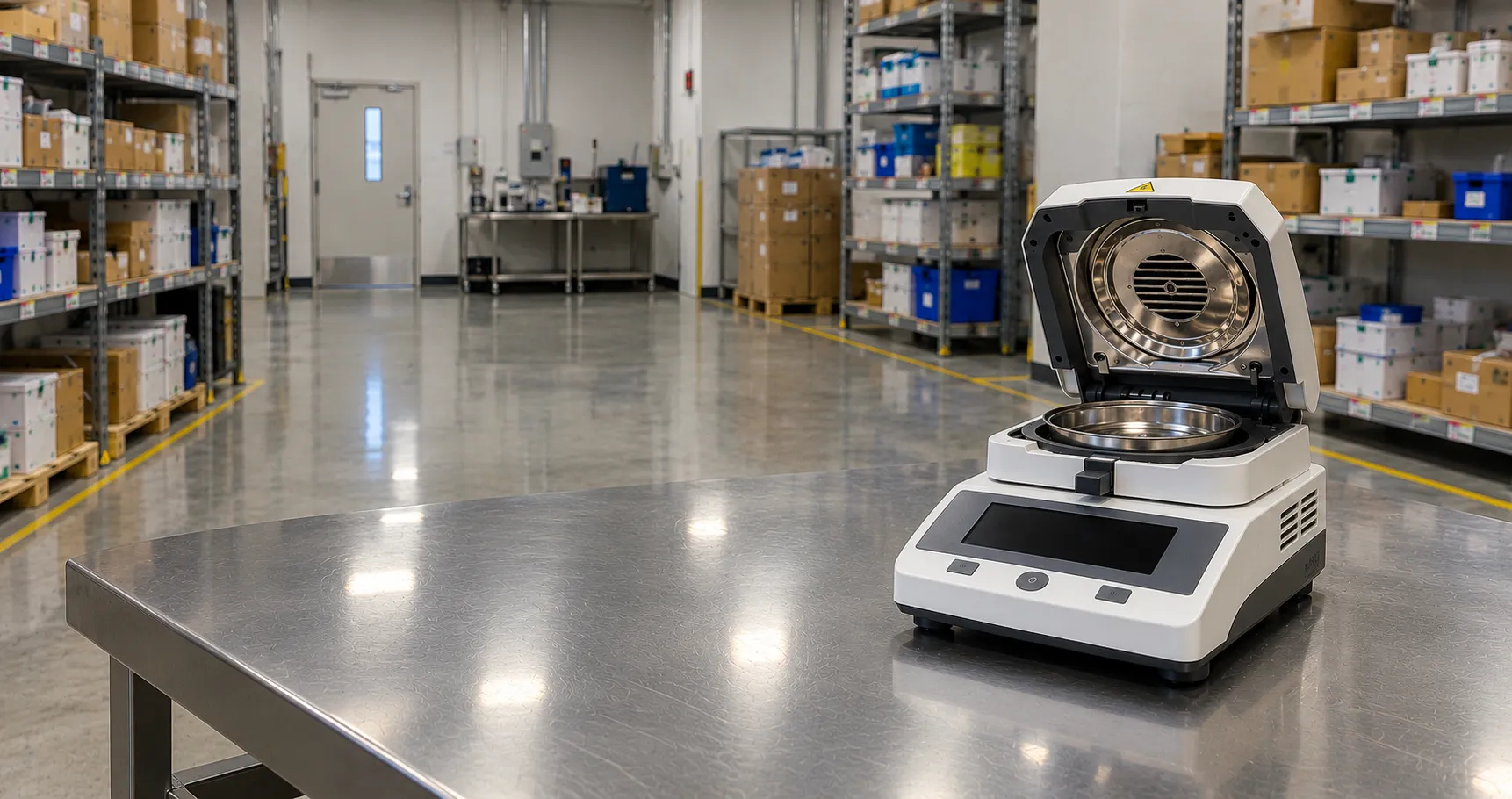
A moisture analyser is a benchtop instrument that measures the moisture content of a sample by loss-on-drying: it weighs the sample, heats it until the water evaporates, then reports the mass lost as a percentage. Because it combines a precision balance with a heating element in one housing, a single measurement replaces the older method of oven-drying and manual re-weighing, cutting a result from hours to minutes.
For a laboratory buyer the appeal is speed and repeatability, but the technique measures total volatiles, not water specifically, so it suits materials where water is the dominant volatile. This overview explains the loss-on-drying principle, the heating technologies, the specifications that separate models, and how the method differs from Karl Fischer titration.
The Loss-on-Drying Principle
The instrument tares an empty aluminium pan, records the wet sample mass, then heats the sample while the integrated balance tracks weight in real time. As moisture leaves, the mass falls; when it stabilises, the analyser calculates the result. Moisture is usually expressed as per cent moisture content (per cent loss divided by wet mass), but most units also report percent dry weight, per cent solids or ATRO, and a moisture-to-dry-mass ratio, so a buyer should confirm the result mode the method requires.
The key assumption is that every gram lost is water. Fats, solvents, essential oils and decomposition products also leave during heating, so an over-aggressive temperature inflates the figure. Choosing the drying temperature and end-point is therefore a method-development task, not a fixed setting.
Heating Technologies Compared
Halogen
A halogen lamp is the most common heat source. It reaches target temperature within seconds, distributes heat evenly across the pan and responds quickly to control adjustments, which shortens drying times and improves run-to-run agreement. Halogen is the usual default for routine quality-control work.
Infrared and quartz
Metal-sheathed infrared or dark-emitter elements heat more gently and are favoured for heat-sensitive or crust-forming samples, where a slower ramp prevents the surface sealing before the core dries. Ceramic and quartz emitters sit between the two in responsiveness.
Microwave
Microwave moisture analysers drive water out from within the sample and are used for very fast, high-moisture applications, though they are a specialist choice rather than a general laboratory tool.
The Integrated Balance
Measurement quality is limited by the balance, so its readability matters most. General models offer 1 mg readability with a capacity around 50 to 110 g; analytical versions provide 0.1 mg readability for small or low-moisture samples, where a coarse balance would hide the very mass change being measured. A sample too small for the readability produces a noisy, unrepeatable result, so match sample size to the balance rather than the other way round. The weighing system should conform to OIML R76 for non-automatic weighing instruments.
Drying Programs and Switch-Off Criteria
Beyond temperature, the switch-off criterion defines when a run ends and drives both speed and reproducibility. Common options include a fixed timer, a weight-stability trigger (for example, mass changing by less than 1 mg over 30, 60 or 90 seconds) and a fully automatic algorithm that predicts the end-point. Drying profiles can be standard (single set temperature), rapid, stepped or gentle ramped, letting the operator dry delicate materials in stages. A reproducible in-house method locks the temperature, profile and switch-off criterion together so different operators obtain the same figure.
Moisture Analyser Versus Karl Fischer
Loss-on-drying measures everything volatile; Karl Fischer titration measures water chemically and specifically, down to trace levels. For a product with a few per cent and no other volatiles, a moisture analyser is faster and cheaper. For low water content, or where solvents and oils are present, Karl Fischer is the reference method and a moisture analyser can only ever approximate it. Deciding which technique your specification actually calls for should precede any purchase, and MediGear can help compare both approaches through our buyer services.
Calibration and Routine Checks
Two things need verifying: the balance and the temperature. Balance accuracy is checked with external calibration weights, ideally with documented traceability, while temperature is verified with a dedicated temperature-calibration kit that places a reference thermometer at the pan. Because the heater degrades slowly over years, periodic temperature checks matter for any regulated method. Keep a log of both, and confirm that reference materials or a comparison against oven-drying underpin the chosen method.
Applications Across Settings
Moisture analysers appear wherever water content affects quality or compliance: pharmaceutical raw-material and granulation control, food and agricultural testing, plastics and resin drying checks, and general laboratory sample preparation. In a pathology or clinical-chemistry laboratory they are more often a support instrument for reagent and material checks than a diagnostic device. The right specification depends on the samples, so define the material and its expected moisture range before comparing models.
Sample Preparation and Technique
How the sample is presented affects the result as much as the settings do. A thin, even layer dries faster and more completely than a heaped pile, which can trap moisture in the centre and dry unevenly, so operators spread the sample across the pan and often use a glass-fibre pad to disperse pastes, creams and liquids into a large surface area. Sample size is a balance: too little strains the balance readability, while too much lengthens drying and risks incomplete moisture loss. Typical charges run from a couple of grams up to twenty, chosen so the mass change is well above the balance resolution. Grinding or slicing solids to a uniform particle size improves repeatability, and a consistent starting mass keeps runs comparable.
Data Handling and Compliance
For regulated laboratories, the record matters as much as the reading. Better analysers store methods, log each result with a time-stamp and operator, and export to a printer, USB or a laboratory information system, so results are traceable rather than transcribed by hand. Pharmaceutical and food sites working to good manufacturing practice look for user access levels, tamper-evident records and audit-trail features that support data-integrity expectations. Confirm what the instrument records and how it connects before purchase, because retrofitting a capture to a basic unit is rarely straightforward.
Procurement Checklist
Before buying a moisture analyser, confirm the following:
-
Balance readability and capacity (1 mg versus 0.1 mg) matched to your sample size and expected moisture level.
-
Heating technology (halogen, infrared or microwave) suited to whether samples are heat-sensitive or crust-forming.
-
Temperature range and resolution, typically up to around 200 to 230°C, with the profiles (standard, stepped, ramped) your method needs.
-
Switch-off criteria available, including weight-stability and automatic end-point options for reproducibility.
-
Result modes (percent moper cent percent solids,per cent and data output for records, printer or LIMS connectivity.
-
Calibration support: external weights and a temperature-calibration kit, with traceability documentation.
-
Consumables such as aluminium sample pans and glass-fibre filters, plus their cost and availability.
-
Whether Karl Fischer is in fact the method your specification demands before committing to loss-on-drying.
Consumables and Total Cost of Ownership
Running costs are modest but real. Disposable aluminium pans are used per sample, glass-fibre pads help spread liquids and pastes, and the halogen or infrared emitter is a wear part that eventually needs replacing. Factor in temperature-verification kits and periodic balance calibration when comparing models, and standardise on one supplier where possible so pans and spares are easy to stock.
Conclusion
A moisture analyser turns the loss-on-drying method into a fast, one-step measurement by pairing a precision balance with a controlled heat source. Specify it around your sample size, moisture range and heat sensitivity, verify both the balance and the temperature, and be clear whether loss-on-drying or Karl Fischer is what your method requires. To compare halogen and infrared models or arrange calibration support, contact the MediGear team, and manufacturers can be checked for regulatory status with the MHRA.
Disclaimer
This article is for informational purposes only. It is published by MediGear (medigear.uk) for general information and procurement guidance, and is not clinical, diagnostic, treatment, technical, engineering, legal or regulatory advice, nor a product endorsement, guarantee or substitute for professional assessment. MediGear does not provide medical consultations. Buyers should consult their clinical, biomedical, estates and regulatory contacts, and the manufacturer's documentation, and independently verify all specifications, certifications, compatibility and suitability before purchase. Specifications, certifications and availability are correct at the time of publication and may change without notice. MediGear is a medical-equipment distributor and does not sell medicines or pharmaceutical products.