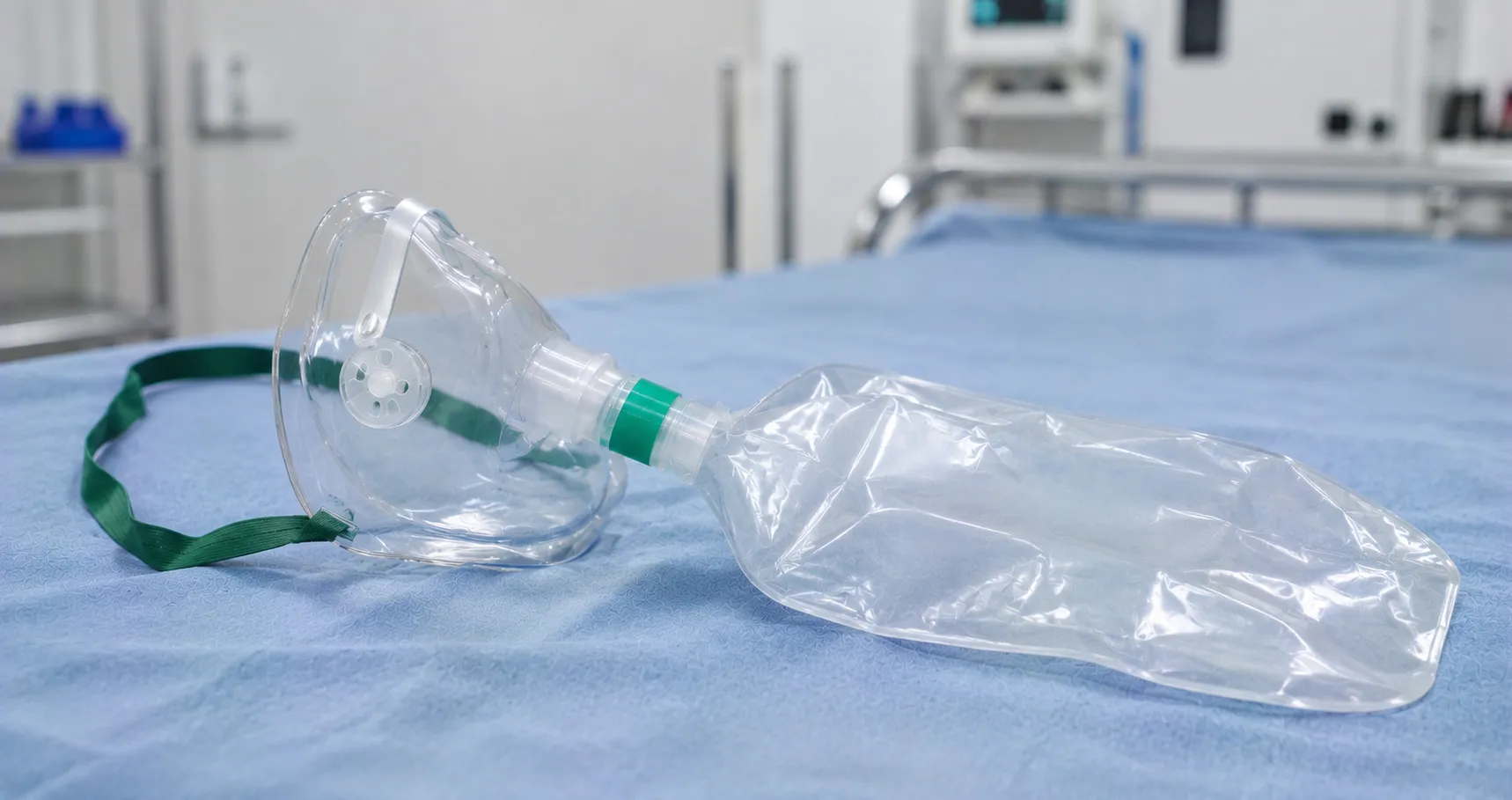
A non-rebreather mask delivers a high concentration of oxygen for emergency use by combining a reservoir bag with a set of one-way valves. The bag fills with pure oxygen between breaths, the patient inhales mainly from that reservoir, and valves stop exhaled gas returning to the bag or fresh oxygen escaping. The result is a high FiO2 from a simple, single-use device that any resuscitation trolley can carry.
For buyers, the details that matter are the reservoir and valve design, the oxygen flow needed to keep the bag inflated, and the fact that this is a high-volume disposable used in critical moments. This guide explains how the mask achieves a high concentration, how it differs from related masks, and the specifications and standards to check.
How the Reservoir and Valves Work
Three valve functions define the device. A one-way valve between the reservoir bag and the mask lets oxygen flow from the bag to the patient but stops exhaled gas entering the bag, so the reservoir stays filled with fresh oxygen. One-way flap valves over the mask's side ports let exhaled gas escape but close on inspiration so the patient does not draw in room air. Together these mean the patient breathes almost entirely from the oxygen reservoir, giving a much higher concentration than an open mask can.
Keeping the reservoir bag inflated is the key to performance. The oxygen flow must be high enough that the bag does not collapse fully on inspiration; if the bag empties on each breath, the delivered concentration drops and the patient works harder. Staff are trained to prime the bag before fitting and to set a flow that keeps it comfortably full throughout the breathing cycle.
The reservoir volume therefore has to be matched to the patient. An adult reservoir holds enough oxygen to cover a normal tidal breath, so that even at a brief high inspiratory flow the patient still draws mostly oxygen rather than room air. A reservoir that is too small for the patient, or a flow set too low, quietly undercuts the whole point of the device. This is why buyers should look at the stated reservoir capacity per size and at how easily the bag reinflates between breaths.
Non-Rebreather Versus Partial Rebreather
A partial rebreather mask looks similar but omits the valve between bag and mask, so the first part of exhaled gas re-enters the reservoir and is rebreathed; it delivers a lower concentration. A true non-rebreather adds that valve, and usually a valve on at least one side port, to prevent rebreathing and room-air dilution. Some designs keep one side port open without a valve as a safety measure so the patient can still draw room air if the oxygen supply fails. Buyers should confirm exactly which valves a given mask includes, as this defines both its performance and its fail-safe behaviour.
Variable Performance and Its Limits
Unlike a venturi mask, a non-rebreather is a variable-performance device: the exact concentration depends on flow, fit, breathing pattern and how well the valves seal. It is chosen precisely because it aims for the highest practical concentration in an emergency, not a controlled set point. Where a specific measured concentration is needed instead, a fixed-performance mask is the better tool. Understanding this distinction helps a department stock the right mix rather than treating all oxygen masks as interchangeable.
Because the concentration is not fixed, a non-rebreather is normally used for a defined episode and then stepped down as the patient stabilises, with the actual response judged by monitoring rather than by the mask's label. That short, decisive pattern of use shapes procurement: the priority is that a mask is instantly ready, correctly assembled and unexpired, rather than that it holds a precise number. A device that performs well in the first minutes of an emergency is the one worth standardising on.
Fit, Sizing and Safety Features
The mask needs a soft, adjustable seal and a malleable nose clip to limit leak, since leak lets room air dilute the oxygen. Adult and paediatric sizes should both be stocked. Look for pliable, clearly seated valves, a generous reservoir, and kink-resistant tubing. A clear mask body lets staff watch for vomit or secretions. Confirm the side-port safety arrangement so staff know how the mask behaves if oxygen is interrupted.
Assembly quality matters more than it might seem. The one-way valves are thin flap discs that must sit correctly to work, and a valve dislodged in packaging or during fitting turns a non-rebreather into an ordinary mask without anyone noticing. Look for masks whose valves are captive and clearly visible so staff can confirm they are seated. Latex-free materials are expected, and a headstrap that holds the mask steady without over-tightening improves both seal and patient tolerance during a stressful episode.
Standards and Regulatory Status
High-concentration oxygen masks supplied in the UK should carry UKCA or CE marking and, where required, be listed with the Medicines and Healthcare products Regulatory Agency. These devices are designed against the ISO standards covering oxygen therapy equipment, and emergency oxygen administration should follow recognised resuscitation and clinical guidance available through the NHS. Ask the supplier to confirm the declared standards, the valve configuration and the reservoir volume for each size.
Single-Use, Infection Control and Total Cost of Ownership
Non-rebreather masks are single-use, supplied non-sterile, and discarded after each patient; they are not designed to be cleaned and reused. Because they sit on every resuscitation trolley and emergency bag, stock rotation and expiry checks matter as much as unit price. Cost is driven by pack pricing, the range of sizes held and the need to keep unexpired masks ready at many points across a site. Standardising on one pattern simplifies staff familiarity in the moments when speed counts.
The same mask is stocked well beyond the emergency department: general wards, theatres and recovery, ambulances and transfer bags, minor-injury units and dental or GP practices holding emergency oxygen all keep them. That wide distribution is exactly why a consistent, well-made pattern pays off. When every clinical area holds the same familiar mask, staff moving between areas assemble and apply it correctly under pressure, and stock control across the site becomes a single line rather than a scatter of near-identical variants.
MediGear helps emergency, ward and procurement teams keep dependable oxygen consumables in stock. Our team supports healthcare buyers in comparing valve design, reservoir size and pack economics, and you can use the contact page to arrange a specification that fits your emergency protocols.
Procurement Checklist for Non-Rebreather Masks
-
Confirm the valve configuration between bag, mask and side ports for true non-rebreathing.
-
Check the reservoir volume and how well the bag stays inflated at working flows.
-
Verify the oxygen flow needed and that your source can sustain it on every trolley.
-
Confirm the side-port safety arrangement if the oxygen supply is interrupted.
-
Stock adult and paediatric sizes with soft seals and malleable nose clips.
-
Confirm UKCA or CE conformity, MHRA registration and the applicable oxygen-therapy standards.
-
Plan stock rotation, expiry checks and pack pricing across all emergency points.
Conclusion
A non-rebreather mask exists to push oxygen concentration as high as a simple mask can in an emergency, using a primed reservoir and one-way valves to stop rebreathing and room-air dilution. Choose on valve design, reservoir performance, sizing and the fail-safe arrangement, and manage it as a rotated, single-use consumable. Sourcing through MediGear lets teams standardise reliable high-flow oxygen masks across every resuscitation point.
Disclaimer
This article is for informational purposes only. It is published by MediGear (medigear.uk) for general information and procurement guidance, and is not clinical, diagnostic, treatment, technical, engineering, legal or regulatory advice, nor a product endorsement, guarantee or substitute for professional assessment. MediGear does not provide medical consultations. Buyers should consult their clinical, biomedical, estates and regulatory contacts, and the manufacturer's documentation, and independently verify all specifications, certifications, compatibility and suitability before purchase. Specifications, certifications and availability are correct at the time of publication and may change without notice. MediGear is a medical-equipment distributor and does not sell medicines or pharmaceutical products.