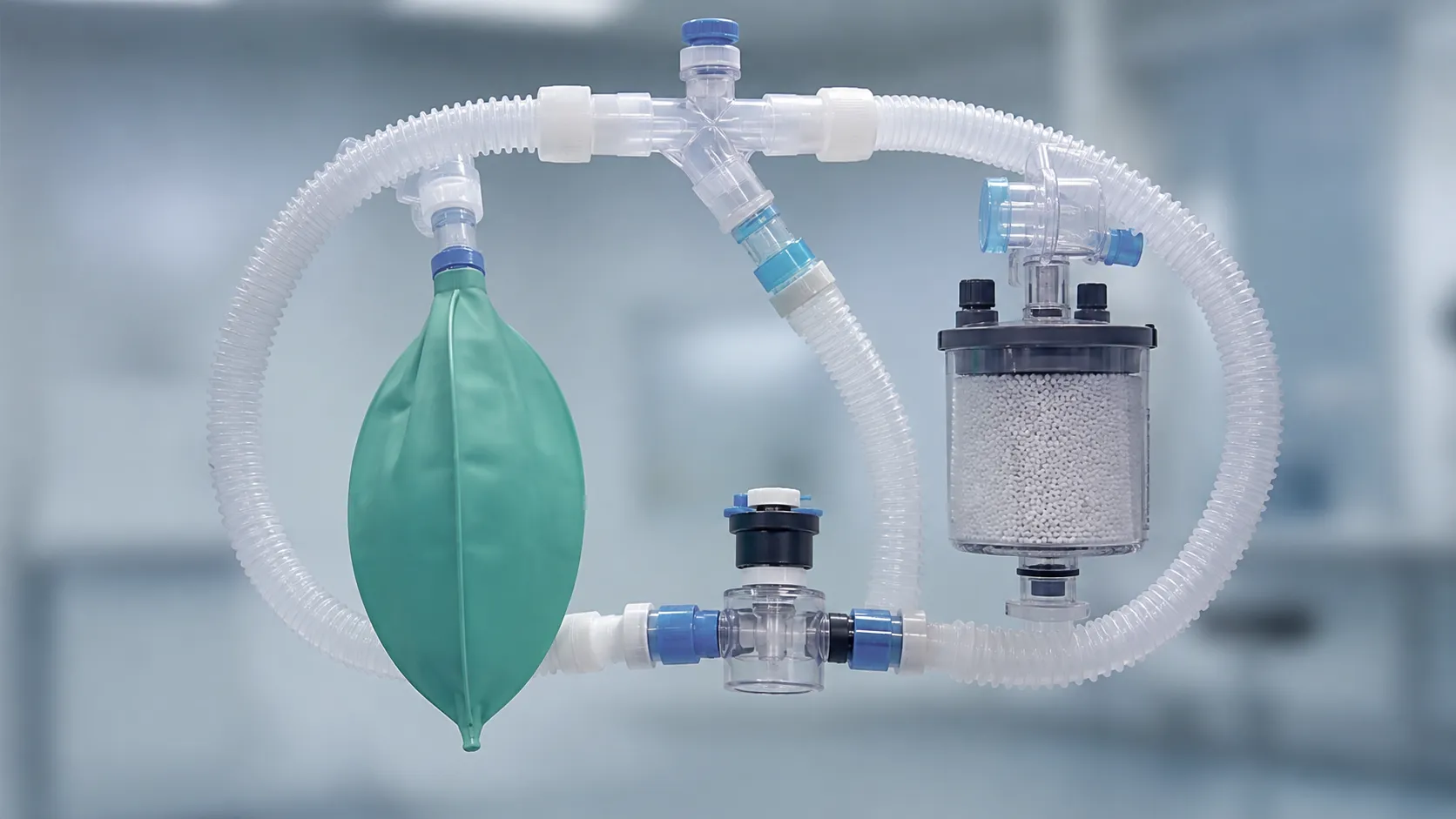
A circle breathing system is the rebreathing circuit at the heart of a modern anaesthetic machine. It lets exhaled gas recirculate after carbon dioxide has been chemically removed, so the same oxygen, nitrous oxide, and volatile agents are breathed again rather than vented. Two unidirectional valves force the gas to travel one way around the loop, and a carbon dioxide absorber scrubs it clean each pass. Because the gas is reused, fresh gas flows can be turned right down, saving costly volatile agents, conserving the patient's heat and moisture, and cutting theatre pollution.
For procurement, the circle system spans a capital anaesthetic workstation and a steady flow of consumables. Understanding the valves, the absorber and the monitoring that makes low-flow safe helps teams specify and stock it well.
How Gas Recirculates Around the Loop
Follow a breath. Fresh gas enters the circle and joins the inspiratory limb; the inspiratory unidirectional valve opens, and gas flows to the patient through the Y-piece. On exhalation, the inspiratory valve shuts, and the expiratory valve opens, directing expired gas down the expiratory limb. That gas passes through the carbon dioxide absorber, where CO2 is removed, then mixes with incoming fresh gas and is available for the next inspiration. Excess volume vents through the adjustable pressure-limiting (APL) valve during manual ventilation, or the ventilator relief valve during mechanical ventilation, into the scavenging system.
The Unidirectional Valves
The two one-way valves are what make the circle a circle. If a valve sticks open or leaks, gas can flow backwards, CO2-laden gas is rebreathed, and the patient's inspired carbon dioxide rises. Valve competence is therefore a core safety check at every machine check and a key point for biomedical servicing. Clear valve domes that let staff see the disc move are a practical advantage.
The Carbon Dioxide Absorber
The absorber canister holds a granular chemical absorbent, most commonly soda lime, a mix of calcium hydroxide with a small amount of sodium hydroxide catalyst. CO2 reacts to form calcium carbonate and water, releasing heat, which is why the canister warms in use. A pH-sensitive indicator dye, such as ethyl violet, changes colour, typically from white to purple as the absorbent is exhausted, giving a visual cue to change it. Modern low-alkali absorbents are formulated to reduce the production of compound A and carbon monoxide that older, drier, strong-alkali soda limes could generate with sevoflurane and desflurane. Absorbent is supplied as loose fill or as sealed prepacked cartridges; prepacked cartridges reduce dust and handling but cost more per case.
Low-Flow and Minimal-Flow Anaesthesia
The economic and environmental payoff comes from running fresh gas flow below the patient's minute ventilation, so most gas is recirculated. Low-flow and minimal-flow techniques reduce volatile agent use, keep the airway warmer and more humidified, and cut atmospheric pollution. They depend absolutely on monitoring: continuous capnography to confirm CO2 removal, inspired oxygen measurement so the recircula. As a result, the mixture never becomes hypoxic, and agent analysis tracks the volatile concentration the patient actually receives. A circle system without that monitoring cannot be run safely at low flows.
Key Specifications to Compare
-
Valve design: competent, low-resistance unidirectional valves with visible discs for checking.
-
Absorber format: loose-fill versus prepacked cartridge, canister capacity and ease of hot-swapping mid-case.
-
Absorbent chemistry: low-alkali formulation to limit compound A and carbon monoxide, with a clear indicator dye.
-
Compactness and dead space: internal volume and how quickly the system responds to setting changes at low flow.
-
Monitoring integration: capnography, inspired oxygen and agent analysis built in or clearly interfaced.
-
Connectors and circuits: 22 mm and 15 mm to ISO 5356-1, single-use versus autoclavable reusable circuits.
-
Cleaning: autoclavable valve and bag-arm components, or single-use to remove reprocessing burden.
Standards, Safety and Regulation
The circle system forms part of the anaesthetic workstation covered by ISO 80601-2-13, the particular standard for the basic safety and essential performance of anaesthetic workstations, under the IEC 60601-1 general framework. Breathing-system connectors follow ISO 5356-1 and reservoir bags ISO 5362. Devices must carry UKCA or recognised CE marking; confirm regulatory status through the MHRA. Guidance on anaesthetic gases and workplace exposure, relevant to scavenging, is available from the HSE.
Machine Checks and Safety Interlocks
A circle system is only safe if the one-way valves, the APL valve and the absorber seals are intact, so these are core items on the pre-use anaesthetic machine check. Valve competence is confirmed visually and by leak and function testing; the absorber is checked for correct filling and seating, and the circuit is pressure- and leak-tested. A poorly seated absorber canister is a classic leak source that both wastes gas and lets room air dilute the circuit. Interlocks such as an anti-hypoxic guard that prevents delivery of a hypoxic oxygen and nitrous oxide mixture, and oxygen-failure alarms, sit around the circle on the workstation and should be part of the specification.
The Environmental and Cost Case for Low Flow
Volatile anaesthetic agents are potent greenhouse gases, and at high fresh gas flows most of the agent delivered is vented. The circle at low or minimal flow keeps agent in the loop, cutting both drug cost and emissions, which is why reducing fresh gas flow is one of the most effective sustainability measures in theatres. The circle system makes this possible, but it depends on the monitoring described above and on staff confidence in low-flow technique. When specifying a workstation, agent-consumption feedback and low-flow decision support are genuinely useful features.
Reusable and Single-Use Circuits
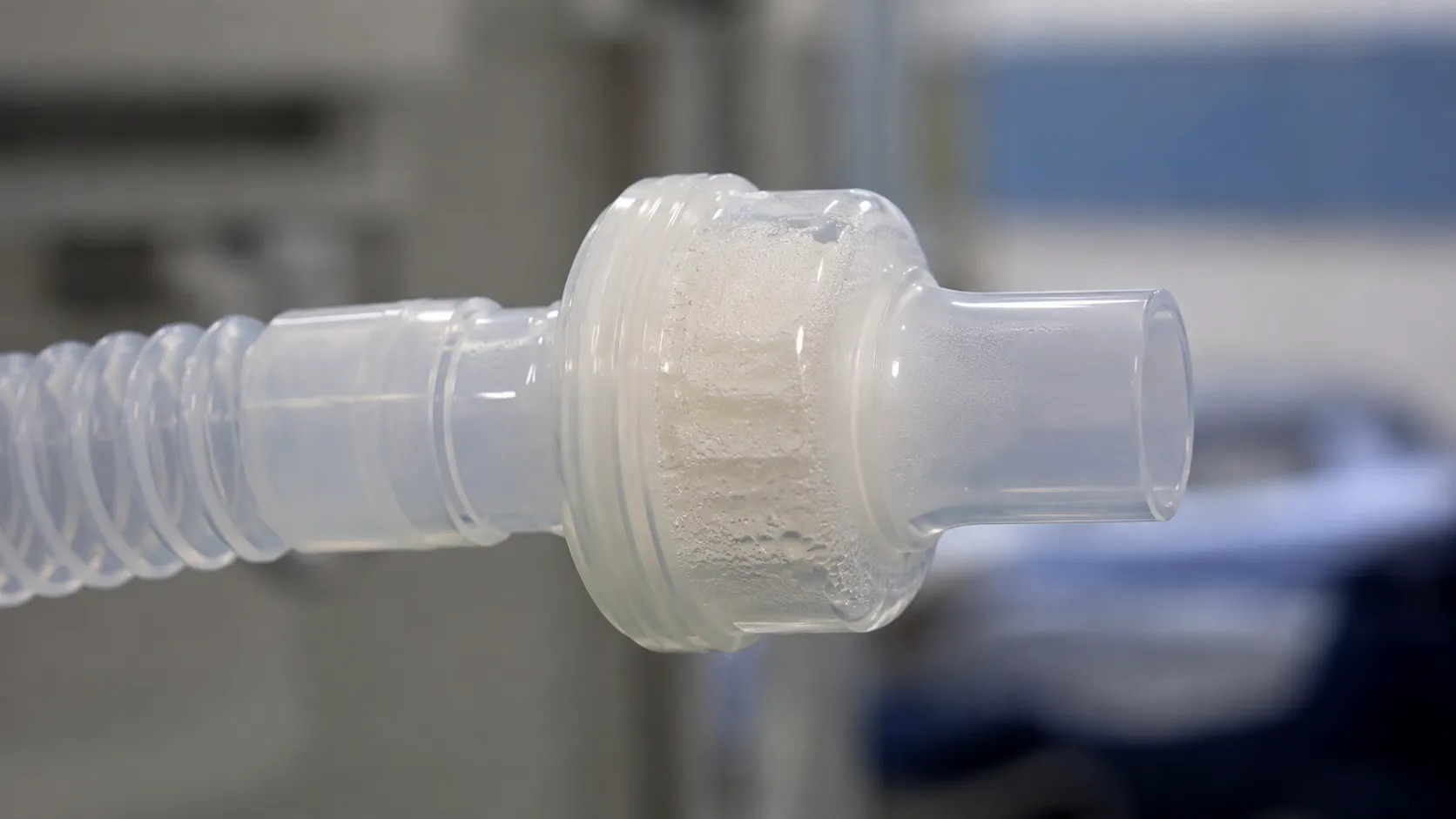
Reusable parts of a circuit, such as circuit assemblies, the bag arm, and the tubing, can be autoclavable components reprocessed between patients, or single-use circuits changed each case. Where a breathing system filter is fitted at the patient end, many services keep a reusable circuit for a defined period rather than changing it every case, following manufacturer and national decontamination guidance; the filter is what makes that safe. Single-use circuits remove reprocessing burden but add consumable spend and waste. Absorbent can be changed between cases or, on many machines, swapped mid-case using a bypass or a canister that seals as it is removed. Prepacked disposable cartridges make this quick and reduce dust exposure for staff, an occupational-hygiene point worth weighing against their higher per-unit cost; ask suppliers whether cartridges are machine-specific or generic.
Consumables, Servicing and Total Cost
Running costs are dominated by carbon dioxide absorbent and breathing circuits, with filters at the patient end. Low-flow technique and efficient absorbent use are the biggest levers on volatile-agent spend. On the capital side, ask about valve and APL servicing intervals, leak-test performance, the price and availability of absorber canisters and seals, and whether circuits are shared with your existing anaesthetic fleet. Standardising absorbent format and circuit type across theatres simplifies stock and training. Track absorbent consumption alongside agent use; together, they show how efficiently each theatre is running low flow and where technique or equipment could be improved.
Conclusion
A circle breathing system recirculates gas by driving it one way through paired valves and scrubbing carbon dioxide in the absorber, enabling low-flow anaesthesia that saves agent, retains heat and moisture and reduces pollution. Specify it on valve competence, absorber chemistry and format, monitoring integration and standards compliance. To compare anaesthetic circle systems, absorbent and circuits, contact MediGear or register your requirements through our buyer services.
Disclaimer
This article is for informational purposes only. MediGear (medigear.uk) publishes it for general information and procurement.CIT guidance. It is not clinical diagnostic, treatment, technical, engineering, legal, or regulatory advice, nor a product endorsement, guarantee, substitute, or professional assessment. MediGear does not provide medical consultations. Buyers should consult their clinical, biomedical, estates, and regulatory contacts and the manufacturer's documentation, and independently verify all specifications, certifications, compatibility, and suitability before purchase. Specifications, certifications and availability are correct at the time of publication and may change without notice. MediGear is a medical-equipment distributor and does not sell medicines or pharmaceutical products.