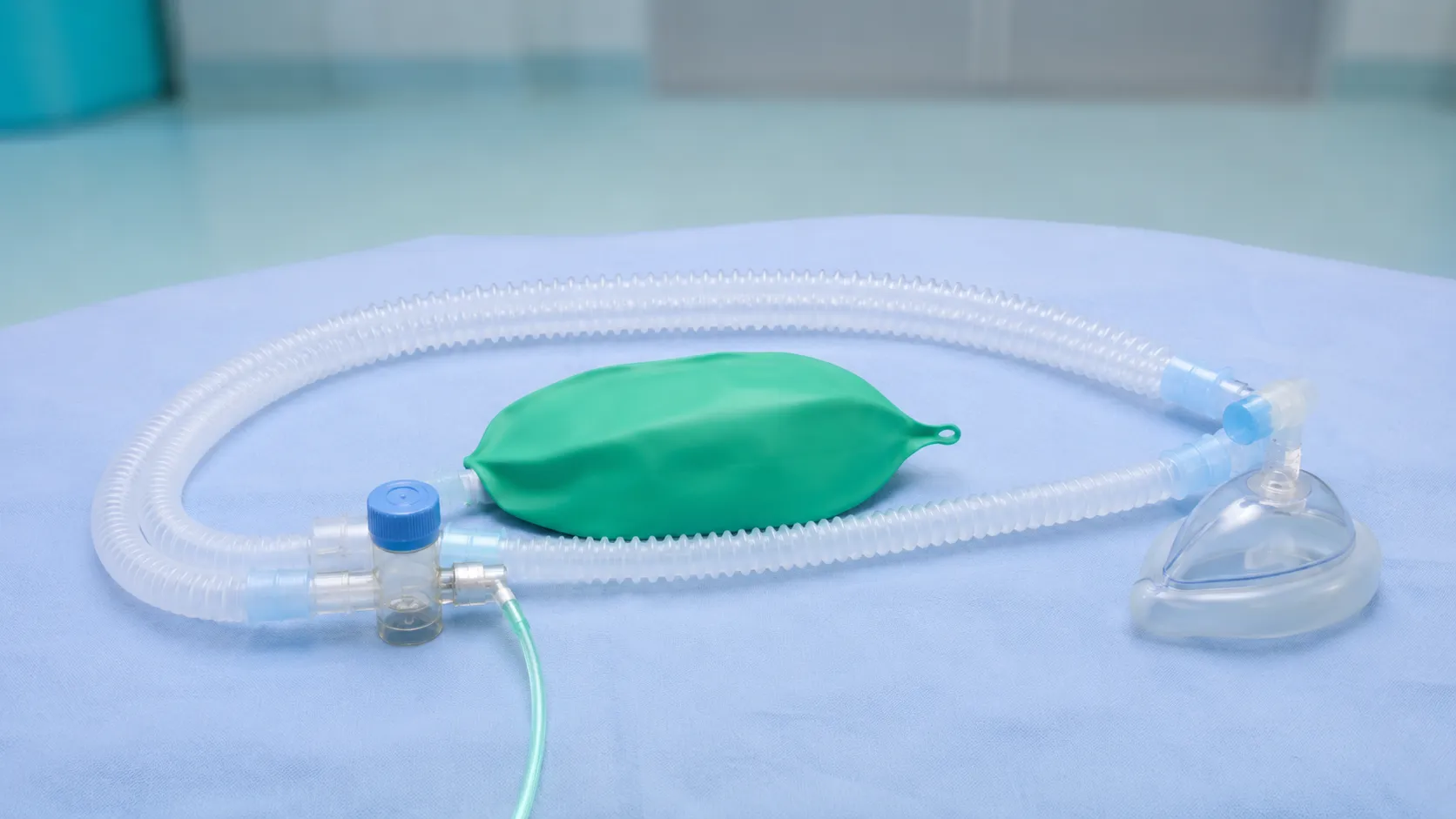
Mapleson breathing systems are a family of simple, semi-open anaesthetic circuits that have no carbon dioxide absorber and no unidirectional valves. Instead, they rely on adequate fresh gas flow to flush exhaled carbon dioxide out through an adjustable pressure-limiting (APL) valve before it can be rebreathed. The same handful of parts, a fresh gas inlet, corrugated tubing, a reservoir bag and an APL valve, are arranged in different orders. That arrangement is what the Mapleson A to F classification describes. They remain a mainstay for manual bagging during induction, transfer, recovery and paediatric anaesthesia.
For buyers, the practical questions are which configurations to stock, what fresh gas flows each needs, and how to specify bags, valves and scavenging. This overview stays at the classification level; a companion article covers the coaxial Bain and the Mapleson D variant in detail.
Why the Arrangement Matters
With no valves separating inspired and expired gas and no absorber to remove carbon dioxide, the only defence against rebreathing is fresh gas flushing the circuit. Where the fresh gas enters relative to the patient, the APL valve and the reservoir bag decide how efficiently exhaled gas is cleared, and therefore how much fresh gas flow is needed. That efficiency changes with whether the patient is breathing spontaneously or being ventilated manually, which is why no single Mapleson system is best for every situation.
The Mapleson A to F Classification
Mapleson A
The Magill and its coaxial Lack version place the fresh gas inlet near the bag and the APL valve near the patient. This is the most efficient arrangement for a spontaneously breathing patient, needing a fresh gas flow roughly equal to minute ventilation, but it is inefficient for controlled ventilation.
Mapleson B and C
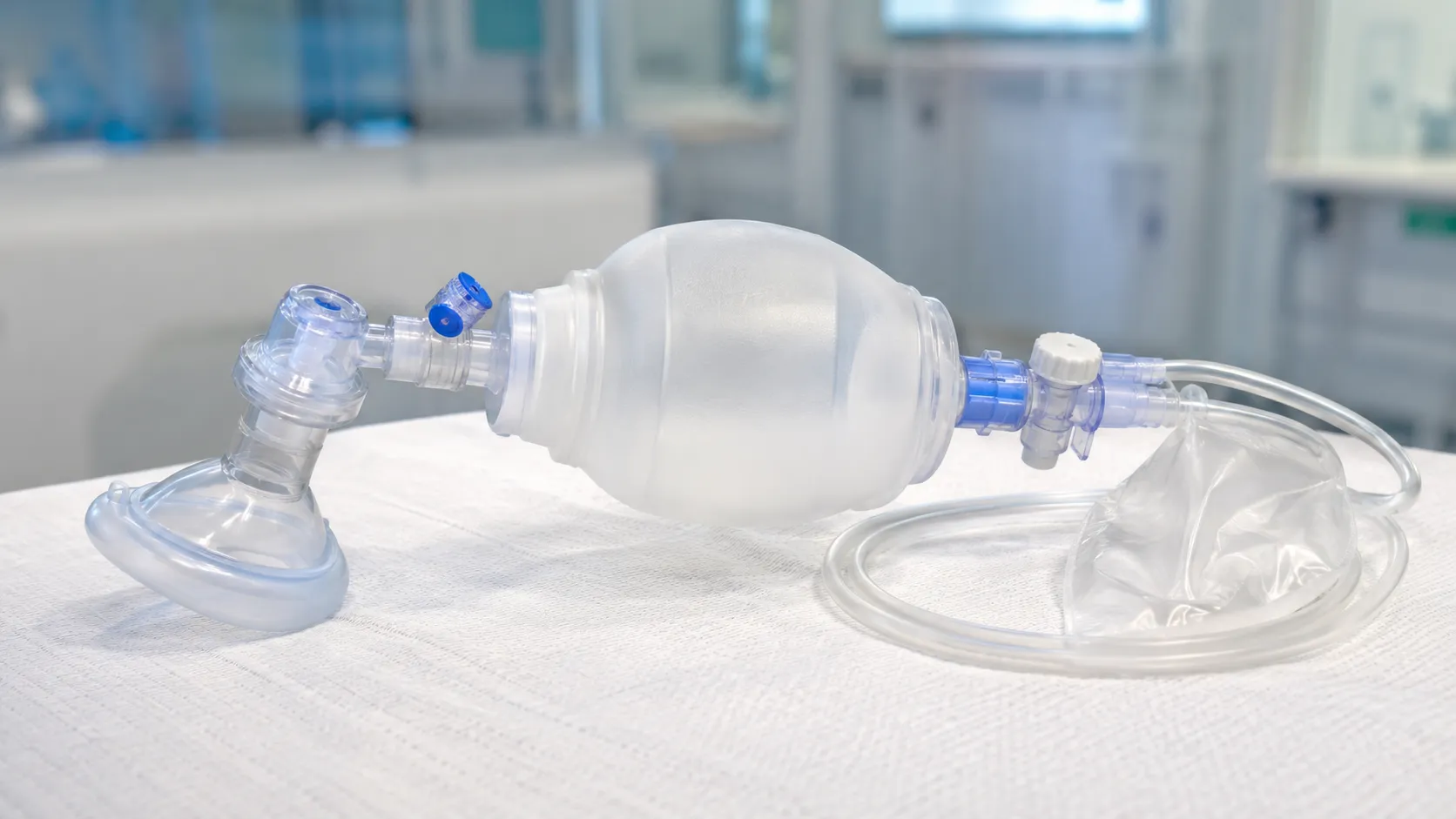
These bring the fresh gas inlet and APL valve close to the patient. The Mapleson C, a short circuit with a bag and valve, is familiar as the resuscitation or transfer “bagging” set kept at bedsides and in recovery. Both need higher fresh gas flows, around twice minute ventilation, to prevent rebreathing.
Mapleson D, E and F
The Mapleson D and its coaxial Bain modification are efficient for controlled, manually assisted ventilation, needing roughly one and a half to two times minute ventilation. The Mapleson E is Ayre's T-piece, a valveless, very low-resistance system for infants and small children. The Mapleson F is the Jackson-Rees modification, an E with an open-tailed reservoir bag added so ventilation can be assisted and the bag observed; it is a long-standing choice for neonatal and paediatric manual ventilation, run at high flows of about two to three times minute ventilation.
Efficiency: Spontaneous Versus Controlled
A useful rule is that efficiency order reverses between breathing modes. For spontaneous ventilation, the order runs A, then D, E and F, then B and C. For controlled ventilation,n it runs D, E and F, then B and C, then A. In other words, the Magill A is excellent for a spontaneously breathing patient but poor for hand-ventilation, while the D-type systems are the opposite. Choosing the right circuit for the mode keeps fresh gas flow and agent concentration sensible.
Manual Bagging in Practice
During manual ventilation, the operator squeezes the reservoir bag while the APL valve is partly closed to build airway pressure, then opens to vent excess into the scavenging system. Bag feel gives a rough sense of compliance and leak. Because these circuits use higher fresh gas flows and carry anaesthetic agent, effective scavenging and, in theatres, an active gas-exhaust connection are important to protect staff from exposure. Reservoir bags come in a range of sizes, commonly 0.5, 1 and 2 litres, matched to patient size, with smaller bags for paediatric use.
Key Specifications to Compare
-
Configuration: which Mapleson types you stock, for example a Magill A, a C bagging set and a paediatric F.
-
Coaxial or parallel: coaxial Lack and Bain designs are tidier and warm-insulating, but require leak-checking of the inner tube.
-
Reservoir bag size and material: 0.5 to 2 litre options in latex-free material, matched to patient range.
-
APL valve: smooth, calibrated pressure control with a scavenging-transfer outlet.
-
Connectors: 22 mm and 15 mm to ISO 5356-1, with scavenging outlets to the 30 mm standard.
-
Single-use versus reusable: disposable circuits versus autoclavable components, and their reprocessing needs.
-
Scavenging compatibility: matching your theatre active gas-scavenging system.
Standards and Regulation
Mapleson circuits are anaesthetic breathing systems whose connectors follow ISO 5356-1 and reservoir bags ISO 5362, and they are used with workstations covered by ISO 80601-2-13, all under the IEC 60601-1 framework where powered elements apply. Scavenging transfer and receiving systems have their own connector requirements to prevent misconnection. Devices sold in the UK need UKCA or recognised CE marking; confirm regulatory status through the MHRA, and see the HSE for anaesthetic-gas exposure guidance relevant to scavenging.
Reservoir Bags, APL Valves and Coaxial Designs
The reservoir bag does two jobs: it stores fresh gas for the next breath and, by its movement, shows spontaneous respiration and rough tidal volume. Sizes from 0.5 to 2 litres are matched to patient size, with an oversized bag muffling the visual signal and an undersized one limiting the reservoir. Latex-free materials are now standard. The APL valve controls how much gas is vented and therefore the airway pressure during hand ventilation; a smooth, calibrated valve with a defined maximum pressure and a clean scavenging-transfer outlet is worth specifying. Coaxial designs, the Lack for the A and the Bain for the D, run one limb inside the other to tidy the circuit and pre-warm inspired gas slightly. Still, the inner tube must be leak-checked, because an unnoticed inner-tube disconnection raises rebreathing. Buyers should confirm whether coaxial inner tubes are captive and how their integrity is verified before use.
Choosing Configurations for Your Service
Rather than stocking every class, most services settle on a small, deliberate set. A Magill or coaxial Lack A covers efficient spontaneous ventilation; a short Mapleson C serves as the ubiquitous bagging and resuscitation set for recovery, wards, and transfer; and a Jackson-Rees F, or a modern valved paediatric alternative, covers infant and neonatal work. Where controlled ventilation through a D-type is wanted, the coaxial Bain is the usual choice and is covered in detail in our companion article. Standardising this shortlist keeps training simple and predictable, and lets you connect bags and scavenging interfaces across theatres and recovery. When comparing suppliers, confirm the bagging sets you standardise on carry the correct patient and scavenging connectors so they interchange across departments without adaptors.
Consumables, Stocking and Total Cost
The stocking task is holding a small, sensible set of configurations rather than every variant. Standardise bag sizes and connectors so circuits, catheter mounts and scavenging interconnect without adaptors, and decide per line whether single-use or autoclavable reusable circuits suit your throughput and decontamination capacity. Higher fresh gas flows mean higher agent use, so match circuit choice to the ventilation mode to control running costs.
Conclusion
Mapleson systems trade the complexity of valves and absorbers for simplicity, at the price of higher fresh gas flows and careful matching of circuit to breathing mode. Knowing the A to F classification and each type's flow needs lets you stock the right configurations for induction, transfer and paediatric bagging. To compare Mapleson circuits, reservoir bags and scavenging-compatible sets, contact MediGear or register your requirements through our buyer services.
Disclaimer
This article is for informational purposes only. It is published by MediGear (medigear.uk) for general information and procurement guidance and is not clinical, diagnostic, treatment, technical, engineering, legal, or regulatory advice, nor a product endorsement, guarantee, or substitute for professional assessment. MediGear does not provide medical consultations. Buyers should consult their clinical, biomedical, estates and regulatory contacts, and the manufacturer's documentation, and independently verify all specifications, certifications, compatibility and suitability before purchase. Specifications, certifications and availability are correct at the time of publication and may change without notice. MediGear is a medical-equipment distributor and does not sell medicines or pharmaceutical products.