What Is a Bain Circuit and How Fresh Gas Is Delivered
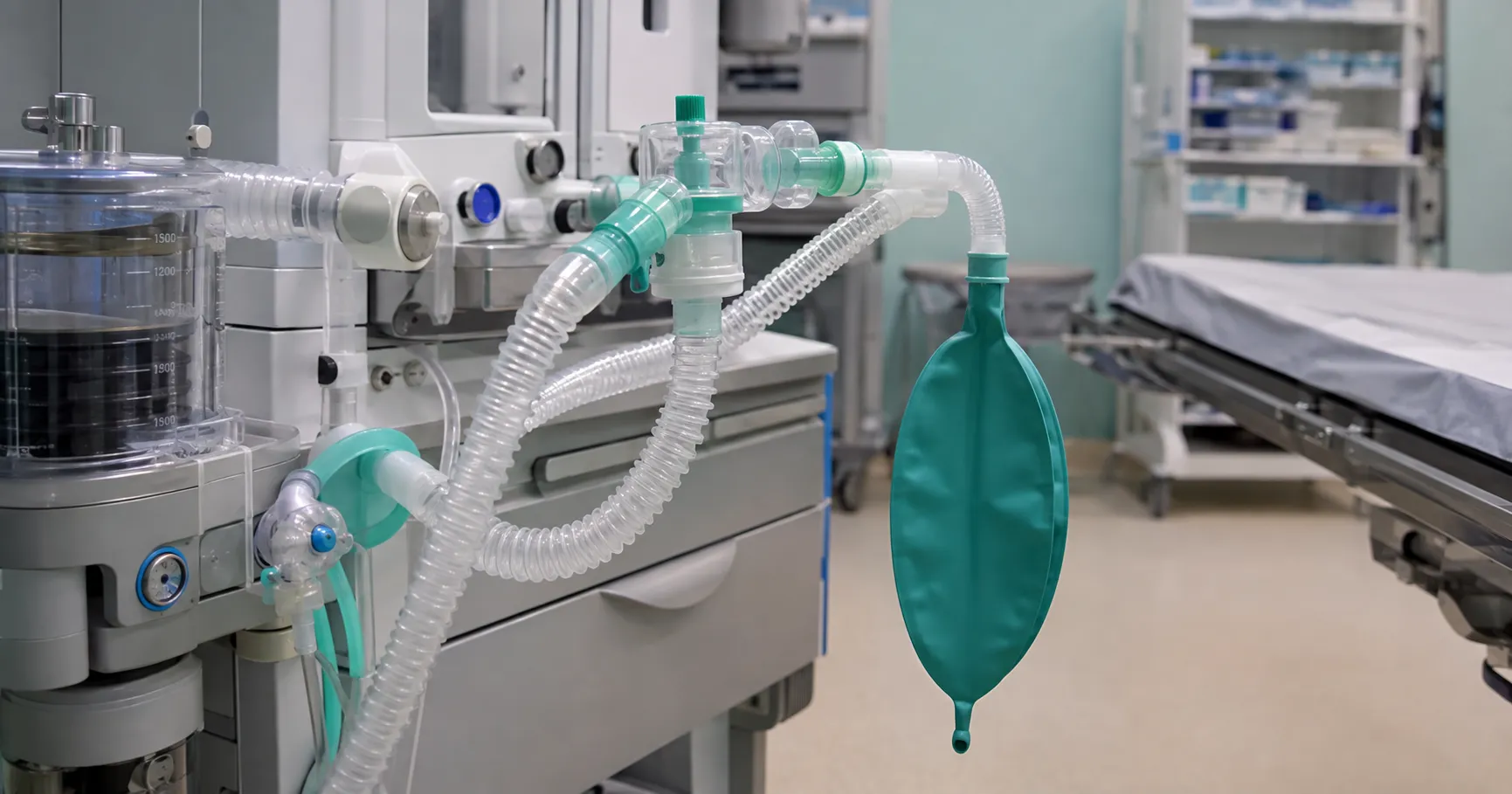
A Bain circuit is a coaxial anaesthetic breathing system in which fresh gas travels to the patient through a narrow inner tube within a wider corrugated outer tube, which carries expired gas back to a reservoir bag and the pressure-relief valve at the machine end. It is the coaxial form of the Mapleson D configuration, and its defining feature is that fresh gas is delivered directly at the patient connection. In contrast, exhaled gas passes back along the outer sleeve.
This guide is written for anaesthetic equipment buyers, theatre leads, and biomedical engineers specifying breathing systems. It covers exactly how the coaxial delivery works, the fresh-gas-flow requirements that ensure safety, the integrity check every unit must pass, and the specifications and standards to verify before purchase.
How the Coaxial Design Delivers Fresh Gas
The circuit is a tube within a tube. A slim inner tube, commonly around 7 mm bore, sits concentrically inside a wider outer corrugated tube of roughly 22 mm. Fresh gas from the anaesthetic machine feeds the inner tube and emerges at the patient end, so the patient always receives gas straight from the machine. Exhaled gas flows in the opposite direction down the outer channel toward the reservoir bag and the adjustable pressure-limiting (APL) valve mounted back at the machine end, where scavenging is simple to attach.
Placing the valve and bag at the machine end is the practical advantage. The patient end stays light and uncluttered, which suits head, neck, and dental work, as well as situations where the anaesthetist is positioned away from the airway. A secondary benefit is a small degree of warming: returning exhaled gas in the outer tube gives up a little heat to the fresh gas in the inner tube.
Fresh Gas Flow and Rebreathing
Because it is a Mapleson D, the Bain relies on fresh gas flow to wash exhaled carbon dioxide from the system, and the required flow rate differs sharply between modes. During controlled ventilation, the geometry is efficient, and a fresh gas flow of approximately 70 ml/kg/min is commonly considered sufficient to prevent rebreathing. During spontaneous ventilation, the same circuit is inefficient. It requires much higher flows, frequently cited as around 150 to 250 ml/kg/min, or roughly one-and-a-half to two times the minute ventilation, to prevent carbon dioxide from being re-inhaled.
These figures are general guides, not settings to apply unthinkingly; capnography confirms adequacy in practice. The point for a buyer is that the Bain is chosen where controlled ventilation predominates, because that is where its low-flow economy and light patient end genuinely pay off.
The Pethick Test and Inner-Tube Integrity
The one failure that makes a coaxial circuit dangerous is a disconnected, kinked or fractured inner tube, because fresh gas would then be dumped into the outer tube and massive rebreathing would follow, all while the outside of the circuit looks normal. The Pethick test checks for this before use. The patient end is occluded, and the circuit is filled by the oxygen flush, so the reservoir bag distends; the occlusion is released, and the flush is operated with the patient end open. If the inner tube is intact, the high-velocity fresh gas jet at the patient end creates a Venturi effect that empties the reservoir bag. A bag that stays full signals a compromised inner tube, and the circuit must not be used.
Because the inner tube cannot be inspected directly along its length, this functional check is important on every setup. Reusable versions in particular should be examined for wear at the connections where the inner tube is most likely to detach.
Reusable and Single-Use Variants
Bain circuits come as reusable and single-use products. Single-use versions remove reprocessing burden and cross-infection risk and dominate high-throughput lists; reusable versions reduce consumable spend but must be cleaned, inspected and reassembled correctly, with the inner tube seated securely. Lengths vary, and a longer circuit extends reach for imaging or shared-airway work but adds internal volume, so match the length to how the theatre is laid out rather than defaulting to the longest available. A separate paediatric variant with a smaller reservoir bag and lighter tubing is also available, and it should be specified where the department anaesthetises children rather than scaling an adult circuit down informally.
Key Specifications a Buyer Must Check
Confirm the machine-end fittings match your anaesthetic workstation's common gas outlet and scavenging, and that the patient connector is the standard 15 mm/22 mm size compatible with your masks, filters and tracheal-tube connectors. Check the reservoir bag volume suits your patient mix, that the APL valve range and scavenging transfer suit your extraction system, and whether a manometer port or gauge is included. Verify circuit length, inner-tube security and whether the product is single-use or validated for a stated number of reprocessing cycles. The availability of matching bags, valves, and consumables should be confirmed before standardising a theatre suite on a single system.
Standards, Regulation and Compatibility
A Bain circuit is a medical device and should carry valid UKCA or CE marking and be supplied by a manufacturer registered with the MHRA for the UK market. The conical 15 mm and 22 mm connectors follow ISO 5356-1, and anaesthetic breathing tubes are covered by ISO 5367, so gauge compatibility against these when mixing components. Where the circuit forms part of an anaesthetic workstation, the ISO 80601-2-13 particular standard for that equipment governs the wider system. Request the instructions for use, the declared internal volume, and the reprocessing validation, and align local checks with your trust's device-management policy in line with UK guidance.
Decontamination, Maintenance and Total Cost
For single-use circuits the cost model is simple: unit price times throughput, plus safe disposal. Reusable circuits shift costs to decontamination, drying, inspection, and eventual replacement, and the true savings depend on how many validated cycles each set actually achieves before the inner tube or connectors show wear. A breathing-system filter is normally used at the patient end regardless, which protects the circuit and, for reusables, may extend the reprocessing interval per your infection-control policy. Whichever route you choose, build the Pethick check and a visual inspection into the pre-use routine and document them.
Use Across Care Settings
The Bain is at home in operating theatres, particularly for head-and-neck, dental and remote-airway cases, and in anaesthetic rooms feeding controlled ventilation. It also appears in veterinary anaesthesia, where the light patient end and long reach suit varied patient positioning. It is less suited to prolonged spontaneous ventilation because of the high fresh gas flows required, so departments that run long spontaneous cases often prefer a circle system for gas economy and reserve the Bain for the work it does best.
Procurement Checklist
-
Confirm that the Bain circuit is UKCA- or CE-marked and that the maker is MHRA-registered.
-
Check 15 mm/22 mm ISO 5356-1 patient connector, machine-end, and scavenging compatibility.
-
Verify inner-tube security and that the Pethick test can be performed on every unit.
-
Match circuit length and reservoir bag volume to your case mix and layout.
-
Decide single-use versus a reusable set validated for a stated cycle count.
-
Confirm APL valve range, scavenging transfer and any manometer port suit your workstation.
-
Cost of disposal or reprocessing, filters and replacement against real throughput.
Conclusion
A Bain circuit earns its place through coaxial fresh-gas delivery at the patient end and a light, uncluttered airway, making it a strong choice for controlled ventilation and head-and-neck work. Specify connector compatibility, inner-tube integrity, and the fresh-gas economy that suits your case mix, and never skip the Pethick check. To compare compliant breathing systems, bags, and valves, or to arrange a facility quote, contact MediGear or set up a buyer account.
Disclaimer
This article is for informational purposes only. It is published by MediGear (medigear.uk) for general information and procurement guidance. It is not clinical, diagnostic, treatment, technical, engineering, legal or regulatory advice, nor a product endorsement, guarantee or substitute for professional assessment. MediGear does not provide medical consultations. Buyers should consult their clinical, biomedical, estates and regulatory contacts, and the manufacturer's documentation, and independently verify all specifications, certifications, compatibility and suitability before purchase. Specifications, certifications and availability are correct at the time of publication and may change without notice. MediGear is a medical-equipment distributor and does not sell medicines or pharmaceutical products.