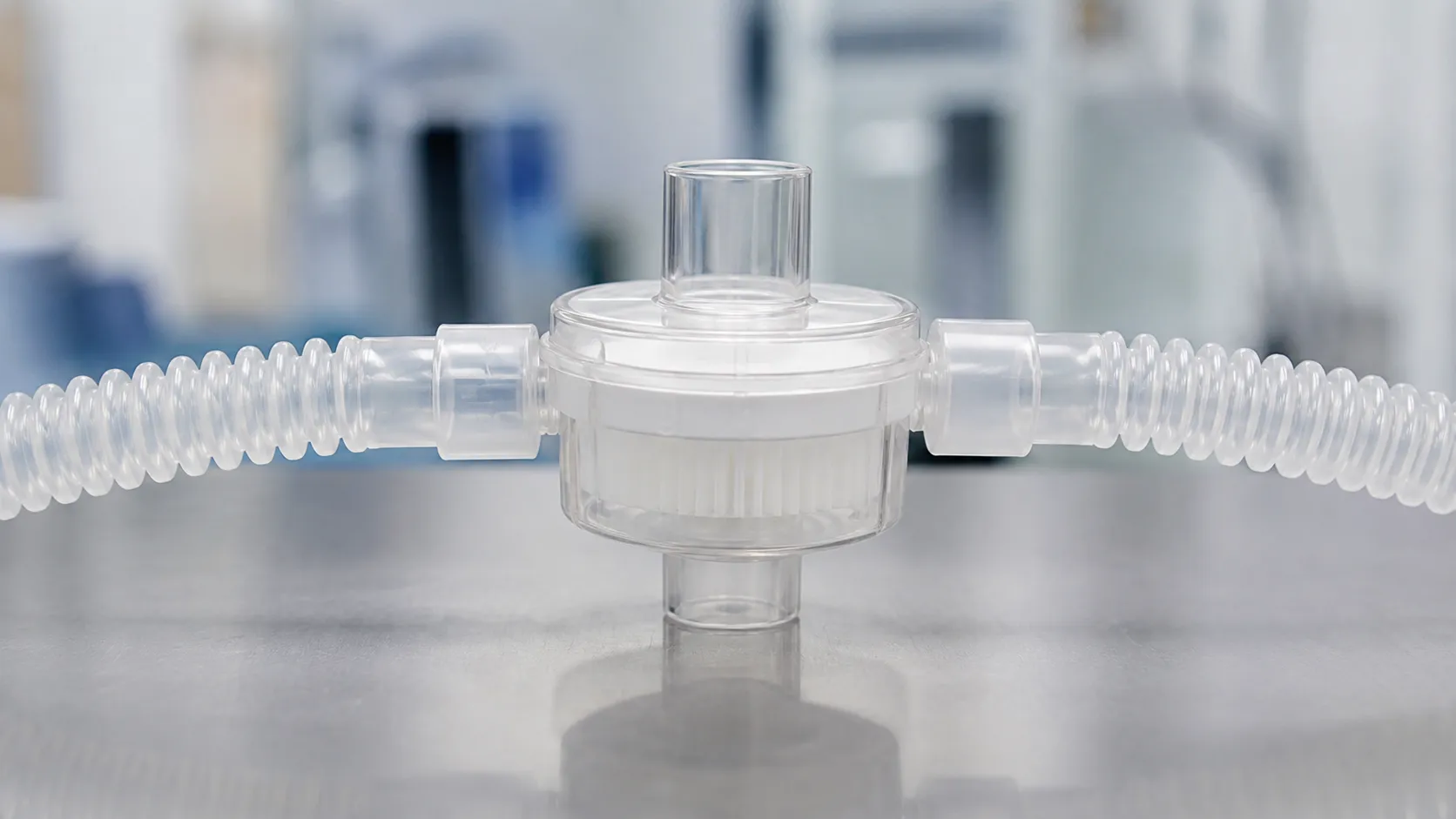
A breathing system filter is a single-use barrier placed in the anaesthetic or ventilator circuit to stop bacteria, viruses, and particulates from crossing between the patient, the machine, and the next case. It protects the patient from a contaminated circuit, protects the anaesthetic machine and its internal channels from patient-derived contamination, and lets the reusable parts of a circuit system be kept between patients when a fresh filter is fitted at the patient end each time. Most theatre filters also carry an integrated heat and moisture exchanger, making them an HMEF.
For procurement, the decision is not simply “a filter”. Filtration mechanism, efficiency, dead space, resistance and whether humidification is combined all vary, and they determine clinical fit across adult, paediatric and critical-care circuits.
How Breathing System Filters Capture Organisms
Two mechanisms dominate. A mechanical filter uses a densely pleated hydrophobic glass-fibre membrane; the pleats provide large surface area, so efficiency stays high, and the water-repellent membrane resists wetting and liquid strike-through. An electrostatic filter uses a thin charged felt that attracts and holds particles, giving low resistance and low dead space for a given efficiency. Still, its performance can fall if the medium becomes wet. Pleated mechanical media generally offer the highest, most stable filtration at the cost of slightly greater resistance and bulk; electrostatic media are lighter and cheaper. Neither is “best” in the abstract; the right choice depends on the patient and the case.
Filtration Efficiency and How It Is Quoted
Manufacturers quote bacterial filtration efficiency (BFE) and viral filtration efficiency (VFE), often as figures such as greater than 99.99% or 99.999%. Those numbers are only comparable when measured the same way. The relevant method is ISO 23328-1, which challenges the filter with a sodium chloride aerosol to assess salt-filtration performance, while ISO 23328-2 covers the non-filtration aspects such as connectors, resistance and dead space. When comparing products, check the test standard and challenge conditions behind the percentage, not just the headline figure, and note that a very high efficiency usually comes with higher resistance.
Standalone Filters Versus HMEFs
A standalone breathing system filter provides barrier protection only. An HMEF combines that filter with a heat and moisture exchanger in one housing, so a single component both conditions the gas and protects the circuit at the patient end. The trade-off is that combining functions adds internal volume, and therefore dead space, and some resistance. In short adult cases, the HMEF is efficient and convenient. Where dead space is critical, such as low-tidin al-volume paediatric ventilation, a low-volume dedicated filter, or a eparate approach to humidification, may b preferred. For the humidification side of HMEFs, see our companion articles on heat moisture exchangers and active heated humidifiers.
Placement and Changing Frequency
Filters are typically positioned at the patient end, between the catheter mount and the circuit, and a machine-end or expiratory filter may also be used to protect the ventilator and internal channels. The patient-end filter is single-use and changed for every patient. Where a filter is used at the patient end, many services extend the reusable circuit's reuse interval to a defined period rather than changing it each case, following manufacturer and national decontamination guidance. Local infection-control policy always governs the exact regime.
Key Specifications to Compare
-
Filtration efficiency: BFE and VFE with the ISO 23328-1 test conditions stated, not a bare percentage.
-
Mechanism: pleated hydrophobic versus electrostatic, weighed against the case mix and wetting risk.
-
Dead space and weight: internal volume and mass, especially for paediatric and low-tidal-volume use.
-
Resistance: pressure drop at clinical flows, fresh and after moisture loading.
-
Humidification: plain filter or HMEF, and the moisture output if combined.
-
Connectors and ports: 22 mm and 15 mm to ISO 5356-1, plus a gas-sampling luer for capnography.
-
Range coverage: matching adult, paediatric and neonatal sizes from one supplier.
Standards and Regulation
Breathing system filters are assessed under the ISO 23328 series, with part 1 covering the salt-filtration test method and part 2 the other requirements, and connectors follow ISO 5356-1. Filters used with anaesthetic workstations sit within the wider ISO 80601-2-13 framework for those machines. UK devices must carry UKCA or recognised CE marking; verify regulatory status and adverse-incident reporting through the MHRA, and check national decontamination and reuse guidance on GOV.UK.
Resistance, Wetting and Failure Modes
A filter is only as good as its seal and its behaviour when wet. Electrostatic media can lose efficiency if saturated with condensate or secretions, while pleated hydrophobic media resist wetting, but resistance rises as they load. A filter that wets through can let liquid carry organisms across, defeating the barrier. On long cases or in humidified circuits, monitor for rising resistance and change a soiled filter rather than leaving it in place. Weight and bulk at the patient end matter too, since a heavy filter can kink a tube or drag on a supraglottic airway. Filter position also affects gas sampling: a capnography line taken from a port on a wet or heavily loaded filter can read inaccurately or block, so sampling ports should sit on the patient side and be kept clear.
Use Across Anaesthesia, Critical Care and Emergency
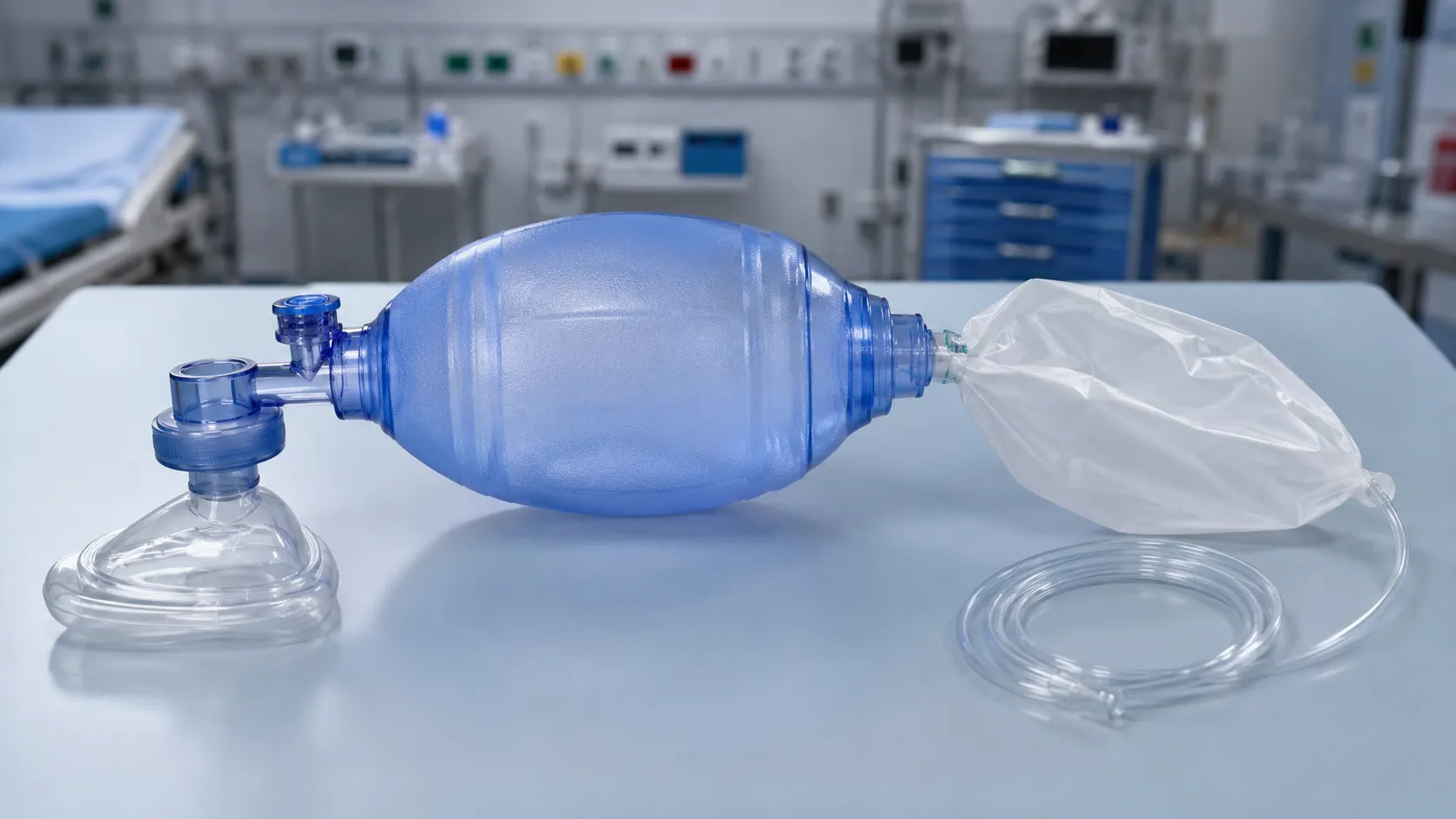
In theatres, an HMEF at the patient end conditions the gas and protects the machine, and is the common default for routine lists. In critical care, where active humidification is often used, a plain low-dead-space filter is fitted because an HME would be redundant and waterlogged next to a heated humidifier; a filter may also sit on the expiratory limb to protect the ventilator and its exhaled-flow sensor. In emergency and transfer settings, a filter on a self-inflating resuscitator or transport ventilator protects both patient and device between uses. Matching the filter type to the setting avoids stacking redundant components.
Paediatric and Low-Volume Filters
Small patients need filters with minimal dead space and low resistance, because the same internal volume that is trivial on an adult breath significantly raises rebreathed carbon dioxide at paediatric and neonatal tidal volumes. Dedicated paediatric and neonatal filters trade a little filtration surface for much lower volume. Check the quoted dead space and resistance at the low flows these patients generate, not the adult figures, and confirm the connectors match paediatric catheter mounts and circuits.
Consumables, Stocking and Total Cost
Because a patient-end filter is used on every case, volumes are high and consistency matters. Standardising one adult filter or HMEF, plus matched paediatric and neonatal versions, keeps dead space appropriate without a sprawling catalogue and reduces adaptor use through common connectors. Weigh the per-unit price against verified efficiency and dead space; the cheapest filter is a poor economy if it fails to seal, wets out or forces circuit changes. Where a patient-end filter supports extended circle-circuit reuse, the filter spend is offset by fewer circuit changes. Keep documentation of the tested filtration efficiency and standard for each line, since infection-control and audit teams may ask for it, and confirm each new batch still meets the quoted specification before it goes into use.
Conclusion
Breathing circuit filters are the barrier that lets anaesthetic machines and reusable circuits be run safely between patients. Choose on verified BFE and VFE to ISO 23328, the right mechanism for your case mix, appropriate dead space and whether humidification should be combined in an HMEF. To compare filters and HMEFs across adult and paediatric ranges, or to set up standing orders, contact MediGear or register through our buyer services.
Disclaimer
This article is for informational purposes only. MediGear (medigear.uk) publishes it for general information and procurement guidance. It is not clinical, diagnostic, treatment, technical, engineering, legal, or regulatory advice, nor a product endorsement, guarantee, or substitute for professional assessment. MediGear does not provide medical consultations. Buyers should consult their clinical, biomedical, estates and regulatory contacts, and the manufacturer's documentation, and independently verify all specifications, certifications, compatibility and suitability before purchase. Specifications, certifications and availability are correct at the time of publication and may change without notice. MediGear is a medical-equipment distributor and does not sell medicines or pharmaceutical products.