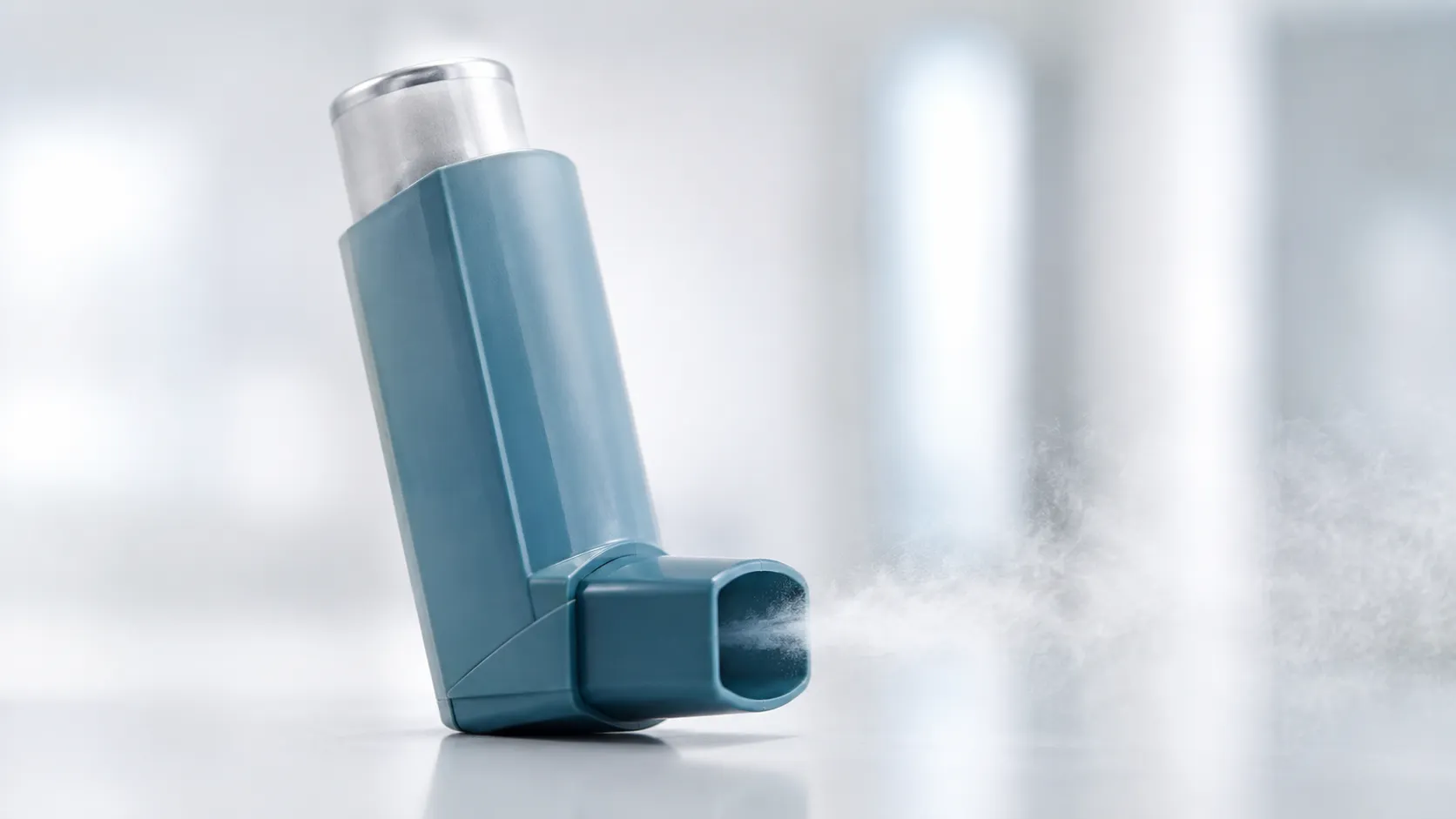
A metered dose inhaler is a pressurised handheld device that delivers a fixed, measured dose of medication as a fast aerosol puff each time it is actuated. A metering valve releases one precise volume of drug suspended in a propellant, and the patient must breathe in as the puff is fired so the fine particles are carried into the lungs. That timing between actuation and inhalation is the defining feature of the pressurised metered dose inhaler, and it is what separates it from breath-actuated dry powder devices.
This guide is for procurement, respiratory-service and community teams who need to understand the pressurised metered dose inhaler as a device, how the dose is metered and timed, and which accessories and assessment aids a facility legitimately buys around it.
How the Metering Valve Works
Inside the inhaler, the drug is held in a sealed canister as a suspension or solution in a liquefied propellant under pressure. A small metering chamber in the valve fills with one dose between actuations. When the canister is pressed into the actuator, that fixed volume is released and the propellant flashes to vapour, atomising the drug into an aerosol that leaves the mouthpiece at speed. The metering valve is what guarantees each puff carries the same measured amount, which is why a damaged or blocked valve, or a canister used past its dose count, undermines the entire principle.
Why Puff Timing Matters
The aerosol leaves the mouthpiece quickly and slows within a fraction of a second, so the patient must begin a slow, steady inhalation just as the puff is fired. Actuate too early and the cloud has dispersed before the breath arrives; actuate too late and the fast spray hits the throat. Poor coordination is the most common reason a pressurised metered dose inhaler under-delivers, and it is precisely why spacers and valved holding chambers exist, to hold the cloud so the timing window no longer has to be perfect. For buyers, that link between the inhaler and the spacer is the practical procurement connection.
Propellant and Priming
Modern pressurised inhalers use hydrofluoroalkane propellants, which replaced the older chlorofluorocarbon propellants withdrawn on environmental grounds; newer low-global-warming propellants are being introduced across the sector. Because the drug is a suspension, many devices need priming, a test spray or two, before first use or after a period unused, so the metering chamber delivers a full dose. Some also need shaking before each actuation to keep the suspension even. These handling steps directly affect delivered dose and are a routine part of device education.
Breath-Actuated Variants
To reduce the coordination burden, breath-actuated pressurised inhalers fire the dose automatically when the device senses the patient's inhalation, rather than requiring a manual press timed to the breath. These suit patients who struggle to synchronise actuation and inhalation but still generate a reasonable inspiratory flow. They do not remove the need for correct technique entirely, and they cannot be used with a standard spacer, so device selection is a balance between coordination ability, inspiratory effort and the accessories a patient needs. Understanding these variants helps a service advise on the right device family.
Dose Counters and End-of-Life
A canister continues to spray propellant even after the drug doses are used up, so a patient without a counter can keep actuating an effectively empty inhaler. A dose counter that shows remaining actuations is now expected on pressurised metered dose inhalers and prevents this, and it is worth emphasising in device education. Floating or shaking a canister to judge how full it is is unreliable, so the counter is the only dependable end-of-life indicator, which matters for patients relying on the device in an emergency.
Particle Size and Delivered Dose
The therapeutic aerosol needs to sit in the respirable range, broadly one to five microns, to reach the lower airways, and the metering valve, propellant and actuator orifice together set the particle size the device produces. Technique then determines how much of that reaches the lungs: a slow, deep inhalation with correct timing, ideally through a spacer where coordination is a problem, maximises the fine-particle delivery. This is why the same canister can perform very differently between patients, and why accessories and assessment matter as much as the device itself. A short breath-hold of around ten seconds after actuation gives the fine particles time to settle in the lower airways rather than being breathed straight back out, which is a further reason technique and device education repay the effort a service puts into them.
Standards, Regulation and Procurement Scope
A pressurised metered dose inhaler is a drug-device combination, and the medicine is a licensed pharmaceutical product regulated by the MHRA, dispensed through pharmacy rather than supplied by a device distributor. What a facility buys around it are devices: spacers and valved holding chambers, placebo demonstration inhalers for teaching, and inhaler-technique assessment aids, all of which are medical devices carrying UKCA or CE marking. Design-verification testing for aerosol drug delivery devices is set out in ISO 20072. Keeping the medicine and the device separate keeps procurement compliant and accurate.
Procurement Checklist
-
Separate the licensed inhaler medicine, dispensed through pharmacy, from devices a distributor supplies.
-
Stock spacers and valved holding chambers to overcome actuation-inhalation timing problems.
-
Confirm the spacer back-piece accepts the pMDI devices your service dispenses.
-
Hold placebo demonstration inhalers for technique teaching and training.
-
Confirm UKCA or CE marking on spacers, trainers and assessment devices.
-
Emphasise dose counters and priming as part of device education.
-
Consider breath-actuated device awareness for patients with coordination difficulty.
Environmental Footprint and Propellant Transition
The propellant that makes a pressurised inhaler work is also its environmental weak point. Hydrofluoroalkane propellants are potent greenhouse gases, and a single pressurised inhaler can carry a carbon footprint many times that of an equivalent dry powder device, which is why reducing the impact of inhaler therapy is now a stated NHS priority. Manufacturers are transitioning to next-generation propellants with a far lower global-warming potential, and these lower-carbon pressurised inhalers are beginning to reach the market. For a medicines-optimisation or procurement team, the practical points are to be aware that this transition is under way, that pressurised inhalers remain essential for patients who cannot generate enough inspiratory flow for a dry powder device, and that spacers extend the usefulness of pressurised inhalers for exactly those patients. Any inhaler recycling or take-back scheme your service supports also sits within this footprint discussion.
Use Across Care Settings
Pressurised metered dose inhalers are used everywhere from emergency departments and wards to GP practices and homes, and the supporting devices a facility procures track that reach. Acute and paediatric areas need spacers and demonstration devices to hand; community and asthma services need durable teaching aids and technique-assessment tools. Standardising the spacer and training kit across settings simplifies stock and training, and it focuses the total cost on reusable accessories and consumable holding chambers rather than the pharmacy budget.
Conclusion
A pressurised metered dose inhaler delivers a precisely metered puff, but that puff only works when it is timed to the breath, which is why the device knowledge a buyer needs centres on the metering valve, priming, dose counters and, above all, the spacers that make timing forgiving. Keep the licensed medicine separate from the devices you buy, and confirm UKCA or CE marking on those accessories. To source compliant spacers, holding chambers and respiratory training devices or arrange a facility quote, contact MediGear or set up a buyer account.
Disclaimer
This article is for informational purposes only. It is published by MediGear (medigear.uk) for general information and procurement guidance, and is not clinical, diagnostic, treatment, technical, engineering, legal or regulatory advice, nor a product endorsement, guarantee or substitute for professional assessment. MediGear does not provide medical consultations. Buyers should consult their clinical, biomedical, estates and regulatory contacts, and the manufacturer's documentation, and independently verify all specifications, certifications, compatibility and suitability before purchase. Specifications, certifications and availability are correct at the time of publication and may change without notice. MediGear is a medical-equipment distributor and does not sell medicines or pharmaceutical products.