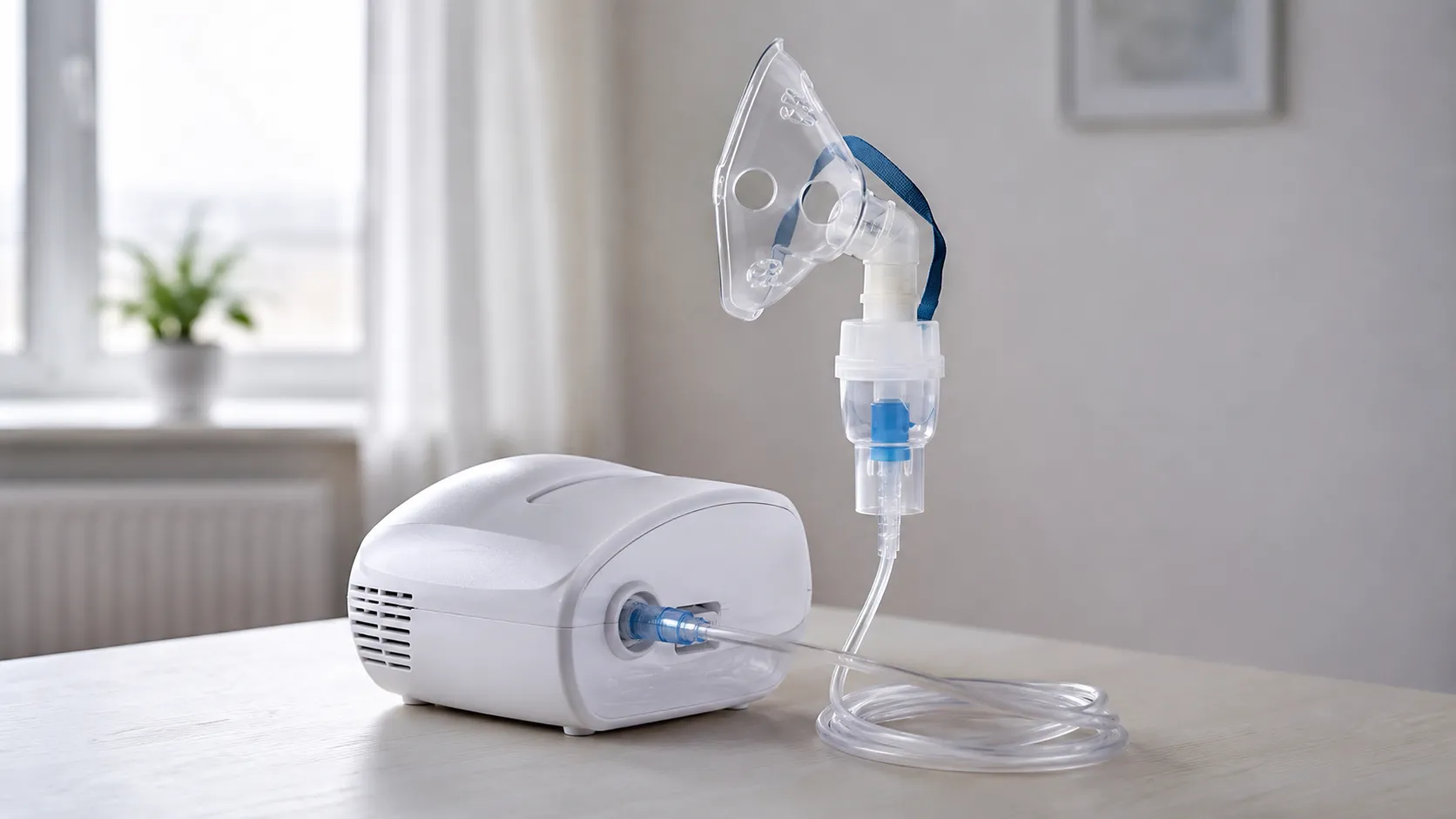
A portable nebuliser compressor is the driver unit that supplies pressurised air to a jet nebuliser cup, forcing liquid medication into a fine mist the patient can breathe. It is the machine, not the mask or chamber: the compressor provides the compressed air, and the nebuliser cup uses that air to atomise the drug. For home therapy, a portable compressor lets a patient run treatments away from a hospital wall-gas supply, which is why it is a common item on domiciliary respiratory equipment lists.
This guide is for procurement, community-equipment and biomedical teams specifying portable nebuliser compressors for home and clinic use. It covers how the compressor drives atomisation, piston versus other designs, output specifications, portability and power, filters and maintenance, and the standards to confirm before buying.
How a Compressor Drives Atomisation
The compressor draws in room air, compresses it with a small motor-driven pump, and delivers a steady stream of pressurised air through tubing to the nebuliser cup. Inside the cup, that fast air jet passes a narrow orifice and shears the medication liquid into droplets; a baffle then filters out the larger droplets so only the fine, respirable fraction leaves the cup. The compressor's job is to supply enough flow at enough pressure to run this process consistently. If the air output is weak, atomisation slows, treatment times lengthen, and the particle size can drift, so the compressor's output specification is the heart of the purchase.
Output Specifications That Matter
Two figures define a compressor: the air output flow, typically quoted in litres per minute, and the operating pressure it can sustain. Jet nebuliser cups are commonly designed around a driving flow of six to eight litres per minute, and the compressor must meet the flow and pressure the chosen cup needs to atomise properly. Because the particle size a system produces depends largely on the nebuliser cup and the driving gas, treat the compressor and cup as a matched pair; pairing a weak compressor with a demanding cup gives poor atomisation and longer treatments. Confirm the manufacturer's stated flow, pressure and compatible cups rather than assuming any compressor drives any nebuliser.
Piston and Diaphragm Designs
Most portable nebuliser compressors use a piston pump, where a motor drives a piston to compress air; these are robust, well understood and widely serviced. Smaller, lighter units may use a diaphragm pump to reduce size and noise, generally at lower output and suited to lighter-duty domiciliary use. Mesh nebulisers use a vibrating membrane instead of a compressor, making them near-silent and highly portable, but they are a different technology with their own cleaning demands. For a compressor-driven purchase, the piston-versus-diaphragm choice is a trade-off between output and duty on one side and size, weight and noise on the other.
Portability, Power and Noise
Portability is the reason for this device class, so weight, dimensions and power options decide fitness for home use. Mains-only units are fine for a fixed home set-up; battery- or in-car-powered units suit patients who travel or need treatment away from a socket, and rechargeable-battery run time then becomes a key figure. Noise level, quoted in decibels, matters for overnight or paediatric use and for patient acceptance, and duty cycle, how long the unit can run before it needs to rest and cool, matters where treatments are long or frequent. A compressor that overheats mid-treatment is a poor choice for a heavy home user.
Filters, Cleaning and Consumables
Compressors draw room air through an inlet air filter that protects the pump and keeps the delivered air clean; this filter is a consumable and must be changed on the manufacturer's schedule. The nebuliser cup, mask, mouthpiece and tubing are separate consumables with their own cleaning and replacement cadence, and the cup in particular wears and should be replaced periodically to keep atomisation efficient. Wipe down the compressor body per instructions, and never immerse it. Building the filter and cup replacement cadence into the cost model is essential, because a neglected filter or worn cup quietly degrades therapy long before the compressor fails.
Single-Patient and Multi-Patient Use
A key procurement distinction is whether a compressor is intended for single-patient domiciliary use or for multi-patient use in a clinic. Domiciliary units stay with one patient, and the consumable set is theirs alone. Where a compressor is shared across patients in a clinic, it must be decontaminated between uses per its instructions, and every patient needs their own single-patient nebuliser cup, mask, and tubing, because the aerosol pathway cannot be shared. Some models are marketed specifically as multi-patient hospital-grade units with higher duty cycles and more robust decontamination guidance, and matching that intended use to your setting avoids both under-specifying and overspending.
Standards and Regulation
A nebuliser compressor is an active electrical medical device and should carry valid UKCA or CE marking and be registered with the MHRA. Its electrical safety falls under the IEC 60601-1 general standard for medical electrical equipment, while the nebulising system and its components, cups, masks and connectors, are covered by ISO 27427. For domiciliary equipment services, electrical-safety testing and planned maintenance should follow your local policy in line with Health and Safety Executive guidance on portable electrical equipment. Request the instructions for use, the output specification and the list of compatible nebuliser cups at the point of order.
Procurement Checklist
-
Confirm UKCA or CE marking, MHRA registration and IEC 60601-1 electrical safety.
-
Check air output flow and pressure meet the nebuliser cups you will pair with it.
-
Treat compressor and cup as a matched pair and confirm compatible cups.
-
Match single-patient domiciliary or multi-patient clinic use to your setting.
-
Assess weight, power options, battery run time and noise for home use.
-
Check duty cycle suits long or frequent treatments without overheating.
-
Cost the inlet filter, nebuliser cup and consumable replacement cadence.
Battery, Charging and Transport Practicalities
For genuinely portable use, power details decide whether a compressor is usable away from home. Where a unit runs on a rechargeable battery, look at the number of treatments per charge, the recharge time, and whether the battery is user-replaceable or built in, because a fixed battery becomes the life-limiting part of the whole device. Check that a mains adapter and, where relevant, a vehicle adapter are included or available, and that the voltage rating suits travel abroad. Weight and a carry case matter for a patient moving the unit daily, and a compact footprint helps where the compressor lives on a bedside table. For a domiciliary service issuing units at scale, agreeing a common charger and battery type across the fleet reduces the spares burden. It simplifies the advice given to patients and carers.
Total Cost and Servicing
The purchase price of a portable compressor is only part of the picture. Over its life, the unit consumes inlet filters and nebuliser cups, needs periodic electrical-safety testing in a service context, and may need spares or servicing for the pump. Warranty length, service intervals and spare-part availability therefore belong in the comparison alongside output and portability. For a domiciliary programme distributing many units, standardising on one or two compressor models with a common consumable set keeps stock, training and servicing manageable and lowers the true cost per patient.
Conclusion
A portable nebuliser compressor drives home nebuliser therapy, so specify air output flow and pressure matched to the cup, the right single- or multi-patient use, sensible portability and power, and an honest duty cycle. Confirm UKCA or CE marking and IEC 60601-1 safety, and cost the filters and cups over the unit's life. To compare compliant nebuliser compressors, cups and consumables or arrange a facility quote, contact MediGear or open a buyer account.
Disclaimer
This article is for informational purposes only. MediGear (medigear.uk) publishes it for general information and procurement guidance; it is not clinical, diagnostic, treatment, technical, engineering, legal, or regulatory advice, nor a product endorsement, guarantee, or substitute for professional assessment. MediGear does not provide medical consultations. Buyers should consult their clinical, biomedical, estates and regulatory contacts, and the manufacturer's documentation, and independently verify all specifications, certifications, compatibility and suitability before purchase. Specifications, certifications and availability are correct at the time of publication and may change without notice. MediGear is a medical-equipment distributor and does not sell medicines or pharmaceutical products.