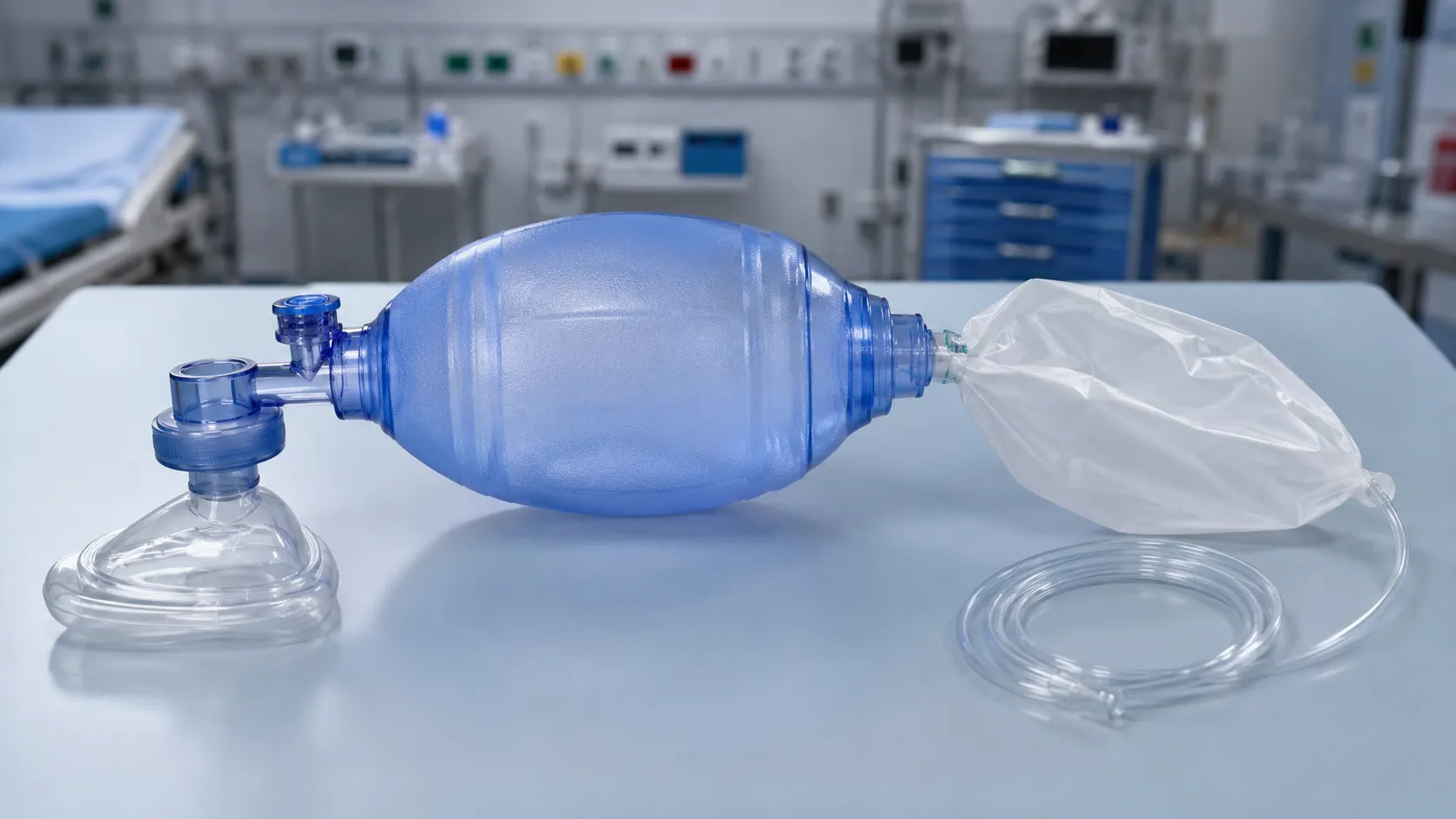
A self-inflating resuscitation bag is a manual ventilator that refills itself via elastic recoil, delivering rescue breaths without any pressurised gas supply, making it the default airway tool for emergencies and transport. Squeezing the bag pushes gas through a one-way patient valve to a mask or tracheal tube; releasing it lets the bag spring back and draw in fresh air ready for the next breath.
This guide is for procurement and resuscitation equipment leads specifying manual resuscitators for crash trolleys, ambulances, and wards. It explains the valve and reservoir that govern the delivered oxygen, the sizes and pressure limits to match patients, the applicable standard, and the specifications to confirm before buying.
How It Works Without a Gas Supply
The defining feature is self-reinflation. The bag is made of a resilient material that returns to shape on its own, so it works on room air even when no oxygen is connected, which is precisely why it is trusted for cardiac arrest and failed-airway situations. An intake valve at the tail lets air refill the bag, and a non-rebreathing patient valve, typically a duckbill or leaf design, directs the exhaled gas to the patient during compression and vents exhaled gas to the atmosphere on release, so the patient does not re-inhale expired gas.
On its own, the bag delivers roughly 21 per cent oxygen, the same as air. Connect oxygen at the tail, and the delivered concentration rises to around 40 to 60 per cent, depending on flow and technique. Add an oxygen reservoir bag or tubing, and at a flow of about 10 to 15 litres per minute, the delivered oxygen can approach 85 to 100 per cent. The reservoir is therefore essential wherever high-concentration oxygen delivery is expected.
Sizes for Adult, Paediatric and Infant Use
Manual resuscitators come in adult, paediatric and infant sizes because delivered tidal volume must match lung size. Adult bags hold about 1500 to 1600 ml, paediatric bags around 500 ml, and infant or neonatal bags around 240 to 280 ml. Bag volume is a ceiling, not a target; the operator delivers only the volume needed for visible, appropriate chest rise. Stocking the right sizes, and the correctly sized masks to seal with them, is as important as the bag itself, because an oversized bag on a small patient invites over-inflation.
Pressure-Limiting Valves and PEEP
Paediatric and infant resuscitators usually incorporate a pressure-limiting (pop-off) valve, commonly set around 40 cmH2O, to reduce the risk of barotrauma from over-vigorous ventilation. Many include a means to override or close the valve when a stiffer lung genuinely needs higher pressure, a decision for the clinician. A pressure manometer port lets teams monitor delivered airway pressure, and a PEEP valve can be fitted to the expiratory port where positive end-expiratory pressure is wanted. Confirm which of these features a given model offers, because they vary by size and grade.
Reusable and Single-Use Options
Bags are supplied as single-use or reusable. Single-use PVC resuscitators are inexpensive, remove reprocessing burden and are the norm on many crash trolleys and in ambulances, where cross-infection control and immediate readiness matter. Reusable silicone resuscitators withstand autoclaving and repeated use, suiting settings that can reliably dismantle, clean, reassemble them, and test the patient valve afterwards. Reassembly is not trivial: an improperly rebuilt valve can fail to ventilate, so reusable systems require a competent decontamination process and a functional check before being returned to service. Specifications a Buyer Must Check
Match the bag size to the patient group, and confirm the delivered volume range and the presence and setting of any pressure-limiting valve. Check that the patient connector is the standard 15 mm/22 mm fitting. It should mate with your masks, filters, catheter mounts, and tracheal-tube connectors, and confirm that the oxygen reservoir and tubing are included where high FiO2 is needed. Verify that the non-rebreathing valve performs within the expected range, that a manometer port and PEEP-valve compatibility are available if required, and that the unit is single-use or validated reusable. Confirm masks in the right sizes and matching consumables are available so the whole set is ready to use.
Standards, Regulation and Testing
Self-inflating resuscitators are medical devices and should carry valid UKCA or CE marking from a manufacturer registered with the MHRA. The relevant particular standard is ISO 10651-4, which covers operator-powered resuscitators, and the patient connectors follow ISO 5356-1 for the 15 mm/22 mm conical fittings. Request the instructions for use and the declared performance data. Because these devices sit on resuscitation trolleys, align stocking and checking with resuscitation and infection-prevention policy; NHS services routinely include a pre-use functional check of the bag and valve in daily trolley checks.
Maintenance, Readiness and Total Cost
Readiness is the real performance metric. A resuscitator that is present but assembled wrongly, missing its reservoir or past its use-by date has failed before the emergency starts. For single-use stock this means date monitoring, sealed packaging and defined restocking after use. For reusable stock it means a validated decontamination cycle, correct reassembly, and a documented function test. Total cost spans the units, the masks and reservoirs, PEEP valves and manometers where fitted, and either disposal or reprocessing. Buying complete, ready-checked sets rather than loose components reduces the chance of a missing part at the worst moment.
The Non-Rebreathing Valve in Detail
The patient valve is the heart of the device and the part most worth scrutinising. Its job is to open on compression so that gas passes only forward to the patient, then redirect exhaled gas to the atmosphere on release, so carbon dioxide is not re-inhaled. Two designs dominate: the duckbill, a flexible slit that opens under forward pressure, and the leaf or fishmouth valve. Either can jam, stick or be reassembled backwards after cleaning, and a valve that sticks in one position either fails to ventilate or lets the patient rebreathe. A pre-use check that squeezes the bag against a gloved hand or test lung, watching the valve move and the bag refill, confirms the whole gas path before the device is trusted on a patient.
Use Across Care Settings
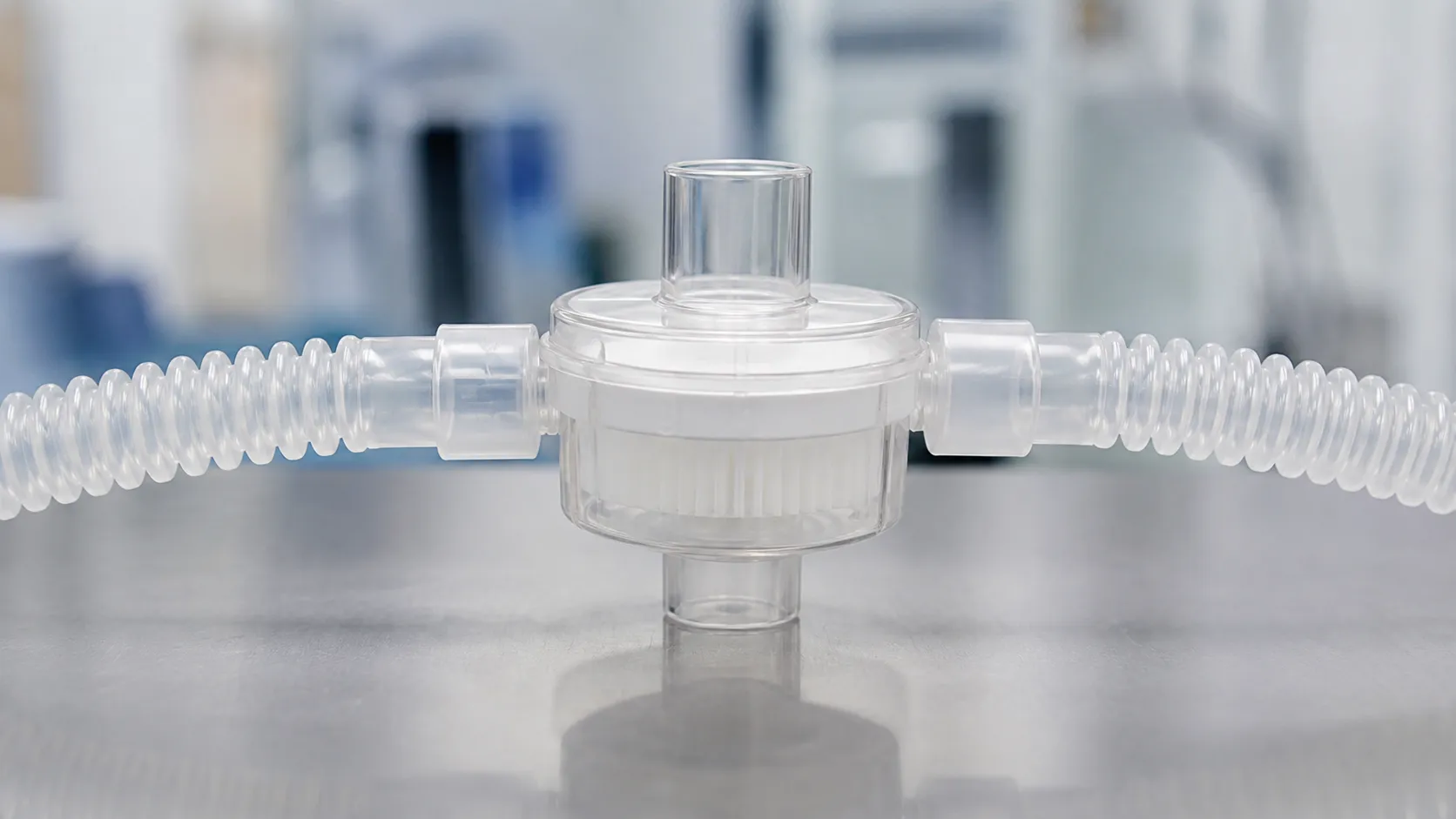
Self-inflating bags are found on hospital crash trolleys, in A&E and theatres, throughout ambulance and retrieval services, in GP practices for emergency use, and in dental and community settings. Their independence from a gas supply is exactly what makes them universal: they work on the ward, in a lift, at the roadside, and during transfers between them. A breathing-system filter is usually fitted between the valve and the mask or tube to protect the patient and, on reusable units, the device as well. Where a controlled oxygen concentration and reliable positive end-expiratory pressure are needed for a delicate newborn, a flow-inflating bag or T-piece resuscitator is the tool of choice. Still, for immediate, supply-independent ventilation across all age groups, the self-inflating bag is the mainstay.
Procurement Checklist
-
Confirm UKCA or CE marking, an MHRA-registered manufacturer and ISO 10651-4 compliance.
-
Stock adult, paediatric and infant sizes with matching masks.
-
Check the 15 mm/22 mm patient connector fits your masks, filters and tube connectors.
-
Confirm the oxygen reservoir and tubing are included for high-concentration delivery.
-
Verify any pressure-limiting valve settings and overrides, and confirm manometer and PEEP compatibility.
-
Decide single-use versus validated reusable, with a defined function-test routine.
-
Cost masks, reservoirs, disposal or reprocessing and restocking after use.
Conclusion
A self-inflating resuscitation bag delivers life-saving ventilation without a gas supply, which is why it is standard on every crash trolley and ambulance. Specify the right sizes, a reliable non-rebreathing valve, a reservoir that lifts delivered oxygen toward 100 per cent, and a readiness routine that keeps every set complete and checked. To compare ISO 10651-4 resuscitators, masks, and reservoirs, or to arrange a facility quote, contact MediGear or open a buyer account.
Disclaimer
This article is for informational purposes only. MediGear (medigear.uk) publishes it for general information and procurement guidance. This is not clinical, diagnostic, treatment, technical, engineering, legal or regulatory advice, nor a product endorsement, guarantee or substitute for professional assessment. MediGear does not provide medical consultations. Buyers should consult their clinical, biomedical, estates, and regulatory contacts and the manufacturer's documentation, and independently verify all specifications, certifications, compatibility, and suitability before purchase. Specifications, certifications and availability are correct at the time of publication and may change without notice. MediGear is a medical-equipment distributor and does not sell medicines or pharmaceutical products.