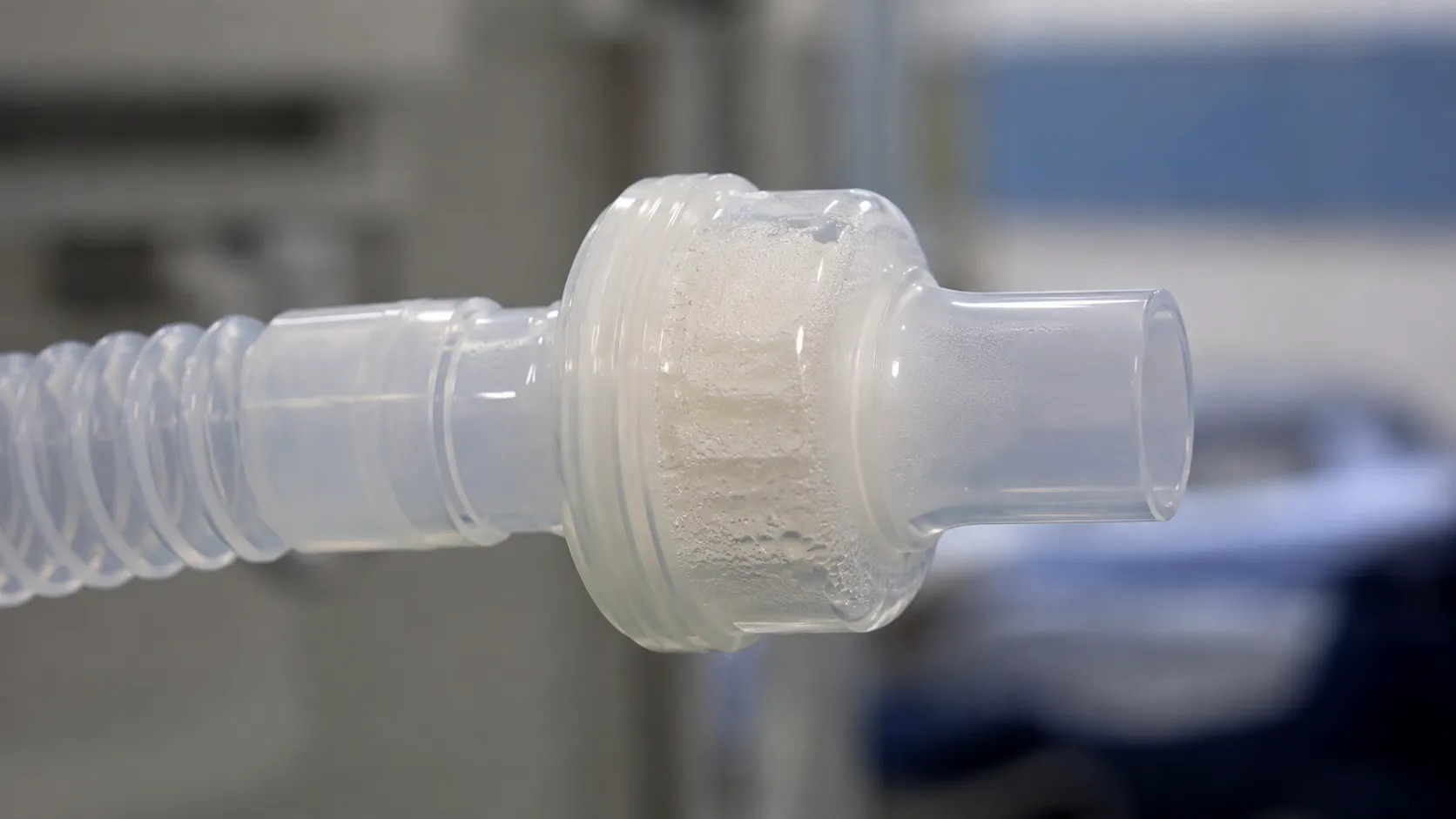
A heat and moisture exchanger, or HME, is a passive humidifier that sits in the breathing circuit and recycles the patient's own warmth and water. On exhalation, it traps heat and moisture from the expired gas; on the next breath, the cooler, drier inspired gas passes back through the same medium and picks up that moisture again. Named the “artificial nose”, it does the conditioning job of the upper airway that an endotracheal or tracheostomy tube bypasses, using no electricity and no water supply.
For buyers, the HME is a low-cost, high-volume consumable where small differences in moisture output, dead space, and resistance change clinician suitability across theatres, critical care, and transfer. Choosing the right variants matters more than the unit price.
How a Passive HME Keeps the Airway Moist
Inside the housing is a condenser element with a large surface area. Warm, saturated expired gas cools against it and deposits water; the element also stores heat. When dry inspired gas flows the other way, it is warmed and re-humidified from that stored reserve. The exchange is never total, so an HME delivers less than the airway's natural output, but enough to keep secretions mobile for many patients over a limited period.
Hydrophobic, Hygroscopic and Combined Types
There are three broad constructions. A hydrophobic HME uses a pleated water-repellent membrane that condenses moisture and also provides useful filtration; output is moderate. A hygroscopic HME uses a felt or paper impregnated with a moisture-retaining salt such as calcium or lithium chloride, giving higher water return. Combined hygroscopic-hydrophobic media aim for good moisture output plus filtration in one unit. Typical passive moisture output sits around 28 to 34 mg/L, below the roughly 44 mg/L an active heated humidifier can sustain.
Dead Space and Resistance: Why Size Matters
Because an HME sits at the patient end, its internal volume becomes apparatus dead space that is rebreathed. On an adult tidal volume of several hundred millilitres, a 3 to 100 mL device is minor. However, on small neonatal tidal volumes, the same dead space is significant and can raise carbon dioxide. That is why manufacturers offer a size range, from adult units down to paediatric and neonatal HMEs with internal volumes of only a few millilitres. Flow resistance also rises as the medium loads with water and secretions, so HMEs are changed on a schedule, commonly around every 24 hours or sooner if visibly soiled, wet or resistant.
When to Use an HME Versus Active Humidification
Passive HMEs suit short and medium cases, routine theatre lists, spontaneous breathing through a supraglottic airway, and transfers where a powered humidifier is impractical. They are generally avoided in favour of an active heated humidifier, where the patient has thick, bloody, or copious secretions; a very low tidal volume; high minute ventilation above roughly 10 L/min; hypothermia; or needs prolonged ventilation with maximal humidity. Never combine an HME with active humidification, which would waterlog and obstruct it. Many HMEs also incorporate a filter, discussed in our companion piece on breathing-circuit filters.
Key Specifications to Compare
-
Moisture output: milligrams of water per litre at the tidal volumes you use, quoted to ISO 9360 test conditions.
-
Dead space: internal volume matched to patient size, with dedicated paediatric and neonatal options.
-
Resistance: pressure drop at clinical flows, ideally with figures at fresh and loaded states.
-
Filtration: whether the unit is a plain HME or an HME with filter (HMEF), and the quoted efficiency.
-
Connectors: 22 mm and 15 mm ports to ISO 5356-1, plus a capnography or gas-sampling luer port if required.
-
Extras: integrated suction access, angled versions and weight, which loads the airway on long cases.
Standards and Regulation
Moisture-output performance is tested to ISO 9360-1 for adult and paediatric use and ISO 9360-2 for tracheostomised patients breathing spontaneously through low tidal volumes. Where an HME also filters, the filtration side is assessed under ISO 23328-1. Connectors follow ISO 5356-1. Devices sold in the UK must hold UKCA or recognised CE marking; you can verify regulatory status and incident-reporting routes through the MHRA.
HME Use Across Care Settings
In theatres, an HME or HMEF at the patient end is standard for routine, limited-duration cases. In critical care, a passive HME can suit stable, short-term ventilation and transfer between departments, switching to active humidification when ventilation is prolonged, or secretions thicken. For a spontaneously breathing tracheostomy patient, small dedicated exchangers sit directly on the tube and are tested under ISO 9360-2 for that low-tidal-volume, spontaneous pattern. Matching the device to the setting, rather than defaulting to one size, is what keeps humidification adequate and dead space appropriate. Practical integration also matters: many HMEs offer a luer port for capnography or gas sampling and an access port for closed suction, letting the airway stay connected during suctioning. Confirm those ports match your monitoring lines and suction catheters, and that adding them has not pushed dead space beyond what a small patient tolerates.
Resistance, Occlusion and Common Pitfalls
The main risks are mechanical. As the medium loads with water, blood, or secretions, its resistance climbs, increasing the work of breathing for a spontaneously breathing patient and the pressure needed to ventilate. A heavily soiled HME can occlude, so nebulised drugs are given on the machine side or the HME is removed during nebulisation, since aerosol both bypasses and clogs it. An HME also takes time, often ten to twenty minutes, to reach full moisture output after a circuit change, so it is not an instant humidifier. Weight at the patient end can drag on the airway during long cases, favouring lighter, angled designs.
Reading the Moisture-Output Figures
Because passive output depends on the patient's own breath, the quoted moisture figure is only meaningful with its test tidal volume. ISO 9360 specifies the conditions, so a device tested at 500 mL and one at 1000 mL are not directly comparable, and a unit that performs well at adult volumes may underperform at low volumes. When comparing HMEs, line up the moisture output at the tidal volume your patients actually use, then weigh it against dead space and resistance rather than picking the highest single number. A modest, reliable output at the right size beats a headline figure quoted at a volume you never use.
Consumables, Stocking and Total Cost
HMEs are strictly single-patient, single-use disposables and are not reprocessed. The procurement task is standardising a small family, typically an adult HME, an adult HMEF, and paediatric and neonatal sizes, so wards and theatres carry the right dead space without a sprawling catalogue. Because volumes are high, small per-unit price differences add up, but never trade away moisture output or an appropriate size to save a few pence. Consistent connectors across your HMEs, catheter mounts and circuits reduce adaptor use and leaks. Where several departments buy independently, a single agreed HME formulary avoids duplicate lines and helps. It helps sales and infection-control teams audit what is in use and confirm each batch meets its quoted specification.
Conclusion
An HME keeps the airway wet by giving back the heat and moisture the patient breathes out, a simple, powerless approach that suits most shorter cases and transfers. Buy on moisture output, correct dead space for the patient, resistance and any filtration need, all confirmed against the relevant ISO test standards. To compare HME and HMEF ranges across adult and paediatric sizes, contact MediGear or set up standing orders through our buyer services.
Disclaimer
This article is for informational purposes only. It is published by MediGear (medigear.uk) for general information and procurement guidance and is not clinical, diagnostic, treatment, technical, engineering, legal, or regulatory advice, nor a product endorsement, guarantee, or substitute for professional assessment. MediGear does not provide medical consultations. Buyers should consult their clinical, biomedical, estates and regulatory contacts, and the manufacturer's documentation, and independently verify all specifications, certifications, compatibility and suitability before purchase. Specifications, certifications and availability are correct at the time of publication and may change without notice. MediGear is a medical-equipment distributor and does not sell medicines or pharmaceutical products.