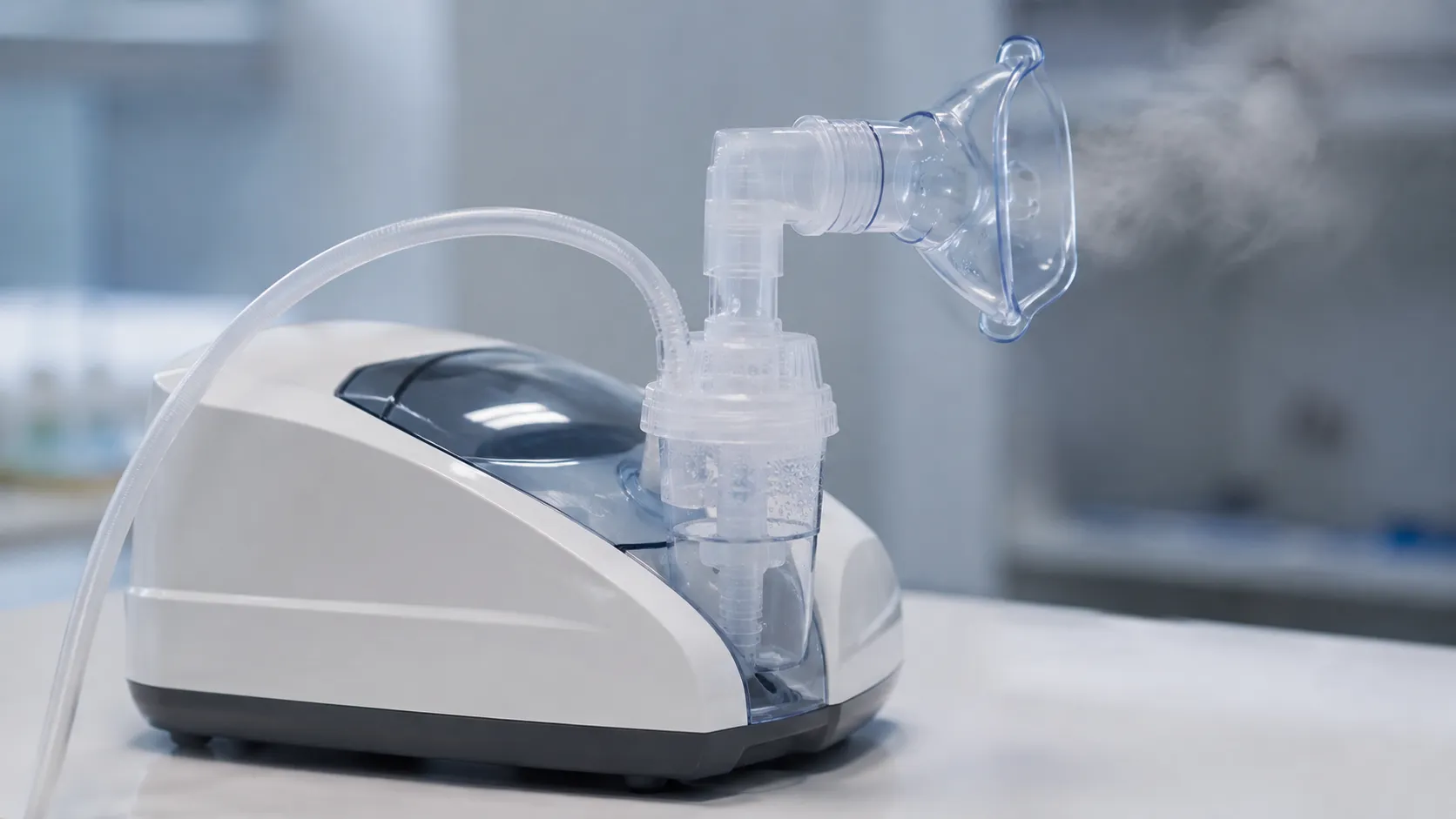
An ultrasonic nebuliser turns liquid into a dense aerosol using a rapidly vibrating piezoelectric crystal, and its high output makes it the workhorse for sputum induction, where nebulised hypertonic saline is used to provoke a productive cough and collect a diagnostic sample. Unlike a mesh or jet device, it drives a fountain of high-volume droplets from the surface of a fluid reservoir, which is exactly what an induction protocol needs.
This guide is aimed at respiratory departments, TB services and biomedical teams specifying induction equipment. It covers the ultrasonic principle, why output and infection control dominate the buying decision, the drug limits that rule out certain uses, and the specifications to confirm before purchase.
How an Ultrasonic Nebuliser Works
A piezoelectric transducer at the base of the unit oscillates at one to three megahertz. Those vibrations pass, often through a water couplant bath, into a chamber where they form a standing wave that raises a small geyser of fluid at the surface. Droplets shear off the crest of that geyser and are carried to the patient by a built-in fan or a stream of air. The transducer frequency largely fixes droplet size, while the drive amplitude and fan set the output rate.
Because the energy is delivered into the bulk fluid, an ultrasonic device can generate a much higher aerosol volume per minute than a small mesh or single jet nebuliser. That capacity is the reason it dominates high-throughput tasks such as induction rather than routine maintenance dosing.
Why It Suits Sputum Induction
Sputum induction nebulises hypertonic saline, commonly in the region of three to seven per cent, to draw fluid into the airways, loosen secretions and trigger a deep, productive cough so that a specimen can be collected. The procedure needs a sustained, high-output aerosol over several minutes, and the ultrasonic device supplies it reliably from a large reservoir. Induced samples support tuberculosis microbiology, cytology and induced-sputum cell counts, so the aerosol must be consistent and the reservoir large enough to run a full protocol without a refill mid-procedure.
Infection Control: an Aerosol-Generating Procedure
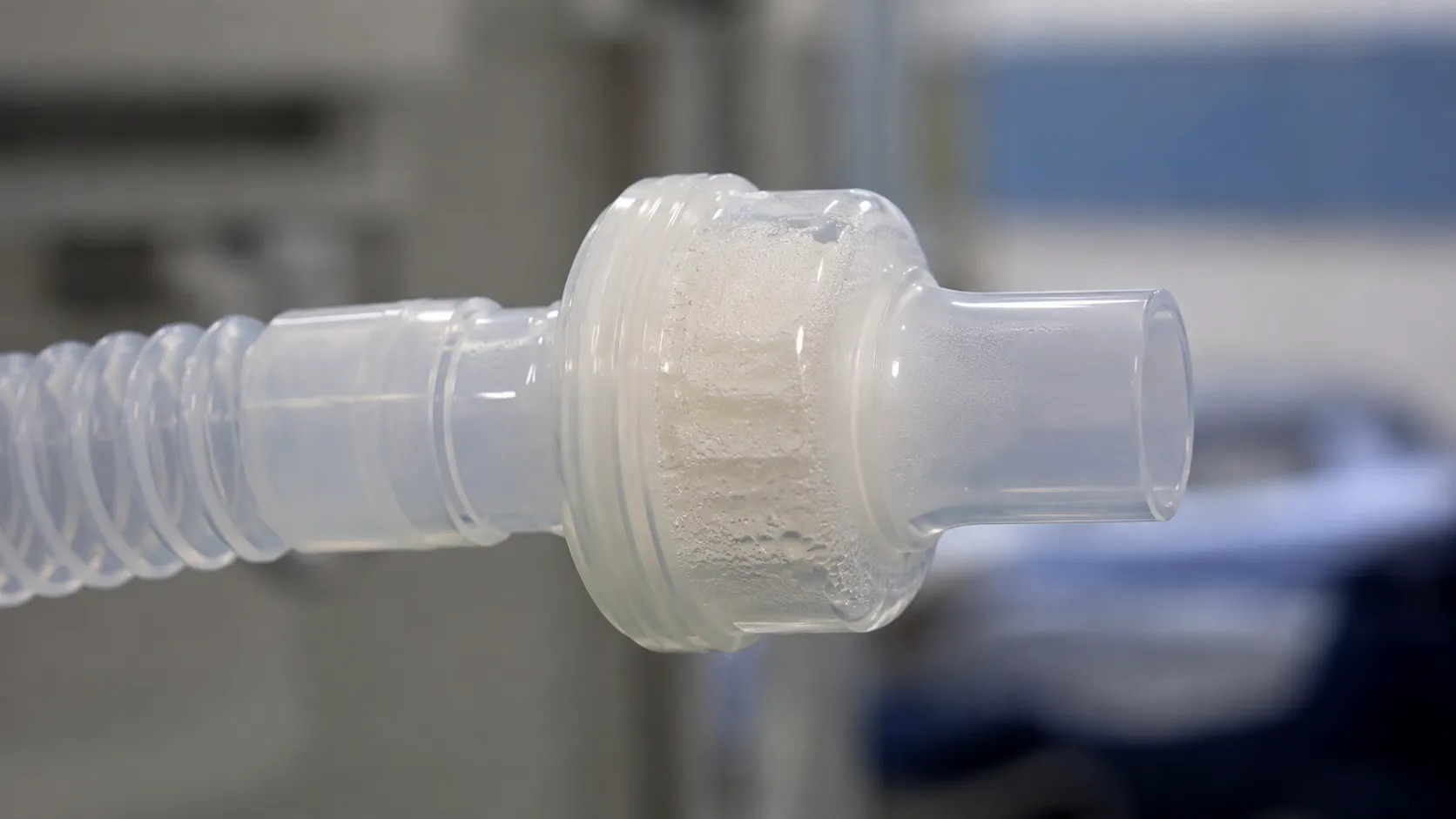
Sputum induction is an aerosol-generating procedure, and in suspected tuberculosis it carries real transmission risk, so the equipment choice cannot be separated from where and how it is used. Departments typically run induction in a negative-pressure or dedicated ventilated room with appropriate respiratory protection, following workplace health and safety and infection-prevention guidance. For the device itself, that means single-patient breathing chambers, mouthpieces, and tubing wherever possible; a co-plant-plant and reservoir design that can be decontaminated between patients using the manufacturer's method; and a filter on the expiratory path where specified.
Drug and Solution Limits
Ultrasonic energy warms the reservoir fluid slightly and imparts significant mechanical energy, which rules out several medications. Protein-based and heat-sensitive drugs, notably dornase alfa, are not recommended for ultrasonic delivery, and suspensions are nebulised poorly because the crystal does not aerosolise undissolved particles evenly. Saline solutions, by contrast, are ideal, which is why the modality fits induction so well. Confirm any intended drug is validated for ultrasonic use, and keep suspensions and delicate biologicals on the appropriate mesh or jet device.
Water Couplant Versus Direct Chamber
Ultrasonic designs split into two chamber arrangements, and the difference shapes both performance and cleaning. In a couplant design, the transducer sits under a water bath that transmits vibration into a separate, disposable medication cup, isolating the drug from the crystal and simplifying patient-to-patient changeover, but adding a water-bath step and a consumable cup. A direct-fill design places the solution straight onto the transducer, which is efficient but requires thorough decontamination of the chamber in contact with the crystal between patients. For an induction service running back-to-back cases, the couplant-plus-single-use-cup approach often wins on turnaround and infection control, so establish which arrangement a quoted model uses before comparing prices.
Setup, Throughput and Room Workflow
Induction is a scheduled procedure, so the device has to fit a room and a rota, not just a bench. Check the warm-up time before the unit reaches full output, how quickly the reservoir can be filled to the required saline concentration, and whether output is adjustable so the operator can start gently and build up as tolerated. Consider the footprint, and whether the unit is trolley-mounted for a dedicated room or portable between rooms, and how the mains lead, fan noise,se and exhaust sit within a negative-pressure space. A clear control and an easy-to-read run indicator reduce operator error during a procedure that already demands attention to the patient and to the rigour of the saline steps.
Output, Reservoir and Particle Size
The specifications that matter most are aerosol output rate, usually quoted in millilitres per minute, reservoir capacity, and particle-size distribution. Higher output shortens the procedure, but a wider or larger particle spectrum deposits more centrally, so match the stated distribution to your induction protocol. Check whether the design uses a direct-fill chamber or a water couplant bath, since a couplant adds a cleaning step and a consumable single-use cup. Confirm the fan-driven airflow and any adjustable output control, and that the reservoir holds enough saline for a complete session.
Standards, Regulation and Servicing
Ultrasonic nebulisers are electrical medical devices and should carry valid UKCA or CE marking and MHRA registration. Aerosol characterisation is assessed under ISO 27427 for nebulising systems, electrical safety under the IEC 60601-1 family, and drug-pathway materials under ISO 18562. Request the declared output and particle-size data tested to a recognised method. The transducer is a wear item, so confirm expected service life, the cost and lead time of a replacement crystal, and the planned maintenance value, since a degraded transducer quietly reduces output and lengthens procedures.
Procurement Checklist
-
Confirm UKCA or CE marking, MHRA registration and declared aerosol output rate.
-
Check reservoir capacity is enough to run a full induction protocol unrefilled.
-
Confirm the particle-size distribution suits your induction and sampling method.
-
Verify single-patient chambers, mouthpieces, tubing and any expiratory filter.
-
Establish the couplant or direct-fill design and its decontamination method.
-
Confirm suitability only for validated solutions, excluding suspensions and heat-sensitive drugs.
-
Check transducer service life, replacement cost and maintenance interval.
-
Confirm the device fits your negative-pressure or ventilated induction room workflow.
Where It Fits Against Other Nebulisers
An ultrasonic device is not a general-purpose ward nebuliser. Its strength is high-volume saline aerosol for induction and similar tasks; its weaknesses are heating fluid, poor handling of suspensions, the couplant cleaning burden, and routine drug dosing toward mesh or jet units. Think of it as a specialist tool for the respiratory or TB service rather than fleet stock. Where a department also needs quiet, portable maintenance dosing, that is a separate purchase, and stretching one modality across both roles usually satisfies neither well.
Conclusion
For sputum induction, the ultrasonic nebuliser delivers the sustained, high-output saline aerosol the procedure demands. Still, it is specified alongside the negative-pressure room, single-patient consumables and infection controls that make induction safe. Confirm output, reservoir size, decontamination and transducer servicing, and keep unsuitable drugs on other devices. To compare compliant ultrasonic nebulisers and induction consumables or arrange a service quote, contact MediGear or set up a buyer account.
Disclaimer
This article is for informational purposes only. It is published by MediGear (medigear.uk) for general information and procurement guidance, and s not clinical, diagnostic, treatment, technical, engineering, legal or re,gulatory advice, nor a product endorsement, guarantee or su,bstitute for professional assessment. MediGear does not provide medical consultations. Buyers should consult their clinical, biomedical, estates and regulatory contacts, and the manufacturer's documentation, and independently verify all specifications, certifications, compatibility and suitability before purchase. Specifications, certifications and availability are correct at the time of publication and may change without notice. MediGear is a medical-equipment distributor and does not sell medicines or pharmaceutical products.