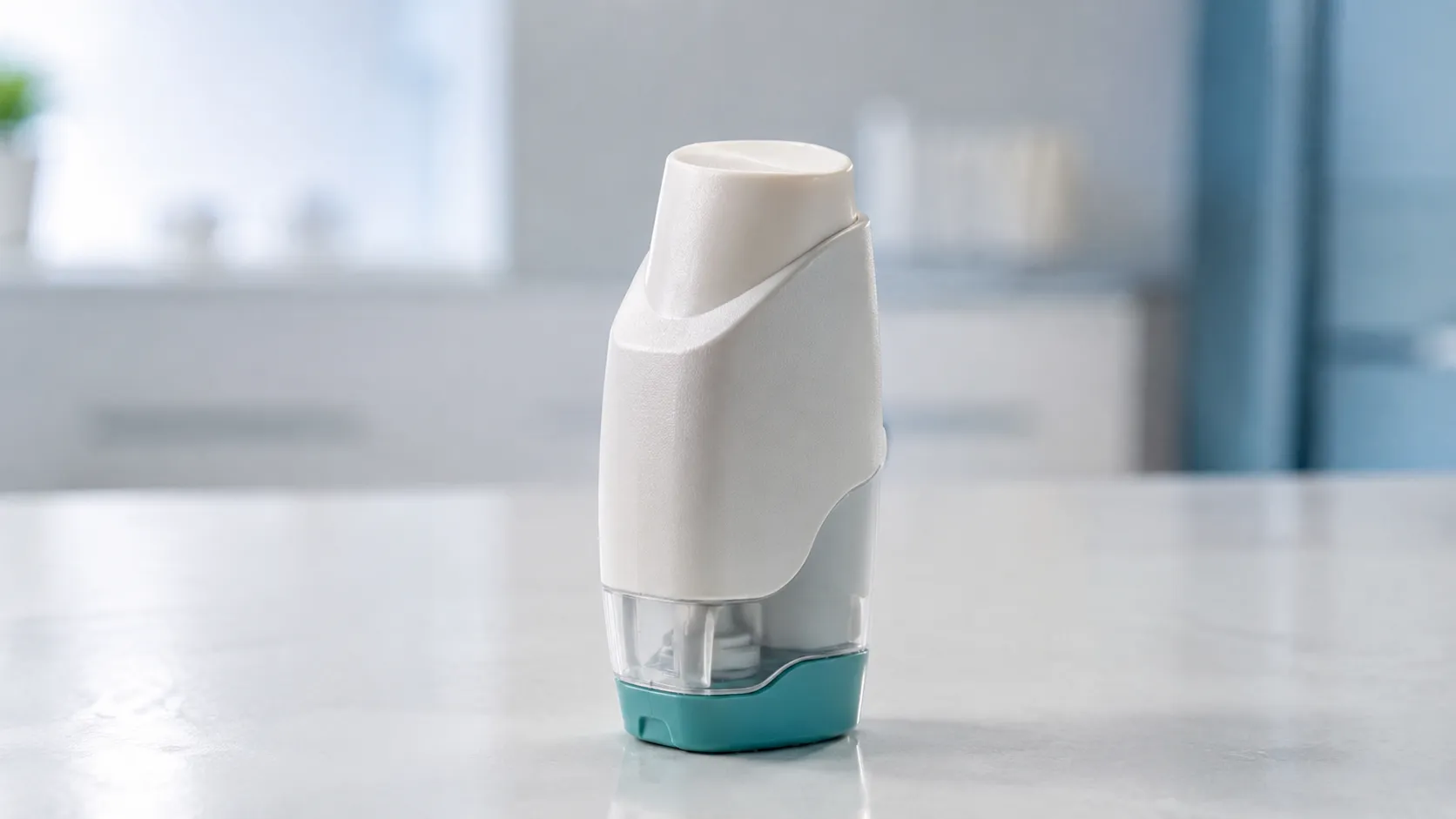
A dry powder inhaler is a breath-actuated device that delivers medication to the lungs as a fine powder, with no propellant and no puff-to-time. The patient's own inhalation draws the dose out of the device and breaks it into respirable particles, so the drug is released only when they breathe in. That single mechanism removes the actuation-inhalation coordination that pressurised inhalers demand, but it replaces it with a different requirement: an inspiratory effort to work the device.
This guide is for procurement, respiratory-service and community-equipment teams who need to understand dry powder inhaler device types and how they differ, so they can support prescribing, stock training aids and specify the right accessories. It focuses on the device, its variants and the practicalities of buying around it.
How a Dry Powder Inhaler Works
Instead of a canister, a dry powder inhaler holds micronised drug, often blended with a coarse carrier such as lactose. When the patient inhales sharply through the mouthpiece, airflow through the device generates turbulence that separates the fine drug from the carrier and carries the respirable fraction into the lungs; in contrast, the heavier carrier is largely deposited in the mouth. The dose is therefore driven entirely by the patient's inspiratory flow, which is why device design centres on getting a reliable dose from a realistic breath.
Device Resistance and Inspiratory Flow
Every dry powder inhaler has an internal resistance, and the patient must generate enough inspiratory flow against it to de-aggregate the powder. Higher-resistance devices need a smaller flow but a more forceful effort; lower-resistance devices need a faster flow. This is the central clinical-engineering point of the whole category: a patient who cannot reach the device's minimum flow will under-dose regardless of how good the drug is. That is why respiratory services use inspiratory-flow trainer devices to check whether a patient can actually operate a given inhaler, and why the assessment tool is a legitimate procurement item even though the meda device distributor does not supply the medicine itself
Dry powder inhalers fall into three broad mechanical types. Single-dose capsule devices require the user to load one capsule per dose, pierce it and inhale, which gives clear feedback that the dose was taken but adds a handling step. Multi-dose reservoir devices hold a bulk supply of powder and meter one dose per actuation from the reservoir, which is convenient but more sensitive to humidity. Multi-dose blister or disk devices carry individually sealed doses on a strip or disk, combining a protected dose with multi-dose convenience. Each type suits different dexterity and reliability needs, and a service usually holds more than one to match patients.
Dose Counters and Feedback
Because there is no visible spray, patients cannot see a dry powder inhaler working, so feedback features matter. A clear dose counter that shows remaining doses prevents a patient from continuing with an empty device, and reservoir and blister devices should have a reliable, easy-to-read counter or indicator. Some devices give a taste or an audible or tactile cue that a dose has loaded. When advising on device selection, these feedback features are a practical differentiator, particularly for older patients or those managing several inhalers.
Humidity Sensitivity and Storage
Dry powder is hygroscopic, so moisture is its enemy. Damp powder clumps and will not de-aggregate properly, cutting the delivered dose, which is why patients are told not to exhale into the device and to store it in a dry place. Reservoir devices are generally the most humidity-sensitive because the bulk powder is exposed each time the device is opened, while blister and capsule formats protect each dose until use. For domiciliary and travel use, this affects how devices should be stored and handled, and it is a genuine point of difference between device types.
Particle Size and the Fine Particle Fraction
As with any inhaled therapy, the useful part of the dose is the fine particle fraction in the respirable range, broadly one to five microns, which can reach the lower airways. In a dry powder inhaler, the device and the patient's inspiratory effort together determine how much of the loaded dose ends up in that range. This is why the same nominal dose can deliver differently depending on the device and the breath, and why flow assessment and device familiarity are so closely tied to real-world effectiveness. A quick, deep inhalation followed by a short breath-hold lets more of the fine fraction settle in the airways rather than being exhaled, so the technique the device demands is as much a part of the outcome as the powder itself.
Standards, Regulation and Procurement Scope
A dry powder inhaler is generally a drug-device combination, and the medicine is a licensed pharmaceutical product regulated by the MHRA, not an item a device distributor supplies. What a facility does buy around it are devices: inspiratory-flow assessment trainers, placebo demonstration inhalers for teaching, and cleaning or storage accessories, all of which are medical devices that should carry UKCA or CE marking. Design-verification: ISO 20072 describes design-verification for aerosol drug delivery devices; this boundary is clear, medicine versus device, and keeps procurement accurate and compliant.
Procurement Checklist
-
Separate the licensed medicine, prescribed and dispensed, from the devices a distributor can supply.
-
Stock inspiratory-flow trainer devices to check patients can operate their inhaler.
-
Hold placebo or demonstration inhalers across the main device types for teaching.
-
Confirm UKCA or CE marking on any assessment or training devices bought.
-
Match device type, capsule, reservoir or blister, to patient dexterity and reliability needs.
-
Favour clear dose counters for patients managing multiple inhalers.
-
Advise dry storage and no exhalation into the device to protect the dose.
Environmental Footprint and Greener Procurement
Device type now carries an environmental dimension that increasingly features in NHS procurement and formulary decisions. Dry powder inhalers contain no propellant gas, so their carbon footprint per dose is markedly lower than that of pressurised inhalers, whose propellant is a potent greenhouse gas. Where a patient can generate the inspiratory flow a dry powder device needs, choosing that format supports the NHS commitment to reducing the carbon impact of inhaler therapy without compromising treatment. For a buyer or medicines-optimisation team, this means the flow-assessment devices discussed above do double duty: they confirm a patient can use a dry powder inhaler effectively, and they support a switch that is both clinically sound and lower carbon. End-of-life disposal and any inhaler take-back or recycling scheme your service runs also belong in the environmental picture, alongside the device-versus-medicine boundary that governs what a distributor can supply.
Use Across Care Settings
Dry powder inhalers are used across respiratory clinics, GP practices, community pharmacy and domiciliary care, and the supporting devices a facility procures follow that spread. Respiratory and asthma services need flow trainers and a set of demonstration devices; community teams need robust teaching aids. Standardising the training and assessment kit, rather than the medicine, is where a device distributor adds value, and it keeps the total cost focused on durable trainers and consumable teaching accessories rather than the pharmacy budget.
Conclusion
Dry powder inhalers remove the puff-timing problem of pressurised inhalers but depend entirely on the patient generating enough inspiratory flow, so the device knowledge that matters for a buyer is device type, resistance, dose feedback and humidity handling. Support prescribing with flow trainers and demonstration devices, keep the medicine-versus-device boundary clear, and confirm UKCA or CE marking on the devices you buy. To source compliant respiratory assessment and training devices or arrange a facility quote, contact MediGear or open a buyer account.
Disclaimer
This article is for informational purposes only. MediGear (medigear.uk) publishes it for general information and procurement. It is not clinical, diagnostic, treatment, technical, engineering, regulatory, or legal advice, nor a product endorsement, guarantee, or substitute for professional assessment. MediGear does not provide medical consultations. Buyers should consult their clinical, biomedical, and regulatory contacts, review the manufacturer'sdocumentation, and independently verify all specifications, certifications, and compatibility before purchase. Specifications, certifications and availability are correct at the time of publication and may change without notice. MediGear is a medical-equipment distributor and does not sell medicines or pharmaceutical products.