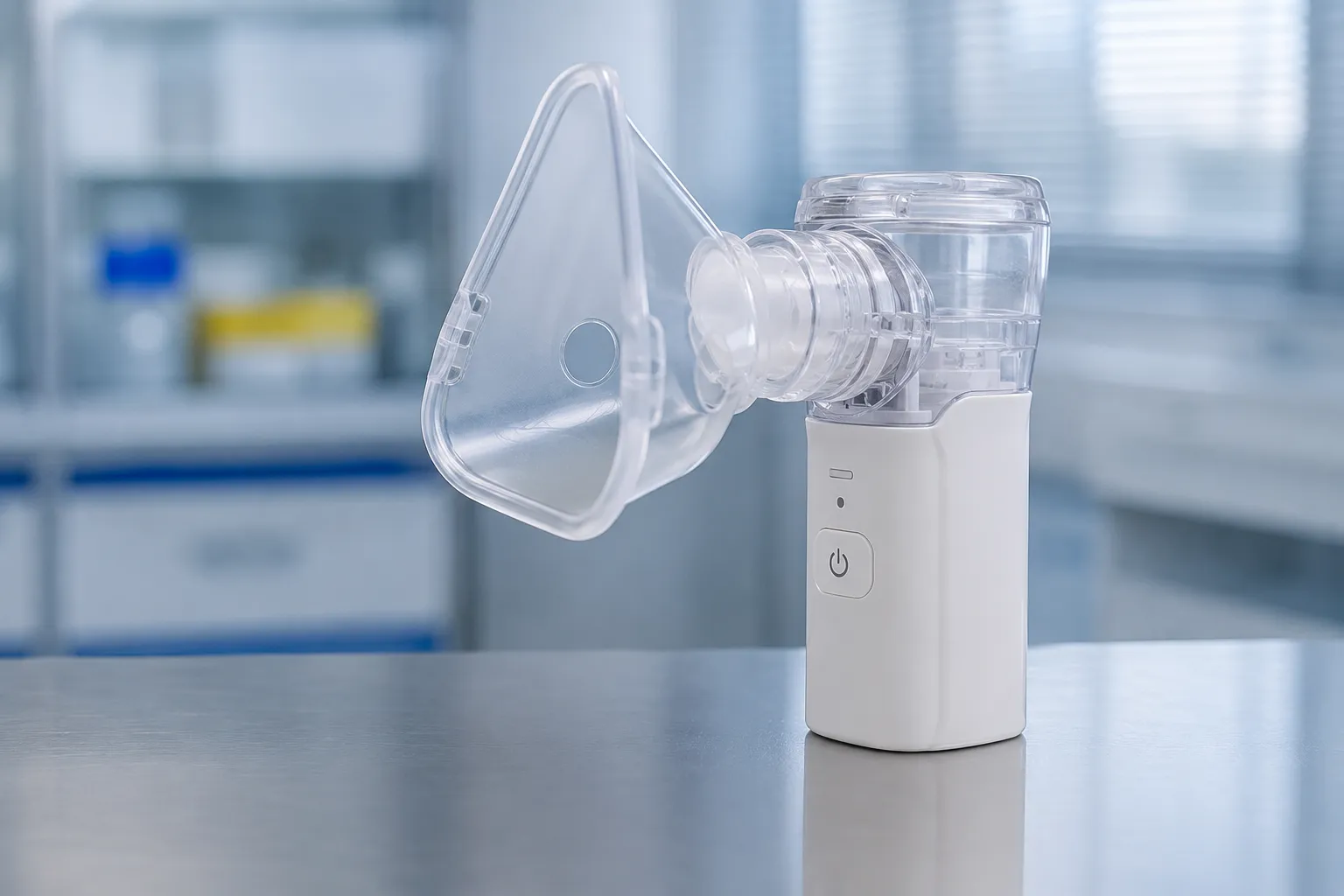
A mesh nebuliser is a small, battery- or mains-powered device that turns liquid medication into a fine, inhalable aerosol by pushing it through a vibrating metal plate perforated with thousands of microscopic apertures. It runs almost silently because it uses a piezoelectric ring on the mesh at high frequency, so the loudest thing in the room is usually the patient's own breathing.
This guide is written for procurement and biomedical teams comparing nebuliser fleets for wards, day units, paediatrics and domiciliary loan stock. It explains the vibrating-mesh principle, why the device is so quiet and efficient, the drug-compatibility limits that catch buyers out, and the specifications worth confirming before you standardise.
How the Vibrating Mesh Produces Aerosol
At the heart of the unit sits a domed aperture plate, or mesh, holding several thousand tapered, laser-formed holes only a few microns across. A piezoelectric element bonded around the plate expands and contracts when driven with an alternating voltage, vibrating the mesh at roughly one hundred to one hundred and eighty kilohertz. Each vibration acts like a micro-pump, drawing a precise volume of drug through every aperture and ejecting it as a uniform droplet. Because the hole geometry sets the droplet size, the aerosol is consistent from the first dose to the last.
Most clinical mesh devices produce a mass median aerodynamic diameter of about five microns, which reaches the lower airways rather than depositing in the mouth and throat. The medication cup sits above or beside the mesh, so the drug is never heated and never mixed with a driving gas, which protects heat-sensitive and protein-based formulations.
Why Delivery Is Almost Silent
A jet nebuliser needs a compressor thumping air through a narrow venturi, and that compressor is the noise. A mesh device removes it entirely. Vibration at over a hundred kilohertz is far above human hearing, so the only audible sound is a faint electronic hum and the click of the controls. Silent operation is not a luxury feature: it lets a treatment run overnight without waking a ward bay, suits anxious paediatric patients, and makes domiciliary use tolerable for families. It also means the device carries a battery instead of a mains-tethered pump, so it is genuinely handheld and portable.
Low Residual Volume and Faster Treatments
Efficiency is the mesh nebuliser's strongest procurement argument. Residual, or dead, volume, the drug stranded in the chamber when nebulisation stops, is typically around a tenth to a half of a millilitre, against roughly eight-tenths of a millilitre to a millilitre in many jet nebulisers. More of each expensive dose reaches the patient, and treatments finish faster because output rates are high and steady. For a unit dispensing costly bronchodilators or antibiotics, that recovered fraction adds up quickly across a year.
Consistent Output From First Dose to Last
Because droplet size is fixed by the aperture-plate geometry rather than by a gas flow that can drift, a healthy mesh produces a stable particle spectrum throughout a treatment, which supports reproducible lower-airway deposition. Output does fall once apertures begin to block, so the practical safeguard is a cleaning routine that stops residue buildup and a replacement schedule that retires a plate before its performance drifts. When trialling models, time a standard fill volume to nebulisation end on a fresh mesh and again after several weeks of daily use, so any real-world drop in output is visible before you commit a fleet.
Drug Compatibility: the Limit to Check First
The micro-apertures that make a mesh accurate also make it fussy. Viscous solutions, some suspensions such as budesonide, and formulations that crystallise can block the mesh, degrading output or stopping it. Always confirm with the drug and device manufacturers that a specific formulation is validated for mesh delivery before committing. This is the single most common oversight in nebuliser procurement, so build formulation compatibility into your evaluation rather than assuming a mesh device handles everything a jet nebuliser did.
Cleaning, the Mesh Lifespan and Consumables
The mesh is a precision consumable. Dried residue in the apertures is the usual cause of falling output, so units must be rinsed and dried strictly to the instructions after each use, and many designs use a replaceable mesh or medication chamber rated for a set number of treatments or months of service. Factor the price and reorder cadence of replacement meshes and cups into total cost of ownership, and confirm whether components are single-patient or can be reprocessed for multi-patient loan use. Our overview of respiratory consumables is a useful reference when modelling this.
In-Circuit and Ventilator Use
Some mesh nebulisers are designed to sit in a ventilator or high-flow circuit, adding aerosol without breaking the circuit or adding bias flow that alters delivered tidal volume. If you intend to nebulise into a ventilated circuit, verify that the model is validated for that placement, that its position relative to the wye and humidifier is specified, and that it does not interfere with flow triggering. A mesh unit's lack of a driving gas is an advantage here, since it avoids the added flow that in-line jet nebulisers introduce.
Standards, Regulation and Verification
Mesh nebulisers are medical devices and should carry valid UKCA or CE marking and be registered with the MHRA for the UK market. Aerosol performance, droplet size and output are characterised under ISO 27427 for nebulising systems, and electrical safety follows the IEC 60601-1 family; ask to see the declared aerosol output rate and particle-size data rather than marketing summaries. Materials in the drug pathway should meet ISO 18562 biocompatibility for the breathing-gas route. Request the instructions for use and confirm the stated performance was tested to a recognised method.
Procurement Checklist
-
Confirm UKCA or CE marking and MHRA registration for the model.
-
Check the declared MMAD and aerosol output rate, tested to ISO 27427.
-
Verify the specific drug formulations you dispense are validated for mesh delivery.
-
Confirm residual volume and compare it against your current jet nebulisers.
-
Establish mesh or chamber lifespan, replacement cost and reorder cadence.
-
Check whether parts are single-patient or reprocessable for loan fleets.
-
If used in a circuit, confirm validated in-line placement and no trigger interference.
-
Confirm battery type, run time and charging for portable and domiciliary use.
Use Across Care Settings
The same silence and portability that suit a ward at night make mesh nebulisers popular for paediatrics, palliative care and home loan schemes, where a quiet, quick, battery-run treatment improves adherence. In domiciliary programmes, cleaning discipline and the mesh-replacement schedule become the main support burden, so pair the device choice with clear patient instructions and a spares supply line. For a mixed fleet, decide early which drugs stay on jet nebulisers and which move to mesh, and standardise chambers to keep training and stock simple. If you also run high-output work such as sputum induction, that belongs on a different modality rather than a mesh unit.
Conclusion
A mesh nebuliser earns its place through quiet, efficient, portable delivery with very low drug wastage, provided the formulations you use are validated for the mesh, and the cleaning and replacement regime is honoured. Weigh the recovered drug fraction and faster treatments against consumable costs, and match the device to the drugs and settings it will serve. To compare compliant mesh nebulisers, replacement meshes and circuit accessories, or arrange a facility quote, contact MediGear or open a buyer account.
Disclaimer
This article is for informational purposes only. It is published (medigear.uk) for general information and procurement guidance. It is not clinical, diagnostic, treatment, technical, engineering, legal, or regulatory advice, nor a product endorsement, guarantee, or substitute for professional assessment. MediGear does not provide medical consultations. Buyers should consult their clinical, biomedical, estates and regulatory contacts, and the manufacturer's documentation, and independently verify all specifications, certifications, compatibility and suitability before purchase. Specifications, certifications and availability are correct at the time of publication and may change without notice. MediGear is a medical-equipment distributor and does not sell medicines or pharmaceutical products.