A defibrillator delivers a controlled electrical shock to a heart trapped in a lethal rhythm, aiming to halt the disorganised activity of ventricular fibrillation or pulseless ventricular tachycardia so a coordinated beat can return. In emergency cardiac response it is the most time-critical device a resuscitation team reaches for, because survival falls sharply with every minute of delay before the first shock.
This guide is written for UK procurement leads, resuscitation officers and biomedical engineers who specify defibrillators for wards, ambulances, community teams and clinics. It covers the whole family of shock-delivering equipment used by clinicians — from manual units to the defibrillator-monitors that anchor a crash trolley — and what separates them when you decide what to buy.
Manual versus advisory: how much control the operator keeps
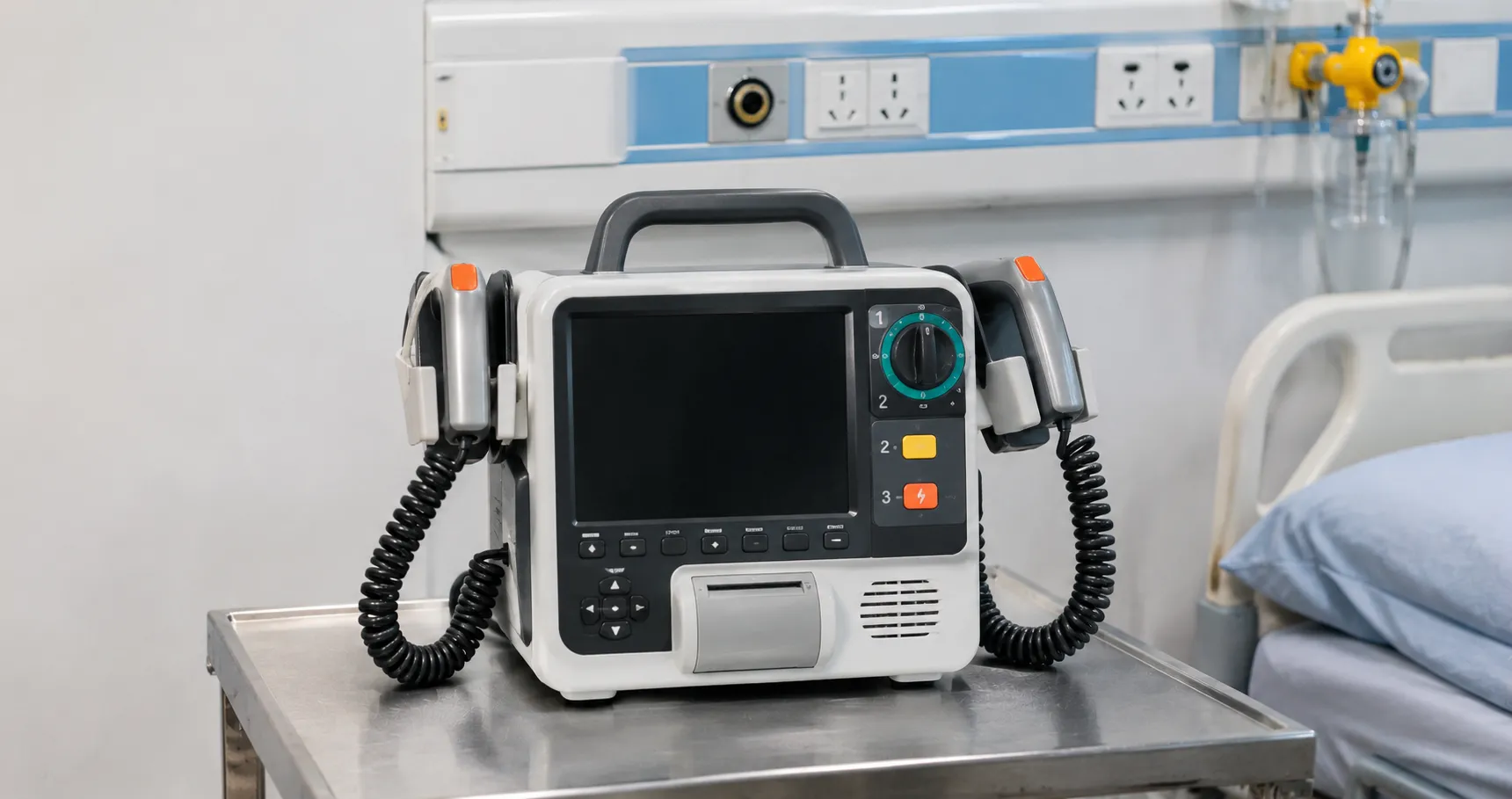
The defining choice with a clinical defibrillator is how much the operator controls. A manual defibrillator lets a trained clinician read the rhythm on the display, select the energy in joules, and decide when to charge and shock. That control suits a resuscitation team that can interpret an ECG, and it also enables synchronised cardioversion for organised rhythms and, on many models, external transcutaneous pacing.
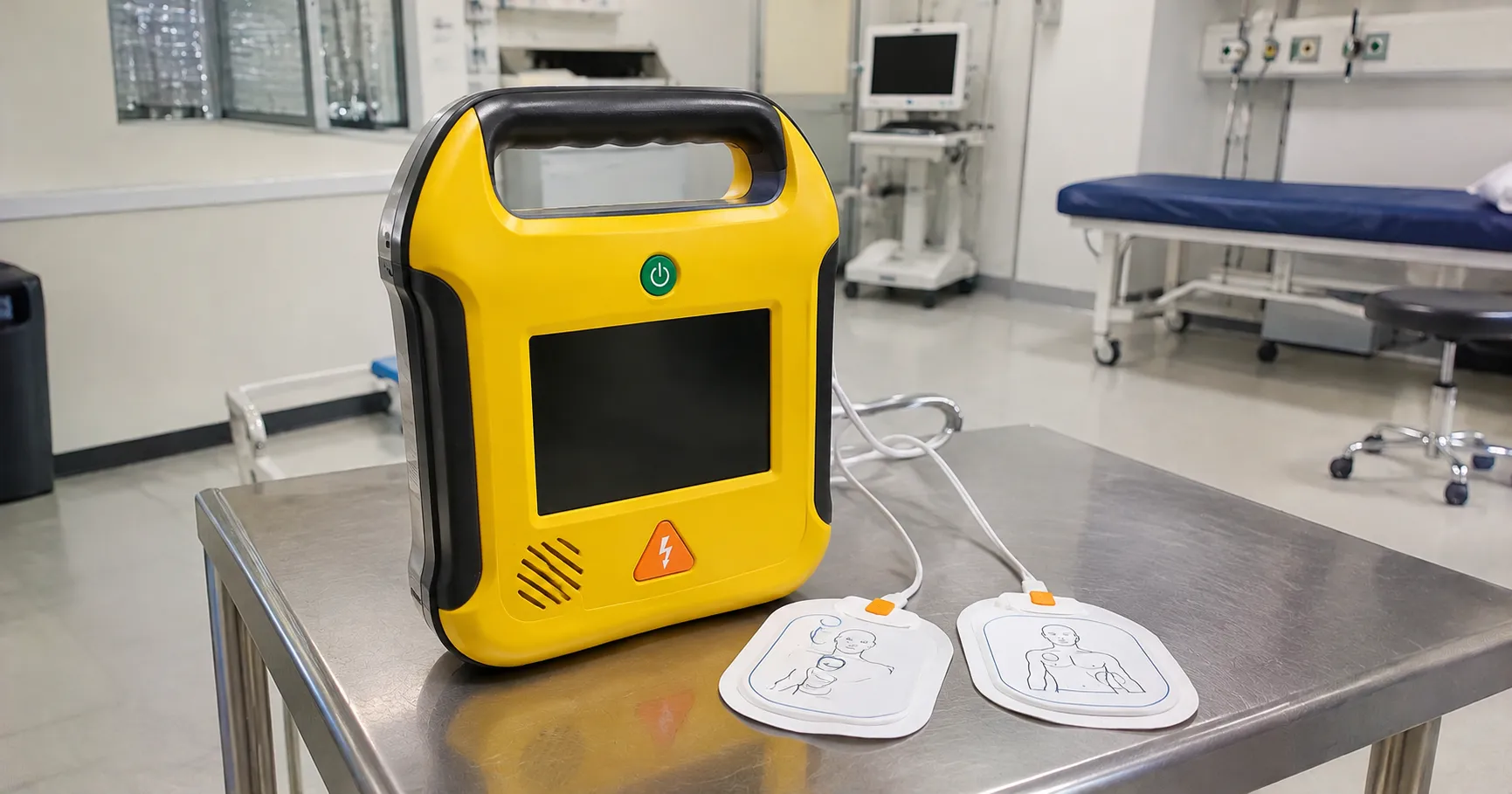
An advisory (semi-automatic) defibrillator analyses the rhythm and tells the operator whether a shock is indicated, leaving the shock button to be pressed manually. Many hospital defibrillators offer both modes on the same chassis, so a device can support a skilled team in resus and a less experienced responder on a general ward. Matching the mode to the competence of the likely users is a genuine procurement decision, not a specification afterthought.
Biphasic waveforms and energy selection
Modern defibrillators are biphasic: current flows one way then reverses, which achieves defibrillation at lower energy and with less myocardial stress than the older monophasic designs. Adult shocks are commonly delivered in the region of 120 to 200 joules depending on the manufacturer's waveform, while synchronised cardioversion typically starts far lower. Paediatric energy is weight-based, so a defibrillator intended for mixed-age use should make small, weight-appropriate settings and paediatric pads straightforward to reach under pressure.
Manufacturers tune their own waveforms, so the joule number on one brand is not directly comparable with another. What matters to a buyer is that the device follows current resuscitation practice, escalates energy sensibly, and charges quickly so the team is not waiting for the capacitor between shocks. Charge time to full energy is a specification worth comparing directly.
Impedance compensation and clean shock delivery
How reliably a shock reaches the heart depends on transthoracic impedance — the resistance of the chest to current, which varies with body size, pad placement and skin contact. Better defibrillators measure this impedance the moment the pads are applied and adjust the waveform so the effective dose is consistent across patients, rather than delivering a fixed current that overshoots in a small patient and underdelivers in a large one. Alongside defibrillation, most clinical units perform synchronised cardioversion, timing the shock to the R wave to treat organised but unstable rhythms, and this is a distinct mode a buyer should confirm is present and easy to select. A device that fumbles the switch between modes under pressure is a poor buy however good its waveform.
The defibrillator-monitor: more than a shock box
On a crash trolley the defibrillator is rarely a stand-alone shock device. A defibrillator-monitor combines defibrillation with multi-parameter monitoring — 3- or 12-lead ECG, SpO2, non-invasive blood pressure, capnography (EtCO2) and often external pacing. Capnography is increasingly expected during resuscitation because it confirms tube placement and gives a live read on the quality of chest compressions. When you compare models, look at which parameters are included as standard, which are paid options, and whether the layout stays legible during a noisy, fast-moving arrest.
Data capture matters too. Event review, code markers and download to a resuscitation audit system let a service learn from each event and evidence its response times. If your governance team reports on resuscitation outcomes, confirm how the device exports data and whether it integrates with the systems you already run.
Pads, paddles and the consumables that keep it ready
Most clinical defibrillation now uses self-adhesive pads rather than hard paddles, because pads allow hands-free shocking, double as monitoring electrodes and improve safety for the team. Pads are single-use and have an expiry date; the adhesive gel dries out, so stock rotation is part of readiness, not an afterthought. Separate adult and paediatric pads, and pre-connected pads that shorten the time to first shock, are worth specifying. Batteries are the other consumable that decides whether a device works when it is grabbed — know the shelf life, the number of shocks per charge, and whether the battery self-tests.
Standards and regulation for defibrillators
Defibrillators sold in the UK are medical devices and must carry valid UKCA or CE marking, with the manufacturer or importer registered with the regulator. The particular safety and performance standard for this device is IEC 60601-2-4 (cardiac defibrillators), which sits on top of the general medical electrical standard IEC 60601-1. Ask suppliers to confirm compliance in writing rather than assuming it. For the regulatory picture around device marking, registration and safety alerts, the Medicines and Healthcare products Regulatory Agency is the primary UK authority. Clinical use should follow current Resuscitation Council UK guidance, which your resuscitation lead will hold.
Where clinical defibrillators are deployed
The same broad category spans very different settings. Acute wards and theatres rely on full defibrillator-monitors on crash trolleys; ambulances and retrieval teams need rugged, battery-tolerant units with pacing and 12-lead transmission; GP practices, dental surgeries and community clinics usually specify a simpler advisory device that a small team can use confidently. Matching the feature set to the setting avoids both under-equipping a resus team and over-specifying a device that a small clinic will never use to its full extent. For a structured way to line up several models against your setting, MediGear's tools for healthcare buyers help you compare verified suppliers on like-for-like terms.
Beyond the purchase price
The headline price of a defibrillator is only part of what it costs to own. Over a typical service life the recurring spend is dominated by pads that expire on a fixed cycle, batteries that need scheduled replacement, and the annual electrical safety and performance testing every clinical device requires. A unit with cheaper pads and a long-life self-testing battery can be markedly cheaper to run than a lower-priced device with proprietary short-life consumables. Standardising on one platform across a site also lowers cost indirectly, because staff train once, spares are shared, and stock of pads and batteries is simpler to manage. When comparing quotes, ask each supplier to model the five-year consumable and servicing cost, not just the capital figure.
Servicing, batteries and staying rescue-ready
A defibrillator earns its keep only if it works the moment it is needed, so planned maintenance and daily readiness checks belong in the buying decision. Confirm the self-test regime, the battery replacement interval and cost, calibration and service intervals, and the availability of loan units during servicing. Training is part of readiness too: the more capable the device, the more its likely users need familiarisation, so factor in supplier-led training and refreshers. This guide draws on manufacturer documentation and UK regulatory guidance and is written for procurement teams; MediGear is a UK medical-equipment distributor that helps facilities compare suppliers rather than a clinical authority, so pair it with your own resuscitation and biomedical engineering advice.
Specifying a defibrillator: your buying checklist
-
Confirm the modes you need — manual, advisory, synchronised cardioversion and external pacing — match the competence of likely users.
-
Check the monitoring parameters included as standard versus paid options (ECG leads, SpO2, NIBP, EtCO2).
-
Compare charge time to full energy and shocks available per fully charged battery.
-
Verify UKCA/CE marking, registration and stated conformity with IEC 60601-2-4 and IEC 60601-1.
-
Cost the consumables: pad shelf life and price, adult and paediatric pads, and battery replacement interval.
-
Ask about event data export and integration with your resuscitation audit system.
-
Agree service intervals, warranty terms, spares availability and loan cover during maintenance.
The bottom line for buyers
Choosing a defibrillator is a balance between the clinical capability your teams can use, the total cost of pads and batteries over the device's life, and the confidence that it will be ready every time. Decide the mode and monitoring you genuinely need, compare like with like on charge time and consumables, and hold suppliers to documented compliance. If you are refreshing a fleet across several sites, standardising on one platform simplifies training and stock; speak to the MediGear team through our contact page to compare options against your requirements.
Disclaimer
This article is for informational purposes only. It is published by MediGear (medigear.uk) for general information and procurement guidance, and is not clinical, diagnostic, treatment, technical, engineering, legal or regulatory advice, nor a product endorsement, guarantee or substitute for professional assessment. MediGear does not provide medical consultations. Buyers should consult their clinical, biomedical, estates and regulatory contacts, and the manufacturer's documentation, and independently verify all specifications, certifications, compatibility and suitability before purchase. Specifications, certifications and availability are correct at the time of publication and may change without notice. MediGear is a medical-equipment distributor and does not sell medicines or pharmaceutical products.