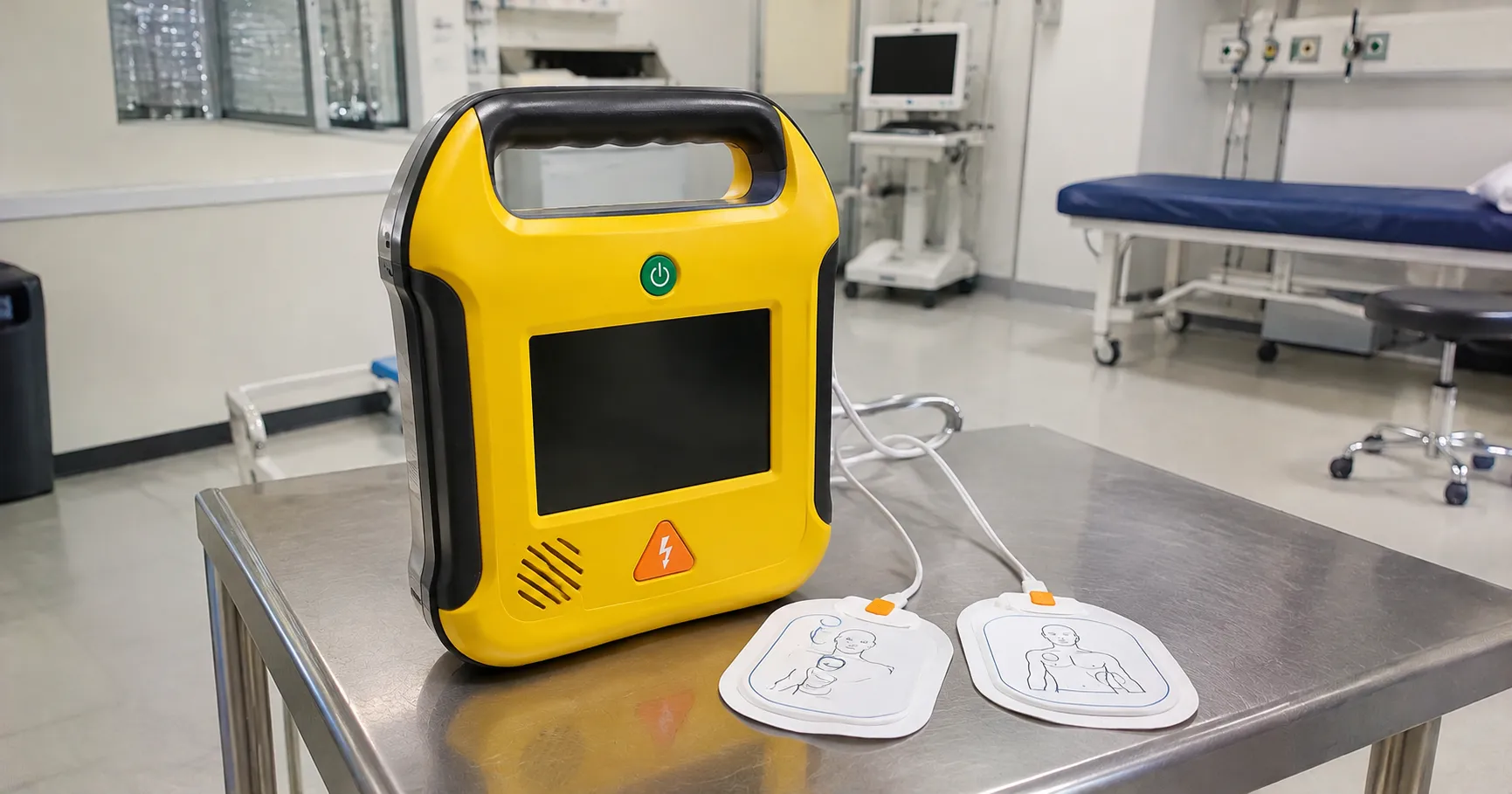
An automated external defibrillator (AED) is a portable device that analyses a collapsed casualty's heart rhythm and, if a shockable rhythm is present, either delivers or authorises a defibrillation shock while guiding the rescuer with spoken and visual prompts. Its whole design purpose is to let a person with little or no training act correctly in the first few minutes of a cardiac arrest, when speed decides survival.
This guide is for UK organisations placing AEDs in workplaces, schools, leisure sites, community locations and clinics. It focuses on what makes an AED different from a clinician's defibrillator — the automation, the prompts and the public-access context — and what to check before you buy one for a site where the likely user is a bystander, not a resuscitation team.
How an AED guides an untrained rescuer
The reason an AED saves lives in lay hands is that it removes the two hardest decisions from the rescuer: is this a shockable rhythm, and how much energy to deliver. Once the pads are on a bare chest, the AED talks the user through every step — call for help, place the pads as shown, stand clear while it analyses, and press the button or stand back while it shocks. Clear voice prompts, visual cues and a metronome that paces chest compressions turn a frightening event into a set of simple instructions. Some models add real-time CPR feedback on compression rate and depth, which measurably improves the quality of resuscitation.
Automatic rhythm analysis and the shock decision
Through the pads, an AED continuously reads the ECG and applies a detection algorithm to decide whether the rhythm is shockable — ventricular fibrillation or fast ventricular tachycardia — or not. If the rhythm is not shockable, the device will not allow a shock and instead prompts CPR, which is an important safety feature: an AED will not shock a normal or asystolic heart. This automatic analysis is the core difference from a manual clinical device, and it is why an AED can be trusted in the hands of a passer-by.
Why minutes decide whether an AED saves
An AED changes outcomes because of where it is, not just what it does. Defibrillation is most effective in the first few minutes of collapse, and the chance of survival falls with every minute that passes before a shock. Ambulance response, however fast, rarely beats that clock, so a device already on site — reached and applied by a bystander — is what bridges the gap until professional help arrives. This is the whole logic of putting AEDs into public and workplace settings: the machine is deliberately simple so that an ordinary person can shorten the time to first shock. Everything else about specifying an AED serves that single aim of getting a working device onto a chest quickly.
Semi-automatic versus fully automatic AEDs
AEDs come in two operating styles. A semi-automatic AED analyses the rhythm, charges, then instructs the rescuer to press a flashing button to deliver the shock. A fully automatic AED does the same analysis but delivers the shock itself after a spoken countdown, with no button to press. Semi-automatic units keep a person in the loop and are often preferred where trained first-aiders are present; fully automatic units remove any hesitation about pressing the button. Neither will ever shock a non-shockable rhythm, so the choice is about your users' likely confidence, not safety.
Public access defibrillation and workplace provision
Placing AEDs where the public or staff can reach them within a few minutes is known as public access defibrillation (PAD), and it is the reason a device in a shopping centre, gym or office corridor changes outcomes. Employers weighing AED provision should treat it as part of their first-aid needs assessment; the Health and Safety Executive sets out how workplaces assess first-aid requirements, and many organisations conclude that an accessible AED is a reasonable and low-burden addition. Registering the device so ambulance services can direct callers to it — through the national defibrillator network, The Circuit — means your AED can be used in a nearby emergency, not just your own.
Cabinets, signage and siting
An AED only helps if it can be found and reached fast. A wall cabinet — heated and, for outdoor sites, weatherproofed to a suitable IP rating — protects the device and keeps it in its working temperature range. Clear standardised signage, a location known to staff, and an openly accessible or code-shared cabinet all shorten the time to first shock. For a 24-hour public-access site, an outdoor locked cabinet with a code released by the ambulance service balances access against theft.
Adult and paediatric use
Most AEDs treat older children and adults with the same pads, and provide a paediatric mode — a key, a switch or dedicated child pads — that lowers the delivered energy for younger children. If your site is a school, nursery or family venue, specify a device with a clear paediatric option and keep the child pads with the unit. The prompts still guide the rescuer either way; the difference is the energy the device is allowed to deliver.
Consumables, batteries and rescue-ready status
An AED spends nearly all its life waiting, so its readiness features matter more than almost anything else. Pads are single-use and expire, typically after a few years, and batteries have a defined standby life; a good AED self-tests daily and shows a clear status indicator so a quick glance confirms it is ready. When comparing models, weigh the replacement cost and interval of pads and batteries over the device's life, because a cheap unit with pricey short-life consumables can cost more to own. This guide is compiled from manufacturer documentation and UK regulatory guidance for procurement teams; MediGear is a UK medical-equipment distributor that helps organisations compare verified suppliers rather than a clinical authority.
Training, ownership and keeping an AED in service
An AED is designed to be usable without training, but a short awareness session noticeably improves the speed and confidence with which staff act, and it is sensible to nominate people responsible for monthly checks. Ownership tasks are light: confirm the status indicator, check pad and battery expiry, keep the cabinet clean and stocked with a spare set of pads, a razor and a towel, and log any use so the device is restored to readiness afterwards. Some organisations add a managed-service contract that tracks expiries and prompts replacement, which suits multi-site estates where checks are easy to overlook. Weigh whether that oversight is worth the fee for the number of devices you hold.
Where AEDs earn their place
Public access defibrillators now appear across a wide range of settings, and the right specification shifts with the location. A gym or leisure centre wants a rugged unit with clear CPR feedback for high-exertion collapses; a large office or warehouse benefits from several devices sited so any point is within a short walk; schools and family venues prioritise a clear paediatric mode; remote and outdoor community sites need a heated, weatherproof cabinet and reliable access arrangements. Mapping likely response distances across your site is a practical step before deciding how many AEDs you need and where they go.
Regulation and quality marks for an AED
An AED is a medical device and must carry valid UKCA or CE marking, with the manufacturer or importer registered with the regulator. The particular safety and performance standard is IEC 60601-2-4 for cardiac defibrillators, applied with the general medical electrical standard IEC 60601-1. For device registration, marking and safety alerts the MHRA is the UK authority to check. Clinical use should follow current Resuscitation Council UK guidance, and your first-aid training provider can align staff practice with it.
Before you buy an AED for your site
- Decide between semi-automatic and fully automatic based on how confident your likely users will be.
- Confirm a clear paediatric mode if children may be present, and keep child pads with the unit.
- Check the standby life and replacement cost of both pads and battery, and the self-test regime.
- Specify a suitable cabinet — heated and weatherproof with an adequate IP rating for outdoor siting.
- Verify UKCA/CE marking, MHRA registration and conformity with IEC 60601-2-4.
- Plan registration on the national defibrillator network so ambulance services can locate it.
- Include CPR-feedback and rescue-recording features if your governance team reviews events.
Choosing well for public access
An AED is one of the few pieces of medical equipment bought in the hope it is never used, yet it must work perfectly the one time it is. Prioritise ease of use for an untrained rescuer, honest whole-life consumable costs and a cabinet that keeps the device findable and ready. To line up several AED models and cabinets against your site on like-for-like terms, MediGear's resources for healthcare buyers help you compare verified suppliers before you commit.
Disclaimer
This article is for informational purposes only. It is published by MediGear (medigear.uk) for general information and procurement guidance, and is not clinical, diagnostic, treatment, technical, engineering, legal or regulatory advice, nor a product endorsement, guarantee or substitute for professional assessment. MediGear does not provide medical consultations. Buyers should consult their clinical, biomedical, estates and regulatory contacts, and the manufacturer's documentation, and independently verify all specifications, certifications, compatibility and suitability before purchase. Specifications, certifications and availability are correct at the time of publication and may change without notice. MediGear is a medical-equipment distributor and does not sell medicines or pharmaceutical products.