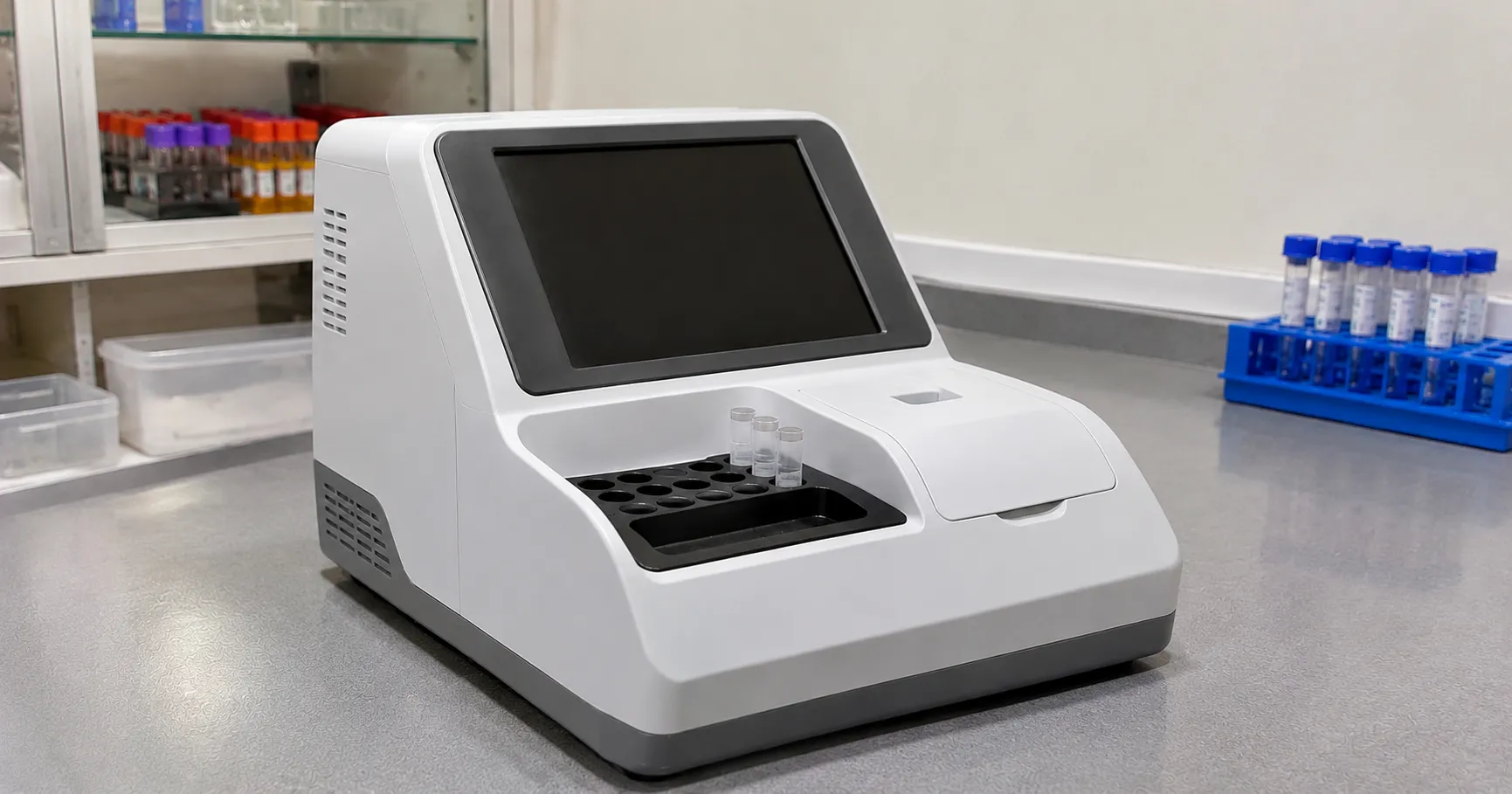
A coagulometer is a laboratory analyser that measures how long a blood plasma sample takes to clot under defined conditions, producing routine coagulation results such as the prothrombin time (PT/INR), activated partial thromboplastin time (APTT), thrombin time and fibrinogen. It works by mixing plasma with a reagent that triggers clotting, then timing the moment a clot forms using an optical or mechanical detector. For a laboratory buyer the core questions are the detection method, the test menu, throughput and how the analyser handles difficult or lipaemic samples.
The clotting time itself is the measurement. What varies between instruments is how reliably they spot the endpoint, how many samples they process, and how much manual work the reagents and workflow demand.
The Clotting Tests It Runs
The everyday menu covers the two screening times. The PT assesses the extrinsic and common pathways and is reported as an INR for monitoring warfarin therapy, using the reagent's International Sensitivity Index to standardise results between laboratories. The APTT assesses the intrinsic and common pathways and is used for heparin monitoring and screening for factor deficiencies. Beyond these, coagulometers run thrombin time, fibrinogen by the Clauss method, D-dimer, and specific factor assays on more capable platforms. A companion article covers fibrinogen analysers in depth, since fibrinogen is often assayed on the same instrument.
Optical Clot Detection
Optical, or photo-optical, detection is the most common method on automated analysers. A light source shines through the sample cuvette and a detector measures changes in transmitted or scattered light as fibrin forms and the plasma turns from clear to turbid. The instrument records the time from reagent addition to a defined change in optical signal as the clotting time. Optical detection supports high throughput and a broad menu including chromogenic and immunoturbidimetric assays, but it can be disturbed by lipaemic, icteric or haemolysed samples that already scatter light, so good instruments include correction or alternative wavelengths.
Mechanical Clot Detection
Mechanical, or electromechanical, detection measures the physical change in the sample as it clots rather than an optical one. In one common design a steel ball oscillates in the cuvette and the analyser detects when rising viscosity slows or stops its movement; in another, magnetic sensing tracks a moving element that the forming clot restrains. The key advantage is that mechanical detection is largely unaffected by sample colour or turbidity, so it copes well with lipaemic and icteric plasma. It typically supports the core clot-based tests rather than the full chromogenic menu, which is why many laboratories value it for difficult samples.
Reagents and Standardisation
Coagulation results depend heavily on reagents. PT uses a thromboplastin reagent whose ISI value determines how the ratio converts to an INR, so laboratories must enter the correct lot-specific ISI and verify the instrument-reagent combination. APTT uses an activator and phospholipid reagent, and different formulations vary in heparin and lupus sensitivity. Fibrinogen, factor assays and D-dimer each need matched reagents and calibrators. Because reagents drive both accuracy and running cost, the reagent system a coagulometer ties you into is as important as the hardware.
Automation and Throughput
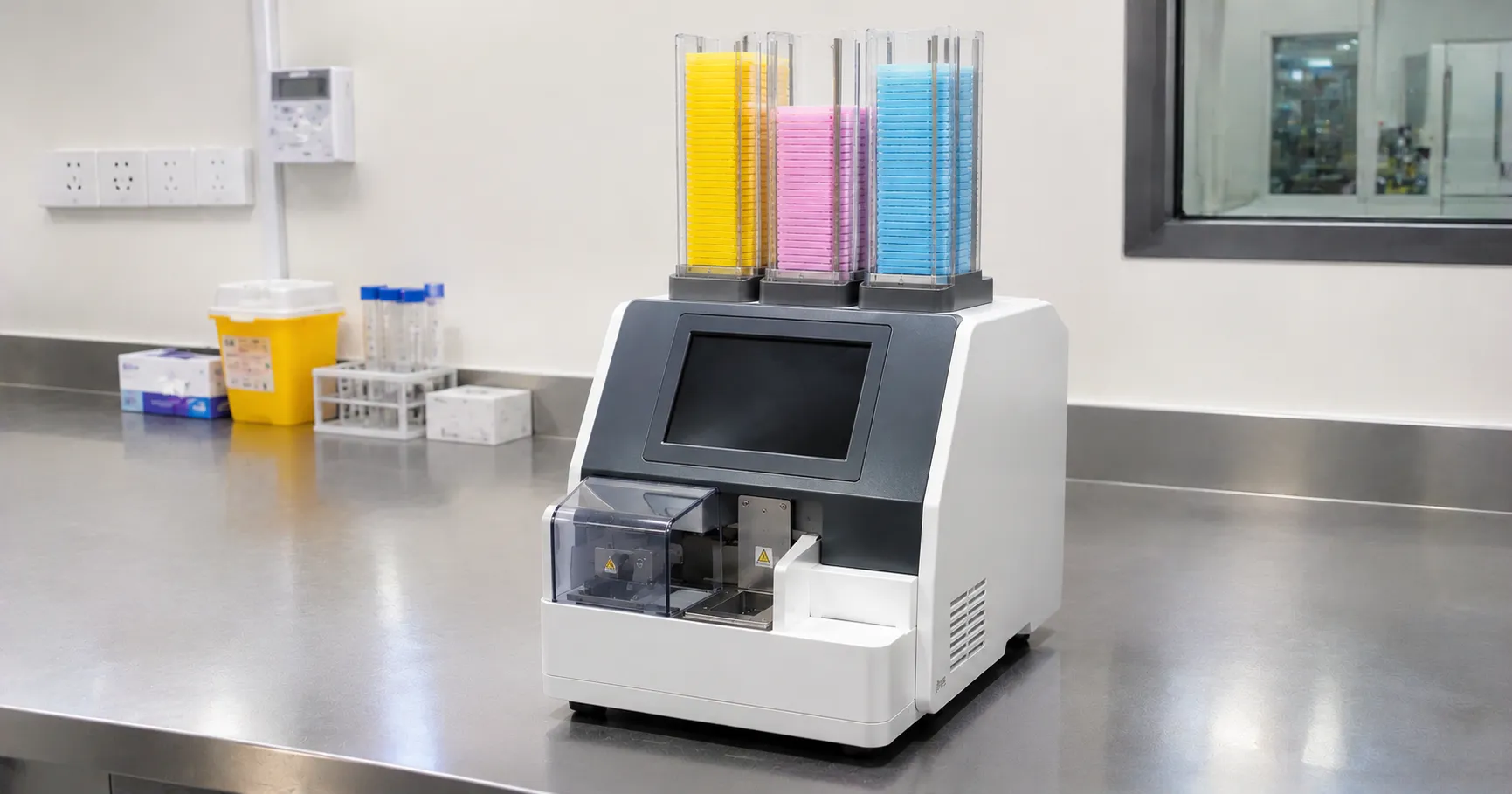
Analysers range from compact semi-automated benchtop units, where the operator pipettes samples and reagents and the instrument times the clot, to fully automated random-access systems with onboard reagent storage, automatic sample handling, cap piercing and continuous loading. Higher automation cuts hands-on time, reduces pipetting error and suits busy laboratories running hundreds of tests a day. Consider samples per hour, the number of channels, reflex and repeat handling, and whether the platform integrates with the laboratory track and information system. To arrange consistent reagent and consumable supply, our buyer services can help.
Standards, Regulation and Quality
A coagulometer is an in vitro diagnostic device and should carry UKCA or CE marking with MHRA support for the UK market. Electrical and safety design follows the IEC 61010-1 family for laboratory equipment, and the laboratory runs to ISO 15189 for quality and competence, covering calibration, internal quality control and traceability of the INR. Confirm the supplier provides the performance and technical documentation your accreditation assessors will request, and that the instrument supports the control and calibrator materials your quality scheme uses. General device guidance is published by the MHRA.
Quality Control and Calibration
Coagulation testing needs disciplined quality control: normal and abnormal control plasmas run regularly, PT and APTT verified across the reporting range, and fibrinogen and factor assays calibrated against reference plasma. INR reporting demands correct ISI entry and, ideally, local verification so warfarin monitoring is reliable. Participation in an external quality assessment scheme confirms comparability with other laboratories. Build in routine maintenance such as cuvette handling, probe cleaning and reagent management, and check the analyser flags results affected by clot detection problems or short sample.
Sample Considerations
Samples are citrated plasma, collected in tubes with the correct citrate ratio and centrifuged to platelet-poor plasma before testing. Under-filled tubes, clotted samples and a wrong anticoagulant ratio all distort clotting times, so pre-analytical control is essential. Lipaemic and icteric samples challenge optical detection, which is where a mechanical channel or the instrument's interference correction earns its place. Ask how the analyser detects and flags short samples, small clots and interference, because silent errors in coagulation results carry real clinical weight.
Matching the Analyser to the Setting
The right analyser depends on your PT/APTT and specialist-assay workload. A large hospital haematology laboratory needs a fully automated, high-throughput coagulometer with a broad menu, track integration and backup capacity. A district general laboratory may run a mid-range automated analyser covering PT, APTT, fibrinogen and D-dimer with room for occasional factor assays. Smaller or near-patient settings sometimes use compact analysers or point-of-care INR devices, which a separate article on portable coagulation analysers covers. Match menu, throughput and resilience to your workload and to how much testing you refer elsewhere.
Procurement Checklist
Before choosing a coagulometer, confirm the following:
-
Detection method, optical, mechanical or both, suited to your sample mix and menu.
-
Test menu covering PT/INR, APTT, fibrinogen and any D-dimer or factor assays you need.
-
Throughput and automation, samples per hour and random-access capability matched to demand.
-
Reagent system cost, shelf life, onboard stability and ISI management for INR.
-
Interference handling for lipaemic, icteric and haemolysed samples, with clear flags.
-
UKCA or CE conformity plus records that support your ISO 15189 scope.
-
QC and EQA compatibility, with suitable control and calibrator plasmas.
-
Service, uptime and spares, including engineer response and backup arrangements.
Total Cost of Ownership
A coagulometer's lifetime cost is dominated by reagents, controls, calibrators and cuvettes rather than the instrument itself, so the reagent commitment and cost per reportable test deserve close scrutiny. Automation reduces staff time and error at busy sites, while a smaller laboratory may prioritise lower fixed costs and a simpler menu. Uptime matters because coagulation results are often urgent, so factor in service response and whether you need backup capacity. Compare reagent pricing, expected volumes and support together. To weigh up coagulometers and coagulation reagents, talk to the MediGear team.
Conclusion
A coagulometer measures plasma clotting times such as PT/INR and APTT by triggering clot formation and timing the endpoint with optical or mechanical detection. Choose on detection method, test menu, throughput, reagent system and interference handling, and confirm UKCA or CE marking and ISO 15189 support. To specify the right coagulometer for your laboratory, contact MediGear.
Disclaimer
This article is for informational purposes only. It is published by MediGear (medigear.uk) for general information and procurement guidance, and is not clinical, diagnostic, treatment, technical, engineering, legal or regulatory advice, nor a product endorsement, guarantee or substitute for professional assessment. MediGear does not provide medical consultations. Buyers should consult their clinical, biomedical, estates and regulatory contacts, and the manufacturer's documentation, and independently verify all specifications, certifications, compatibility and suitability before purchase. Specifications, certifications and availability are correct at the time of publication and may change without notice. MediGear is a medical-equipment distributor and does not sell medicines or pharmaceutical products.