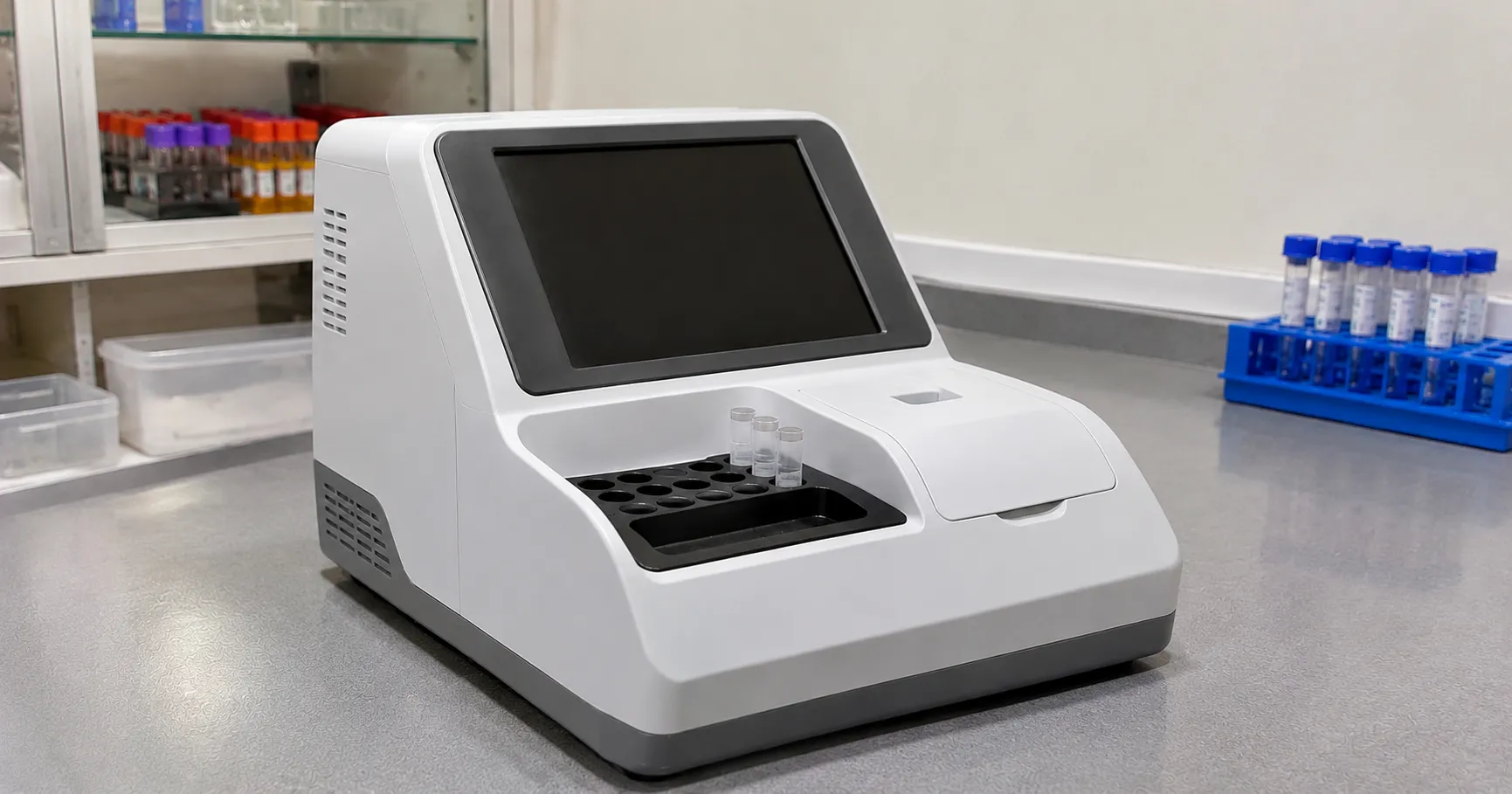

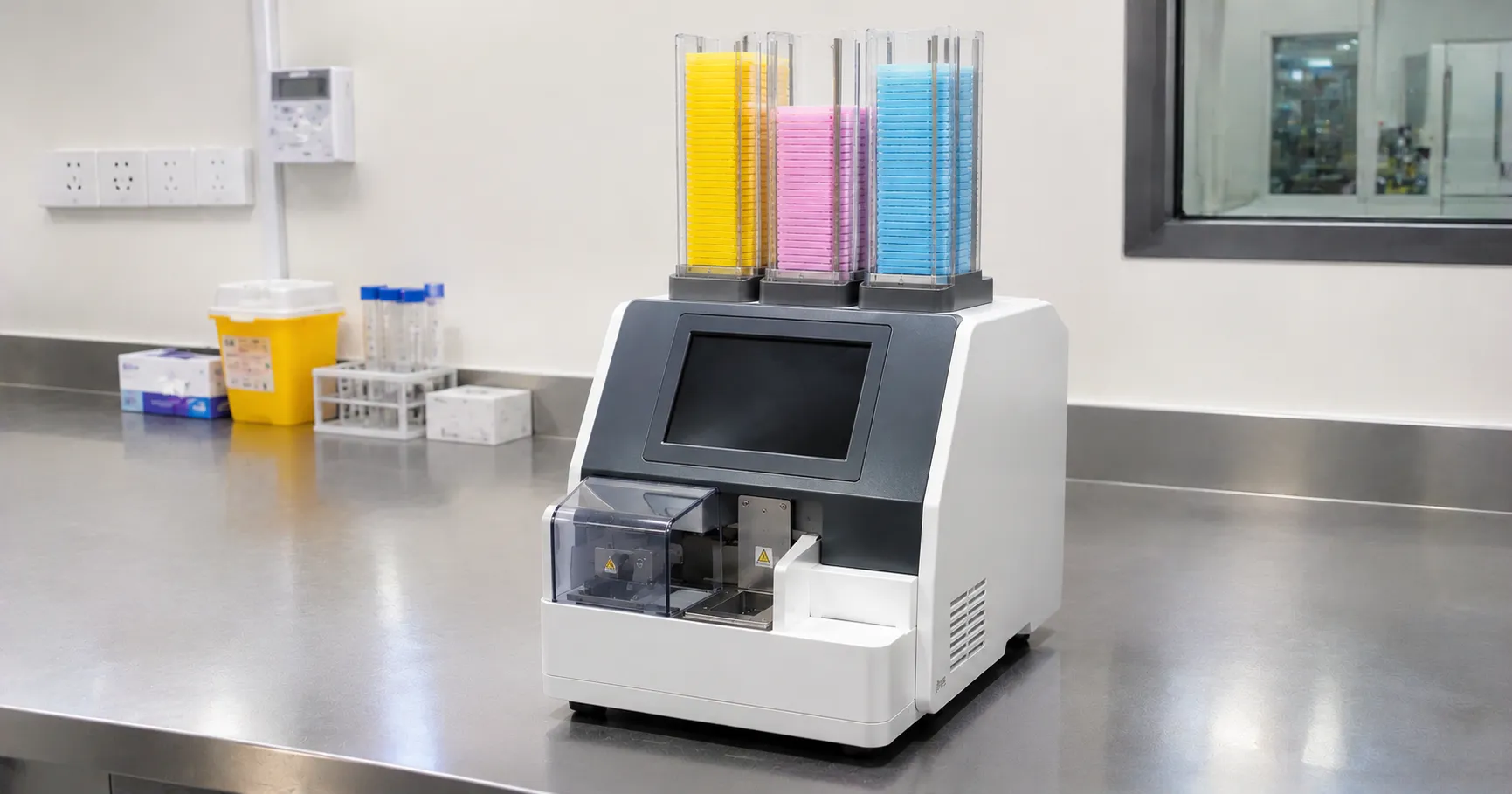
A cassette printer is a benchtop device that marks histology tissue cassettes on demand at grossing, printing the case number, block identifier and often a barcode directly onto the cassette's angled writing face in solvent-resistant ink. It replaces hand-writing or pencil embossing, which are slow, illegible and prone to error, and it does so just in time — one cassette printed as the specimen is placed in it — so the label always matches the tissue it holds.
This article is about the cassette-marking hardware and its chemical-resistant printing. The separate system that labels sample tubes and slides across the specimen journey is covered in its own article; here the focus is the cassette itself.
From Hand-Writing to Automated Marking
For decades cassettes were labelled by hand in pencil or with a solvent-proof pen, or embossed on a mechanical writer. Handwriting is slow, varies between staff and becomes unreadable after years in the archive, and a misread digit sends a block to the wrong case. Automated cassette printing removes that variability: the identifier is rendered in a consistent machine font, printed at the moment of need and, crucially, drawn from the laboratory information system rather than copied by hand. That single change closes one of the oldest gaps in histology, where a transcription slip at cut-up could follow a specimen all the way to the report.
Why the Cassette Marking Is Hard to Get Right
A tissue cassette does not have an easy life. After grossing it is plunged through a tissue processor into a sequence of alcohols, xylene or xylene substitutes, and molten paraffin wax, often at raised temperature, over many hours. Any marking on it must survive that gauntlet unchanged and stay crisply readable months or years later in the archive. Ordinary ink smears or dissolves in the first solvent bath. Cassette printers therefore use specially formulated pigment that bonds to the plastic and resists alcohol, xylene and heat — the single most important property of the whole device.
Printing Technologies
Two marking methods dominate. Inkjet cassette printers fire droplets of solvent-resistant pigment ink onto the cassette face, giving fast, flexible printing of text and barcodes with no contact. Thermal-transfer and drum-based systems press or fuse a resin onto the surface. Some units use a fine-resolution print head that can render a two-dimensional barcode small enough to sit on the cassette's limited writing area. Resolution matters: the face is only a few millimetres tall, so the printer must place legible characters and a scannable barcode in that space, at the angle the cassette is read.
On-Demand Versus Batch Marking
The value of a cassette printer is on-demand printing — each cassette produced at the instant of need, driven by the worklist. That removes the dangerous habit of pre-labelling a tray of cassettes in advance, where a mismatch between cassette and specimen can go unnoticed. The printer pulls the next case identifier from the laboratory information system, prints it, and presents the cassette to the operator. Automated hoppers or magazines hold a stock of blank cassettes, feed them one at a time to the print station and drop the finished cassette ready for tissue, sustaining a steady throughput during busy cut-up.
Barcodes and Positive Identification
Printing a linear or two-dimensional barcode on the cassette turns it into a scannable object that the processing, embedding and microtomy stations can read back. Scanning the cassette at each step confirms the right block is in the right place and links it to the case in the information system, cutting transcription errors and supporting the chain-of-custody traceability expected under ISO 15189 accreditation for medical laboratories. Block and specimen misidentification is a recognised patient-safety risk, of the kind highlighted in NHS safety guidance, and a scannable cassette is a direct control against it. A data-matrix code packs the identifier into a tiny footprint that suits the small cassette face better than a long linear barcode.
Colour Coding and Cassette Compatibility
Laboratories often colour-code cassettes to flag specimen types, urgency or workflow, so a printer should accept the full range of coloured cassettes without mis-feeding, and print legibly on each colour. Cassette shape varies too — different lid angles, biopsy versus standard formats, mesh or slotted designs — so confirm the printer handles the cassette styles the laboratory actually uses. A wrong-format cassette that jams the feed stops cut-up, so match the magazine and print station to your consumable range before committing.
Quality Checks Before Tissue Goes In
A printed cassette is only useful if the marking is right and readable, so a good workflow builds in a quick verification. Many systems let the operator confirm the printed cassette against the on-screen case before tissue is placed, and a downstream scan at embedding checks the barcode still reads after processing. Periodic print-quality checks — looking for faded characters, missing rows or a barcode that will not scan — catch a tiring print head before it produces an unreadable archive block. Building these small checks into the routine turns the printer from a convenience into a genuine safeguard against misidentification.
Integration, Throughput and Reliability
A cassette printer sits at the grossing bench and must keep pace with dissection, so print speed and hopper capacity matter for high-volume laboratories. It should integrate cleanly with the laboratory information system so identifiers flow automatically rather than being keyed in. A compact footprint fits the crowded cut-up bench, and quiet running suits a shared room. Some laboratories pair the cassette printer with a matching slide printer from the same supplier so both share one driver and consumable supply chain. Consider whether one printer per station or a shared unit fits the layout, and whether a backup device is warranted so a single failure does not halt the whole cut-up workflow.
Consumables, Servicing and Total Cost
Running cost is dominated by ink or resin cartridges and by the blank cassettes themselves, so factor cartridge yield and price into the comparison, not just the purchase price. Print heads need periodic cleaning and eventual replacement; a self-cleaning cycle reduces downtime. Ask about maintenance contracts, response times and spares availability, because a printer at the head of the workflow is a single point of failure. Standardising the printer and cassette brand across a network simplifies training, consumable stock and support, and keeps a validated spare within easy reach.
Procurement Checklist
Before specifying a cassette printer, confirm the following:
-
Solvent and heat resistance of the marking, verified against alcohol, xylene or substitute, and molten paraffin.
-
On-demand printing driven by the LIS so each cassette is produced just in time with the correct identifier.
-
Barcode capability, including a data-matrix option small enough for the cassette writing face.
-
Cassette-format and colour compatibility across the biopsy, standard and coloured cassettes the laboratory uses.
-
Throughput and hopper capacity matched to peak cut-up volume, with a backup plan for failures.
-
LIS integration and scanning at downstream stations for end-to-end block traceability.
-
Consumable cost, print-head servicing and spares assessed over a realistic service life.
Conclusion
A cassette printer is judged on one thing above all: does its marking survive the processor and stay legible for the life of the archive block. Add on-demand printing tied to the information system, a barcode that fits the tiny cassette face, and compatibility with your cassette range, and you have a device that removes a real source of specimen error. To compare cassette printers, ink chemistries and LIS integration, contact MediGear or register through our buyer services.
Disclaimer
This article is for informational purposes only. It is published by MediGear (medigear.uk) for general information and procurement guidance, and is not clinical, diagnostic, treatment, technical, engineering, legal or regulatory advice, nor a product endorsement, guarantee or substitute for professional assessment. MediGear does not provide medical consultations. Buyers should consult their clinical, biomedical, estates and regulatory contacts, and the manufacturer's documentation, and independently verify all specifications, certifications, compatibility and suitability before purchase. Specifications, certifications and availability are correct at the time of publication and may change without notice. MediGear is a medical-equipment distributor and does not sell medicines or pharmaceutical products.