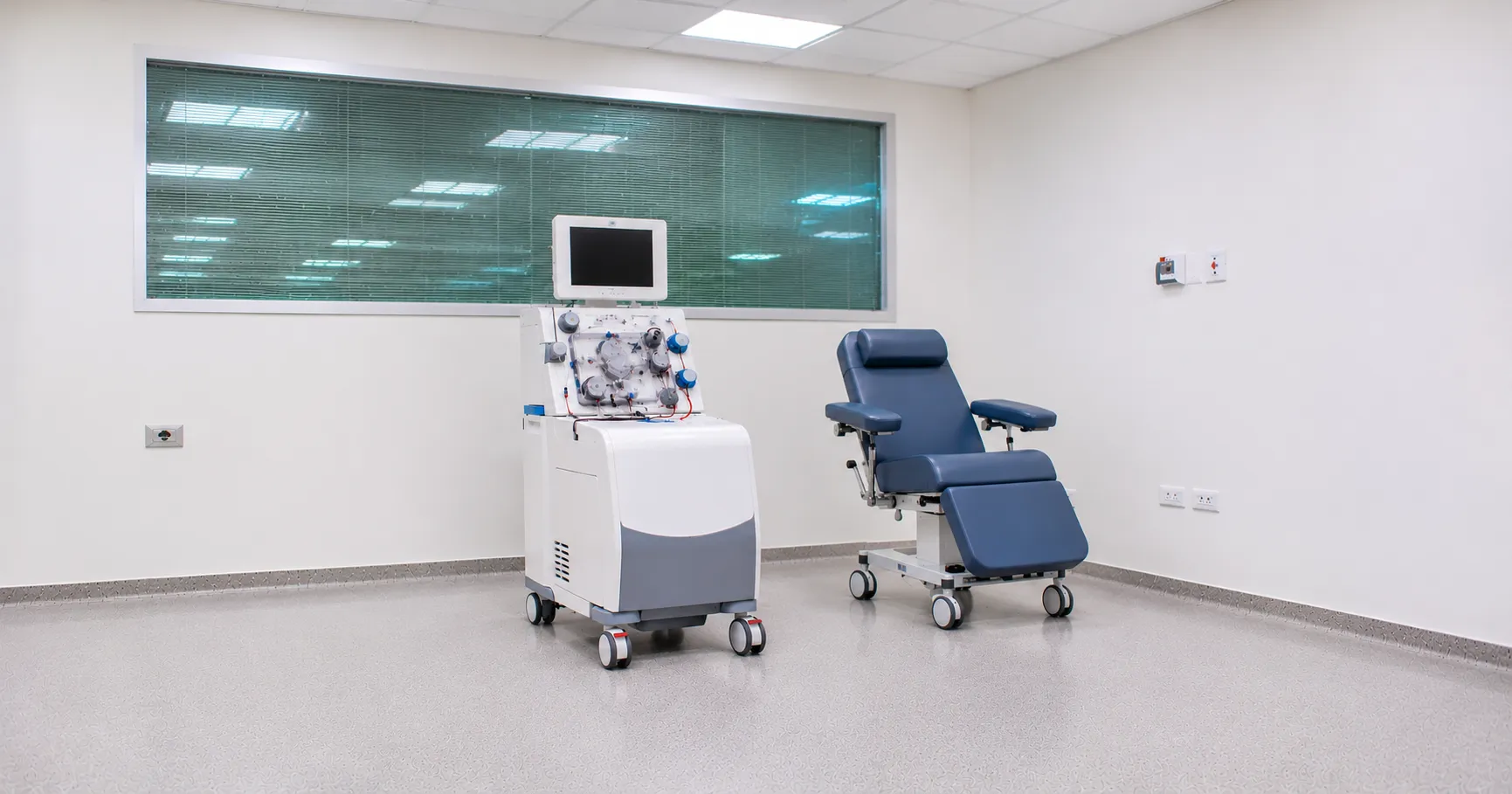
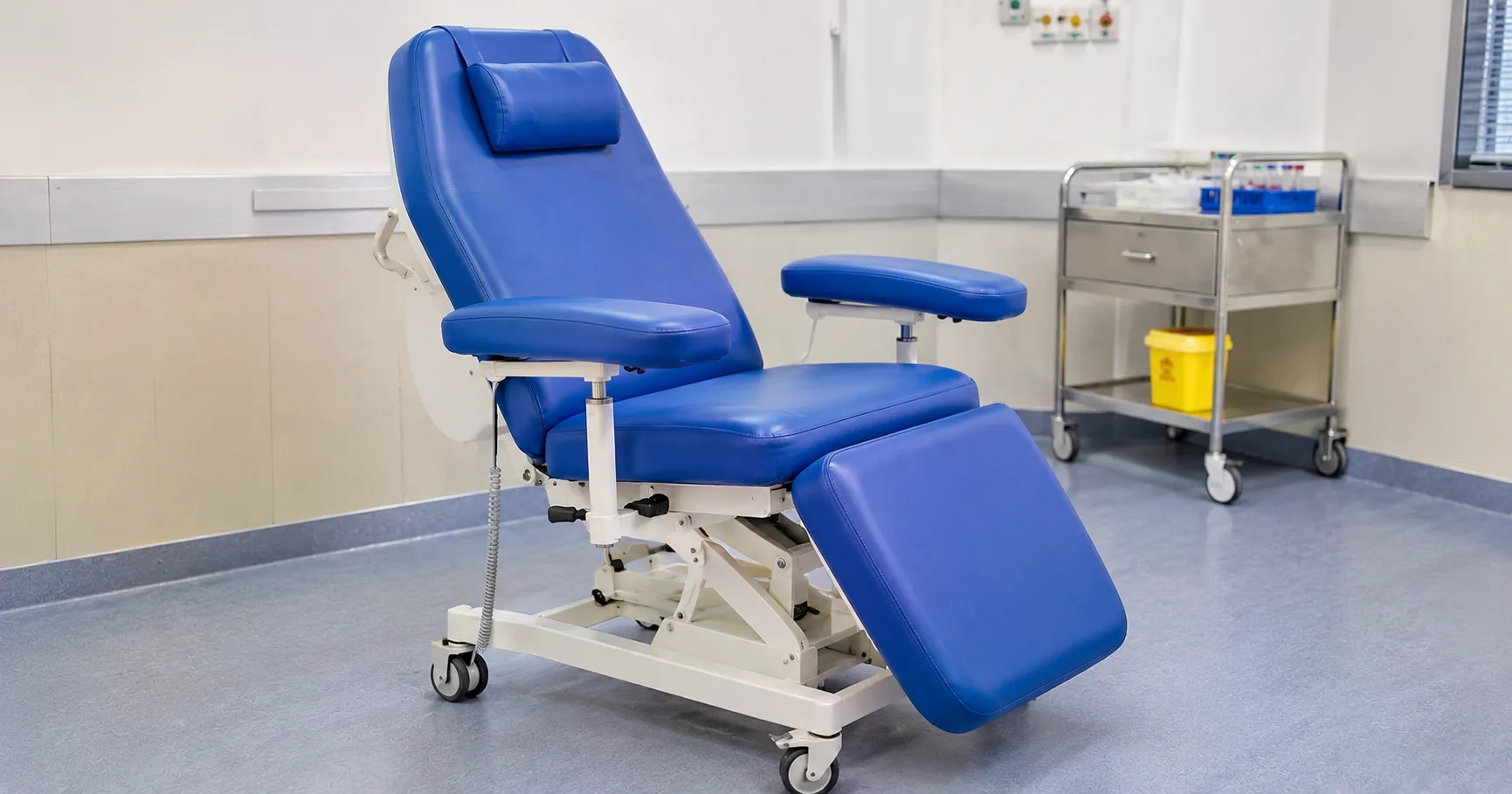
A donor chair is a reclining, adjustable phlebotomy couch designed to support a blood donor comfortably and safely throughout collection and to let staff respond quickly if the donor feels faint. It combines a supportive seat, adjustable armrests that present the arm for venepuncture, and a backrest and leg section that recline — often fully flat and into a head-down Trendelenburg tilt — so a donor showing signs of a faint can be laid down at once. For a blood-service or clinic buyer, a donor chair is judged on the recline mechanism, donor and staff safety features, cleanability, weight capacity and durability under heavy daily use.
The chair is deceptively important. Donor comfort and confidence affect return-donation rates, and rapid, safe positioning is the front-line response to the most common adverse event in donation: the vasovagal faint.
Why the Donor Chair Matters
Most donation reactions are vasovagal — a drop in blood pressure and heart rate that can cause light-headedness or fainting. The single most effective immediate response is to lower the donor's head and raise the legs to restore cerebral perfusion. A chair that reclines quickly into a flat or head-down position, ideally in one smooth movement, lets staff manage a reaction before it becomes a fall or injury. Comfort also matters for its own sake: a relaxed, well-supported donor is less likely to react and more likely to come back, so the chair contributes directly to a safe, positive donor experience.
Recline and Positioning
The defining feature is a smooth, controllable recline from an upright or semi-reclined donating position to fully flat and into Trendelenburg. Two mechanisms are common:
-
Manual recline — gas-strut or lever operated, simple and with no power dependency, relying on staff to adjust the position.
-
Electric (powered) recline — motorised positioning with hand or foot controls, allowing effortless, precise adjustment and rapid emergency recline, valuable for staff ergonomics and heavy throughput.
Whatever the mechanism, the priority is that a donor can be moved head-down fast and safely, and that the donating position presents the arm comfortably for the phlebotomist.
Armrests and Arm Support
Good arm support is central to a clean venepuncture and a comfortable donor. Height- and angle-adjustable armrests position the arm so the antecubital vein is accessible and supported, keeping it still during collection. Wide, padded armrests spread the donor's weight and reduce fidgeting; some fold or swing away to let the donor get in and out and to give staff clear access in an emergency. The ability to set the arm at the right height for a range of donor sizes, and for both arms, makes the phlebotomist's job easier and the draw more reliable.
Comfort and Ergonomics
Comfort comes from generous, contoured padding, a supportive backrest and headrest, and adequate width and length to suit a wide range of body sizes. A footrest or full-length leg section supports the legs and aids the head-down position. Because donation takes several minutes and the donor may be anxious, a chair that feels stable and secure, with no pinch points and smooth adjustment, helps keep the donor relaxed. Staff ergonomics matter too: an adjustable donating height lets the phlebotomist work without stooping, reducing musculoskeletal strain across a busy session.
Safety Features
Safety design protects both donor and staff. Look for a stable, wide base that resists tipping even in full recline with the donor moving, secure locking of the chosen position, and controls that cannot be knocked into an unwanted movement. On powered chairs, a rapid emergency-recline function and a battery or manual override guard against power failure mid-reaction. Smooth, closed surfaces with no finger-traps reduce injury risk. A stated safe working weight capacity that comfortably covers your donor population is essential, and the chair should stay stable across its whole recline range.
Powered Chair Controls and Accessories
On powered chairs the control layout affects both safety and workflow. Look for clearly marked hand or foot controls, a dedicated one-touch emergency-recline (or “faint”) button, and controls positioned so staff can reach them while attending the donor but donors cannot trigger them accidentally. Useful ancillary fittings include an integrated or clip-on drip pole for fluids, a holder for the collection mixer or scale, a waste and sharps tray within reach, and a paper-roll or wipe-clean headrest cover. These fittings keep collection tidy and within the phlebotomist's reach, and their availability as factory options is worth checking rather than improvising later.
Cleanability and Infection Control
Between donors the chair is wiped down, so upholstery and surfaces must tolerate repeated cleaning and disinfection without cracking or degrading. Look for seamless, non-porous, wipe-clean upholstery — typically a durable medical-grade vinyl — with minimal seams and crevices where fluids or contaminants could collect. Removable or easily accessible surfaces make thorough cleaning quicker between donors. Materials that resist blood, alcohol and standard disinfectants keep the chair serviceable through years of frequent decontamination and support the site's infection-control policy.
Mobility, Fixed and Mobile-Session Use
Requirements differ by setting. A fixed donor centre may use robust, static or castored chairs arranged in a donation floor, prioritising comfort and durability. A mobile session in a community hall or bloodmobile needs chairs that fold or dismantle, are light enough to transport and set up quickly, and remain stable on uneven floors. Castors with reliable brakes help reposition chairs for cleaning and access. Match portability and weight to how and where the chairs will be deployed, and check they set up and pack down quickly if they travel.
Standards, Regulation and Servicing
A donor chair used in a clinical setting should be built to relevant furniture and, where powered, medical-electrical safety expectations, carrying UKCA or CE marking where it qualifies as a medical device, with powered versions following the IEC 60601-1 family. Workplace equipment and manual-handling considerations fall under the Health and Safety Executive regime, and blood establishments operate under wider quality standards. Buyers should confirm the load rating, electrical safety and testing regime, and the availability of servicing, spares and replacement upholstery to keep chairs in service for years.
Procurement Checklist
Before choosing donor chairs, confirm the following:
-
Rapid, smooth recline to fully flat and Trendelenburg for reaction management.
-
Recline mechanism — manual for simplicity or powered for ease and emergency speed, with override.
-
Adjustable, supportive armrests presenting the arm well for a range of donors.
-
Safe working weight capacity covering your donor population, stable across full recline.
-
Wipe-clean, seamless upholstery resistant to blood, alcohol and disinfectants.
-
Stability and safety — wide base, secure locking, no finger-traps.
-
Portability suited to fixed centres or mobile sessions, with braked castors if mobile.
-
UKCA or CE marking where applicable, servicing, spares and replacement upholstery.
Total Cost of Ownership
Donor chairs are a long-life capital item, so durability and serviceability drive lifetime value more than purchase price. Heavy daily use and constant cleaning wear upholstery and mechanisms, so replaceable covers, robust actuators and a reliable spares supply keep a chair in service for many years. A comfortable, safe chair also supports donor retention, which has its own value to a service. Weigh build quality, warranty and spares alongside price. To compare donor chairs and related blood-collection equipment, our team can help through MediGear buyer services.
Conclusion
A donor chair keeps blood donors comfortable and, above all, safe, reclining quickly to a head-down position to manage the vasovagal reactions that are donation's commonest adverse event. Choose on recline speed and mechanism, arm support, weight capacity, cleanability and stability, and confirm UKCA or CE marking where applicable. To specify the right donor chairs for your centre or mobile sessions, contact MediGear.
Disclaimer
This article is for informational purposes only. It is published by MediGear (medigear.uk) for general information and procurement guidance, and is not clinical, diagnostic, treatment, technical, engineering, legal or regulatory advice, nor a product endorsement, guarantee or substitute for professional assessment. MediGear does not provide medical consultations. Buyers should consult their clinical, biomedical, estates and regulatory contacts, and the manufacturer's documentation, and independently verify all specifications, certifications, compatibility and suitability before purchase. Specifications, certifications and availability are correct at the time of publication and may change without notice. MediGear is a medical-equipment distributor and does not sell medicines or pharmaceutical products.