
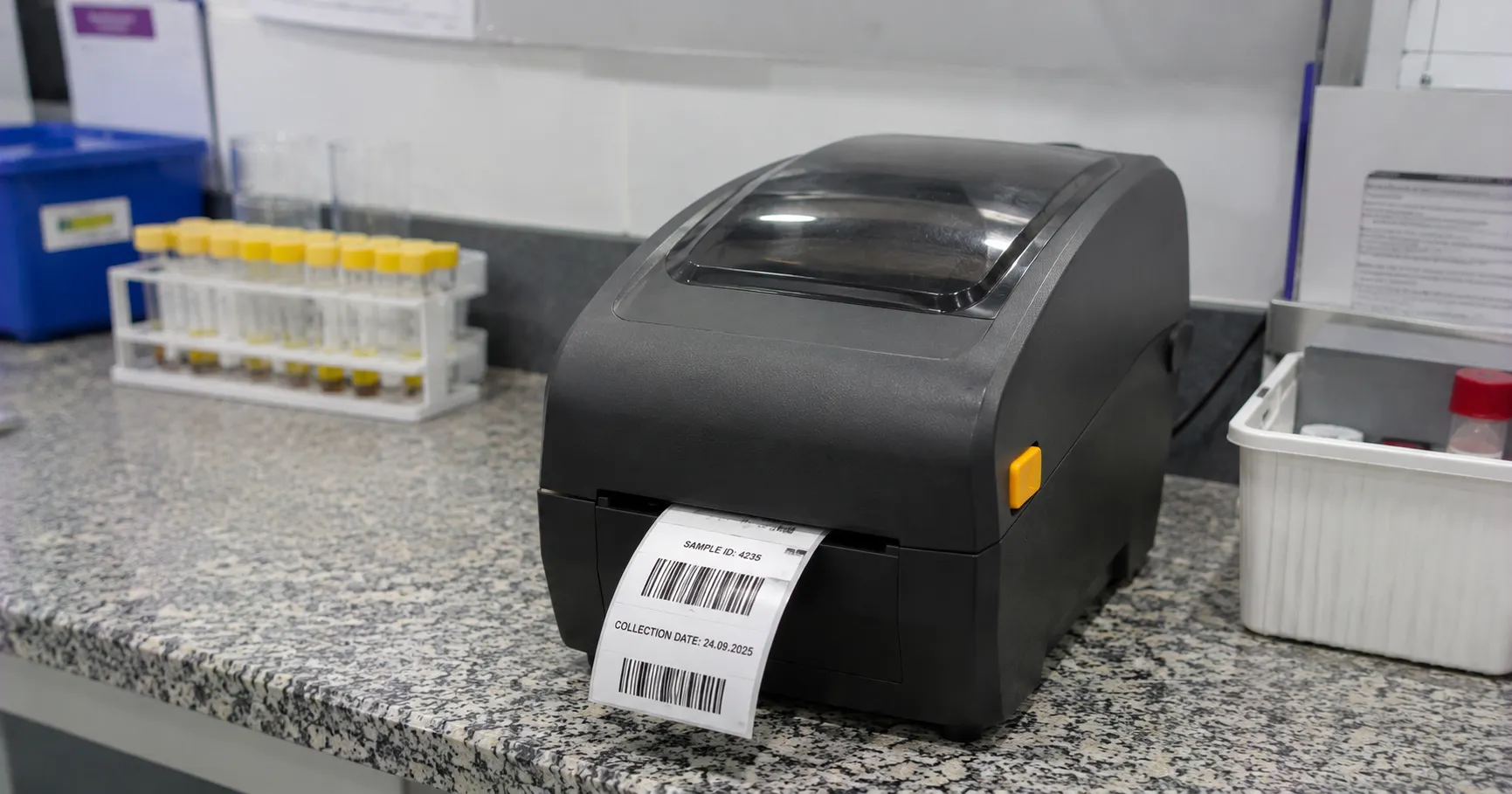
A barcode labelling system is the combination of printers, labels and software that produces machine-readable barcodes for sample tubes, slides and containers and links each one to a patient record in the laboratory information system. Its purpose is positive identification: every specimen carries a unique scannable code from collection to result, so the tube in the analyser and the slide under the microscope are provably the right patient's. Scanning replaces hand-reading and hand-typing, which are the largest sources of laboratory misidentification error.
This article covers the sample-labelling system across the specimen journey — tube and slide labels, barcode symbologies and information-system links — rather than the cassette-marking hardware used at grossing, which is a separate topic.
Positive Patient Identification
The core benefit is closing the identification gap between patient and result. When a sample is labelled at the point of collection with a barcode tied to the patient, and that code is scanned at every subsequent step, the system enforces a match rather than relying on a technologist reading a handwritten name. Mislabelled and misidentified specimens are a recognised patient-safety risk highlighted in NHS patient-safety guidance, and barcode identification is the principal engineering control against them. The label is the physical anchor of that whole chain.
Where Labelling Fits the Specimen Journey
A specimen passes through many hands: collection, transport, reception and accessioning, the analytical bench or the microtomy room, and finally the archive. A barcode labelling system touches each of those stages. At collection the tube is labelled and matched to the request; at reception the sample is booked in by scan; at the bench the analyser or the technologist scans to confirm identity before testing; and in the archive the code keeps the sample retrievable for years. Because the label travels the whole route, its durability and readability at every step are what determine whether the identification chain actually holds.
Linear and 2D Barcodes
Two symbology families are used. Linear (1D) barcodes, most commonly Code 128, encode a string of characters in a row of bars and suit a straightforward accession number on a reasonably sized label. Two-dimensional (2D) codes, chiefly Data Matrix, store far more data in a small square and can be read at any orientation, which matters on a narrow slide edge or a small paediatric tube where space is scarce. Data Matrix also carries built-in error correction, so a code remains readable even if part of the label is scuffed or partly obscured. Many laboratories now favour 2D on slides and small containers for exactly these reasons.
Tube Labelling and the Analyser
Primary-tube labels must wrap cleanly around curved glass or plastic, sit straight for the analyser's reader, and survive centrifugation, refrigeration and, for some assays, brief immersion. A skewed or bubbled label jams the track or fails to scan, so print quality and applicator accuracy are practical concerns, not cosmetic ones. Print-and-apply labellers that print the code and wrap it onto the tube in one action give the consistency automated analysers demand, and reduce the manual handling that introduces skew and misplacement.
Slide Labelling in Histology and Cytology
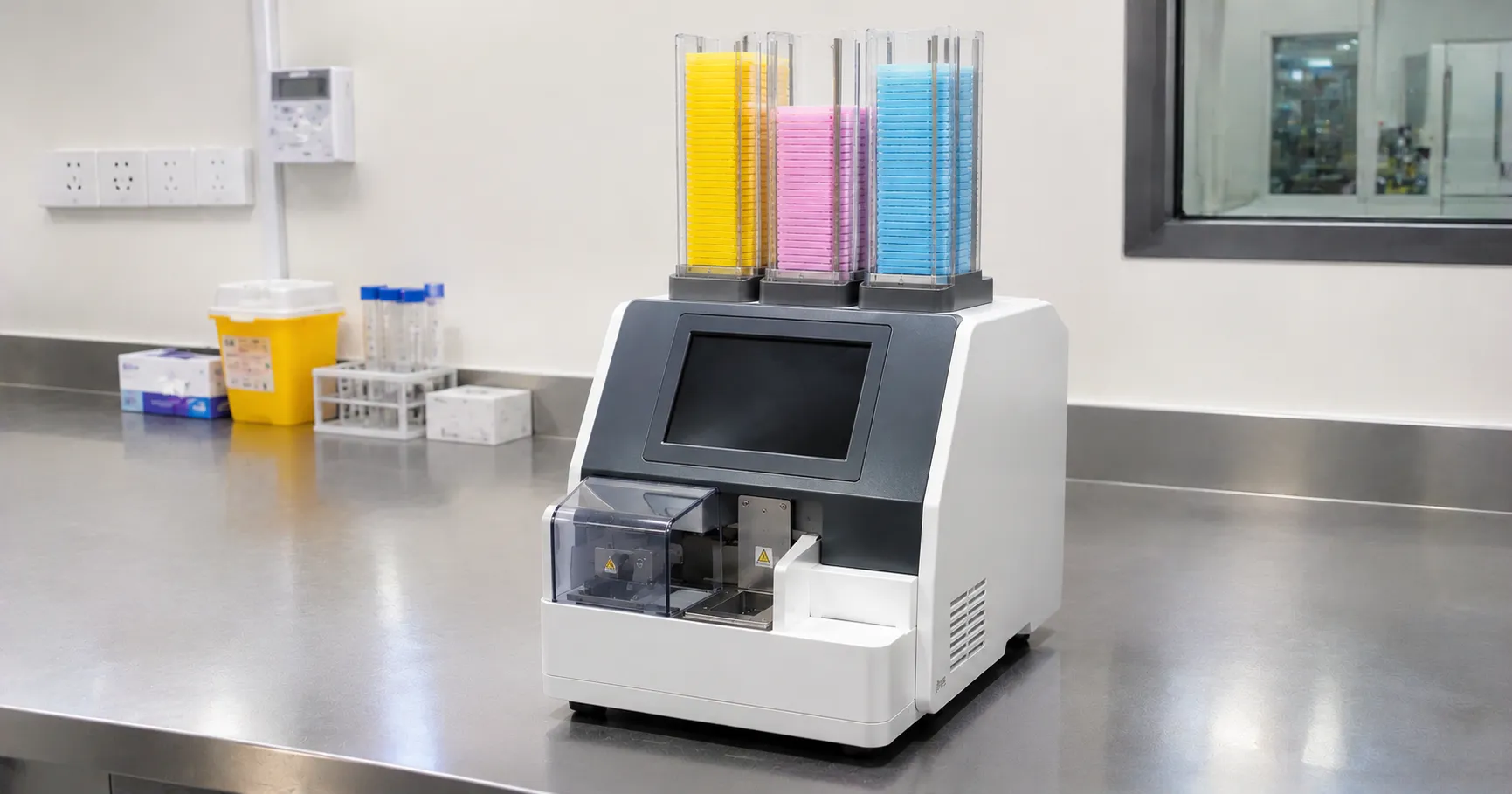
Slides pose a harder challenge than tubes. A microscope slide is small, and in histology and cytology it is bathed in xylene, alcohols and aqueous stains, then archived for years. Slide labels therefore need solvent-resistant print — typically a resin thermal-transfer ribbon — and adhesive that will not lift in staining reagents. On-demand slide printers mark the slide's frosted end with human-readable text plus a 2D barcode that microtomy and staining stations scan to confirm the section matches the block and the case, tightening traceability through the back end of the laboratory.
Integration With the LIS
A labelling system is only as good as its link to the laboratory information system. The LIS should generate the accession identifier, drive the printer, and receive every scan so specimen location and status update automatically. Bidirectional integration lets an analyser query the LIS by scanning the tube barcode and pull the requested tests without manual order entry. This end-to-end electronic chain underpins the sample traceability expected under ISO 15189 accreditation, and removes the transcription steps where errors creep in. Middleware and standard interfaces such as HL7 usually carry that traffic.
Printers, Media and Placement
Hardware ranges from central high-volume label printers in specimen reception to compact bench and phlebotomy-point printers and dedicated slide printers. Thermal-transfer printing with a resin ribbon gives durable, solvent-resistant labels, while direct-thermal media is cheaper but fades and is unsuitable for archived or reagent-exposed samples. Label material, adhesive and size must match the container and the storage conditions — freezer-grade adhesive for cold storage, small-format labels for microtubes. Getting media selection right prevents the peeling, fading and unscannable labels that undermine the whole system.
Central Versus Distributed Printing
Two deployment models exist. Central printing produces labels in specimen reception, where a high-volume printer handles the whole workload and staff apply labels as samples are booked in. Distributed printing places small printers at the point of collection — phlebotomy rooms, wards, clinics — so the tube is labelled with the patient present, which is the strongest form of positive identification because it removes the gap between drawing the sample and naming it. Many services blend the two, printing at collection where patient-side identification matters most and centrally for referred or aliquoted samples. The right mix depends on where samples originate and how far they travel before testing.
Deployment, Standards and Servicing
Rolling out barcode labelling touches phlebotomy, reception, the bench and the archive, so it needs planning across the whole path. Symbology and data format should be standardised — many laboratories align with GS1 conventions — so codes read consistently on every scanner. Budget for scanners at each station, printer servicing, ribbon and label stock, and validation that labels scan reliably after the reagents and temperatures they will face. Standardising printer models and media across a network simplifies support, spares and staff training, and keeps the identification chain unbroken.
Procurement Checklist
Before specifying a barcode labelling system, confirm the following:
-
Positive-identification workflow that labels at the point of collection and scans at every downstream step.
-
Symbology support for Code 128 and Data Matrix, with 2D for slides and small tubes.
-
Solvent-resistant slide labelling using resin thermal-transfer print and reagent-proof adhesive.
-
Tube-label durability through centrifugation, refrigeration and analyser handling, with accurate print-and-apply placement.
-
Bidirectional LIS integration via standard interfaces so orders and scans flow automatically.
-
Media matched to storage: freezer-grade adhesive and correct label sizes for every container type.
-
Standardisation and servicing: consistent symbology such as GS1, scanners at each station, and spares and ribbon supply.
Conclusion
A barcode labelling system is the backbone of specimen safety: it fixes a unique, scannable identity to every tube and slide and enforces a match with the patient record at each step. Judge it on durable, solvent-resistant labels, the right 1D and 2D symbologies, and a clean bidirectional link to the information system — then match the media to how each sample is stored. To design a tube and slide labelling system and integrate it with your LIS, talk to the MediGear team or register your requirements through our buyer services.
Disclaimer
This article is for informational purposes only. It is published by MediGear (medigear.uk) for general information and procurement guidance, and is not clinical, diagnostic, treatment, technical, engineering, legal or regulatory advice, nor a product endorsement, guarantee or substitute for professional assessment. MediGear does not provide medical consultations. Buyers should consult their clinical, biomedical, estates and regulatory contacts, and the manufacturer's documentation, and independently verify all specifications, certifications, compatibility and suitability before purchase. Specifications, certifications and availability are correct at the time of publication and may change without notice. MediGear is a medical-equipment distributor and does not sell medicines or pharmaceutical products.