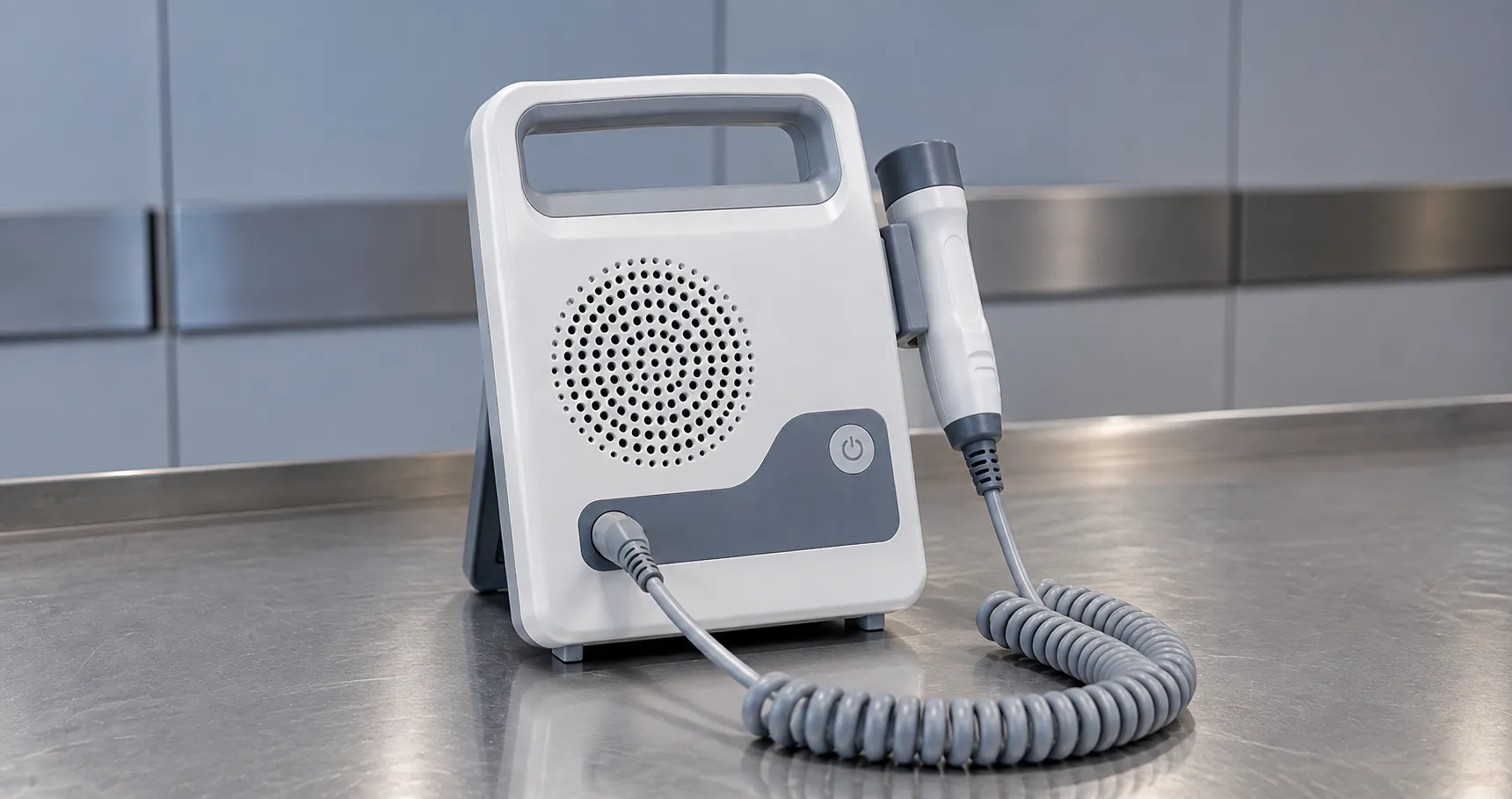
A vascular Doppler machine is a handheld continuous-wave device that sends ultrasound into a peripheral artery and turns the reflected signal into sound so that a clinician can hear blood flow they cannot feel. Held over the dorsalis pedis or posterior tibial artery, it confirms whether a pulse is present and what the flow sounds like — without producing any picture at all.
That last point is the whole story for a buyer. A vascular Doppler machine is an audible, non-imaging instrument. It is small, cheap and rugged; it lives in a pocket or on a trolley, and it does a job that a duplex scanner is far too big and expensive to do at the bedside: a quick, repeatable check that an artery is still flowing.
Continuous-wave, not imaging: the core principle
The machine uses two piezoelectric crystals in the probe tip — one transmitting sound continuously, one receiving. When the beam strikes moving red cells, the returning frequency shifts, and the electronics convert that Doppler shift into an audible tone through a loudspeaker or headphones. Because transmission is continuous rather than pulsed, the device cannot tell you the depth of a signal, which is why it produces no image. Instead, it gives an immediate, intuitive sound: a clear pulsatile swish over a healthy artery, or a muffled or monophasic note where disease has flattened the flow.
Reading the arterial waveform by ear and trace
A trained user does more than confirm a pulse is there. A normal peripheral artery gives a crisp triphasic signal — forward flow in systole, a brief reversal, then a small forward wave. As arterial disease progresses, that pattern degrades to biphasic and then to a soft, monophasic hiss. Many vascular Doppler machines add a small screen or printout showing the waveform as a trace, so you can document the character of the flow rather than hear it. Together, the sound and the trace tell the operator more than a fingertip ever could.
Probe frequency drives what you can assess.
Probe choice matters more than the console. An 8 MHz pencil probe is the general-purpose peripheral-artery workhorse, giving good sensitivity over the vessels of the foot, ankle and wrist. A 5 MHz probe penetrates deeper for oedematous limbs, obese patients or deeper vessels such as the femoral. A higher 10 MHz probe suits very superficial or fine vessels. Interchangeable probes on one handset are a genuine advantage, so check which frequencies a system supports and whether the probes you need are included rather than sold separately.
Pocket, bench and waterproof formats
Vascular Doppler machines come in several shapes for different work. A slim pocket unit with a built-in probe suits a community nurse checking foot pulses on a home visit. A bench or trolley model with a display, waveform trace and printer suits a vascular clinic or leg-ulcer service that needs a documented record. Fully waterproof, sealed handsets exist for settings where the device is wiped down constantly or used near wound irrigation. Match the format to where the assessing actually happens, because a fragile clinic unit will not survive daily domiciliary use.
Where the audible Doppler earns its place
The device turns up wherever a pulse needs confirming and imaging is not to hand. Community and district nursing teams use it in leg-ulcer and tissue-viability work; vascular and diabetic-foot clinics use it for rapid pulse checks; theatres and recovery use sterile-probe versions to confirm flow in a limb or a free flap after surgery. It is also the standard tool for measuring the pressures needed to calculate an ankle-brachial index; the index calculation itself is a separate assessment. Across all of these, the value is the same: an instant, portable answer to a simple question — is this artery flowing?
Standards and marking for a vascular Doppler
As a diagnostic ultrasound device, the vascular Doppler machine falls under the general medical electrical standard IEC 60601-1, with the specific standard for ultrasonic diagnostic equipment, IEC 60601-2-37, governing acoustic output and safety. It must carry UKCA or CE marking, and any supplier should hand over conformance documentation you can file. Device regulation, recalls, and field-safety notices sit with the Medicines and Healthcare products Regulatory Agency at mhra.gov.uk, which is worth checking before you standardise on a model. This guide, based on the manufacturer manual for continuous-wave Doppler units, the IEC 60601 standards family, and current UK regulatory guidance, is written for UK procurement and clinical-engineering teams.
Probe hygiene and infection control
The probe touches intact skin and, in wound work, sits close to broken skin, so it needs cleaning and low-level disinfection between patients using only manufacturer-approved agents. Ultrasound coupling gel is a consumable to budget for, and single-use gel sachets help in community work where cross-contamination is a concern. Sterile probe covers and single-use sterile probes exist for theatre use. Confirm the compatible-disinfectant list before choosing your wipes, because the wrong chemical can craze the probe lens and shorten its life.
Bashorten durability and running costs
The purchase price of a vascular Doppler machine is modest, so whole-life cost hinges on the small things. A pocket unit running on standard batteries avoids charging routines but adds a steady battery spend; a rechargeable model needs a charging habit and an eventual battery replacement. The probe is the fragile, expensive part—a dropped or cut probe cable is the most common failure—so weigh probe warranty and replacement cost heavily; gel, printer paper, and cleaning consumables round out the running cost. When you compare quotes, compare like for like and use MediGear to weigh suppliers on more than headline price.
How it differs from a duplex scanner
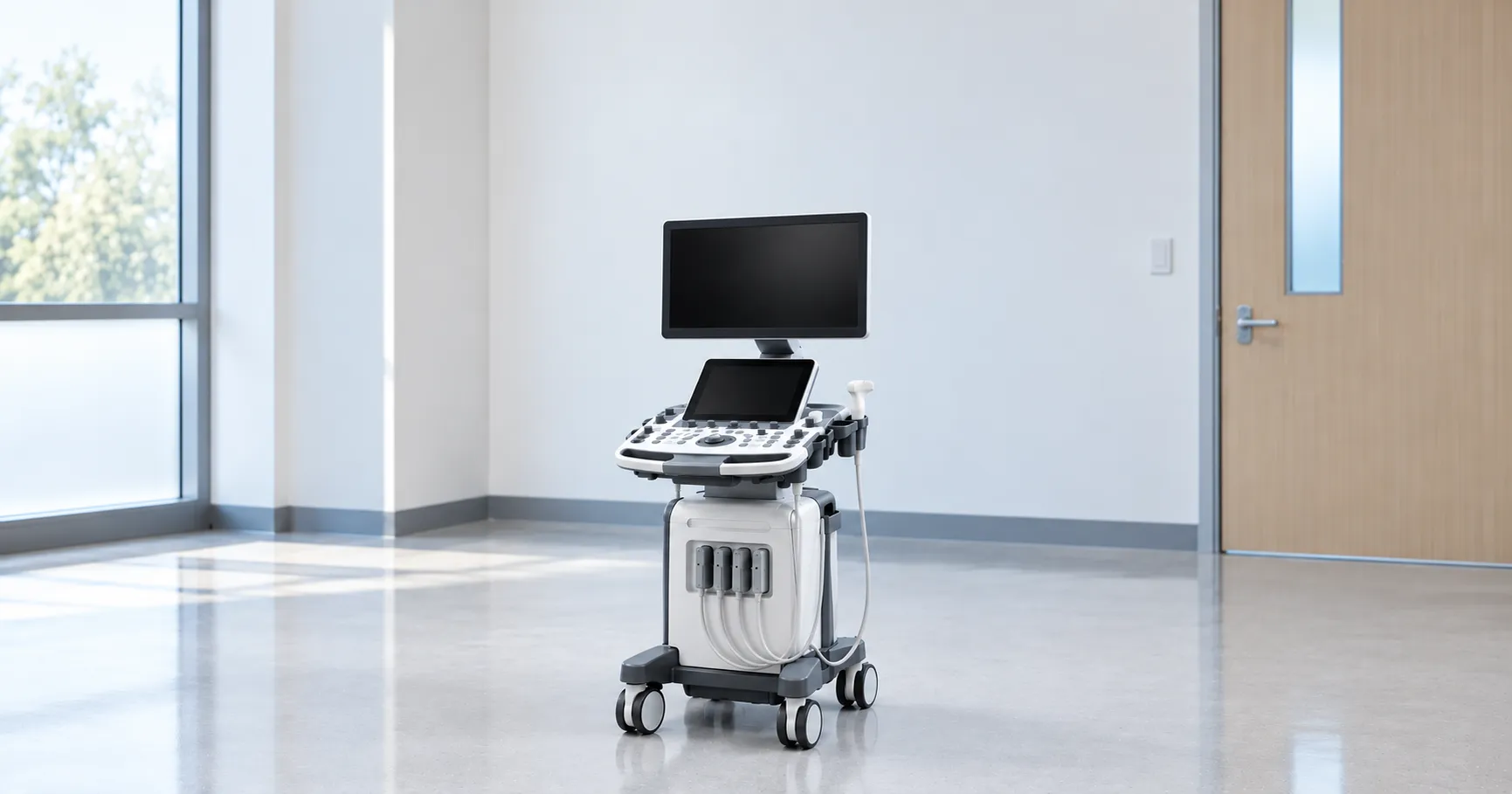
It is worth being clear about the boundary. A vascular Doppler machine gives sound and, at most, a waveform trace; it cannot show the vessel, locate a blockage or measure its length. A duplex ultrasound system does all of that with a real-time image and colour flow, but it is a large capital purchase needing a trained sonographer. The two are complementary, not competing: the handheld Doppler is the fast, portable pulse check at the bedside, and duplex is the detailed imaging study when the handheld raises a question. Buying a handheld Doppler expecting it to image is the classic specification error.
Documentation, records and connectivity
A pulse check only counts if it is recorded. Simpler pocket units leave the operator to write the finding in the notes; clinic-grade machines print or store the waveform so the trace goes into the record and can be compared over time. If your service tracks leg-ulcer or diabetic-foot patients longitudinally, a device that captures and exports the waveform is worth the extra outlay, because a documented change in the trace is more defensible than a remembered sound. Check how any stored trace leaves the device and whether it fits your record-keeping.
Trialling and choosing well
Before you standardise, put the shortlisted handsets in the hands of the nurses and clinicians who will use them every day, on real patients rather than an easy volunteer. Listen for signal clarity over a difficult foot, check the probe feels durable and the controls are usable with gloves on, and confirm the battery and charging routine fits community life. A vascular Doppler machine is a small purchase you use constantly, so reliability and probe durability matter more than any feature list. When you are ready to compare models and suppliers, MediGear can help you line up options on equal terms.
Before you buy a vascular Doppler machine
-
Probe frequencies that match your patients — 8 MHz for general peripheral arteries, 5 MHz for deeper or oedematous limbs.
-
Whether the probes you need are included, and the cost and warranty of a replacement probe.
-
Format fit — pocket for community work, bench with waveform trace and printer for a documented clinic record.
-
Waterproofing or sealing if the device faces constant wipe-down or wound-care use.
-
UKCA or CE marking and conformance to IEC 60601-2-37, with documentation supplied.
-
The manufacturer's approved disinfectant list and the ongoing spend on gel and consumables.
-
Battery type, charging routine and expected battery-replacement cost over the device life.
The bottom line on vascular Dopplers
A vascular Doppler machine is the simple, portable instrument that makes a peripheral pulse audible when it cannot be felt — sound and waveform, never a picture. Buy it for durability, the right probe frequencies and honest running costs, and be clear that it complements rather than replaces duplex imaging. If you are equipping a community or vascular service, MediGear can help you compare verified suppliers and probe options side by side.
Disclaimer
This article is for informational purposes only. MediGear (medigear.uk) publishes it for general information and procurement guidance; it is not clinical, diagnostic, treatment, technical, engineering, legal, or regulatory advice, nor a product endorsement, guarantee, or substitute for professional assessment. MediGear does not provide medical consultations. Buyers should consult their clinical, biomedical, estates, and regulatory contacts and the manufacturer's documentation, and independently verify all specifications, certifications, compatibility, and suitability before purchase. Specifications, certifications and availability are correct at the time of publication and may change without notice. MediGear is a medical-equipment distributor and does not sell medicines or pharmaceutical products.