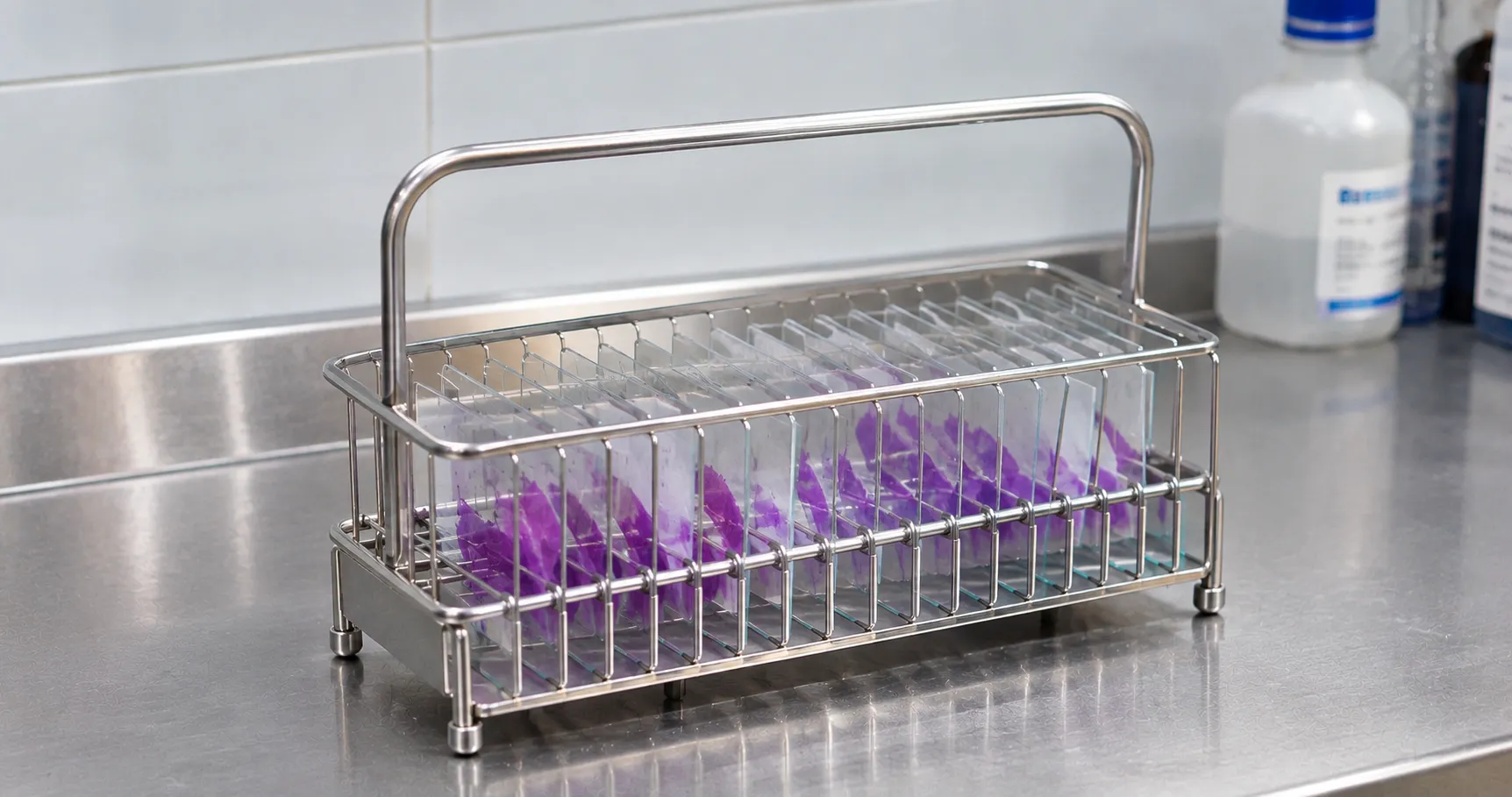
Slide staining racks are the holders, troughs and jars that let a laboratory carry microscope slides through a manual staining protocol — dipping them through fixative, stains, rinses and differentiators in sequence. In practice the system is a matched set: a rack that grips a batch of slides and a series of staining dishes or Coplin jars filled with the reagents, moved by hand or a simple carrier from one bath to the next. They are humble but essential consumables that underpin haematology, cytology, microbiology and histology benches.
For procurement, the questions are about throughput, chemical compatibility and durability. This guide sets out the main formats, the materials to specify and the practical points that decide value.
Why Manual Staining Still Matters
Automated stainers dominate high-volume histology, but manual staining remains everywhere: urgent single slides, Gram stains at the microbiology bench, special stains, teaching, research and any laboratory whose volumes do not justify an automated platform. Manual racks and jars are cheap, flexible and instantly available, with no queue or programming. They also give the scientist full control over timing, which some stains reward. A well-chosen set of racks and dishes is often the most cost-effective staining solution a small or medium laboratory can buy.
The Main Formats
Several formats coexist and most benches keep more than one. Coplin jars hold five to ten slides upright in a small reagent volume, ideal for single or small batches and for economical use of expensive reagents. Staining troughs and dishes take a removable slide rack of twenty to thirty slides for larger batches, using a shallow tank of reagent. Slide racks and carriers are the metal or plastic frames that hold the slides and lift the whole batch between baths in one movement. Draining boards, forceps and a compatible lid set complete the workflow.
Matching Rack to Dish
The rack and the dish must be a matched pair — a rack that does not seat cleanly in its trough wastes reagent and risks uneven staining. Buy them as a system, or confirm dimensional compatibility before mixing brands. Consider slide capacity per batch against your peak workload, and how many parallel reagent stations a full protocol needs, because a long special stain may tie up a whole row of dishes.
Materials and Chemical Compatibility
Material choice is the most important technical decision, because staining reagents include alcohols, xylene or xylene substitutes, acids and strong dyes. Borosilicate glass resists almost all solvents and is easy to clean, but is breakable. Polypropylene and PTFE are tough and light and handle most aqueous and alcoholic reagents, but some plastics craze or dissolve in xylene and other aromatic solvents. Stainless steel racks are durable and autoclavable but can react with certain acidic or metallic stains. Always match the material to your reagent list — a rack that is perfect for Romanowsky stains may fail in a clearing agent.
Where a single bench runs both aqueous and solvent-based protocols, many laboratories keep two dedicated sets rather than trusting one material across every reagent. Glass Coplin jars are often reserved for the solvent steps and clearing agents, with plastic troughs used for the aqueous Romanowsky and rinse stages. Segregating dishes this way protects the plastics from aromatic solvents and prevents solvent carryover contaminating water-based stains, and it makes the layout easier for staff to follow.
Specifications a Buyer Should Check
Beyond material and format, check slide capacity and slide thickness compatibility, because thicker or charged slides may not seat in a rack cut for standard 1 mm slides. Look at reagent volume per dish, since a deep trough uses more expensive stain than a Coplin jar. Confirm lids that limit evaporation and fume escape, stable non-tip bases, and handles that a gloved hand can grip. For frequently handled racks, corrosion resistance and the ease of labelling stations matter for day-to-day order.
Throughput, Safety and Decontamination
Manual staining throughput is set by batch size and protocol length, so a laboratory sizing a bench should count peak slides per session and buy enough parallel stations to avoid a bottleneck. Solvent stains must be used in a fume cupboard or on a ducted bench, and reagents disposed of as chemical waste under your local COSHH arrangements; the Health and Safety Executive sets the framework for handling hazardous substances at work. Racks and dishes need routine cleaning, and any item that contacts potentially infectious material must be decontaminated appropriately — glass and stainless items generally tolerate autoclaving, while some plastics do not.
Consumables, Durability and Total Cost of Ownership
These items are low unit cost but break, craze and stain over time, so budget for replacement. Glass jars chip; plastic dishes discolour; metal racks bend. The real economy is in choosing materials that survive your reagents and in buying matched sets that seat correctly. Where a laboratory's manual volumes are rising, compare the cumulative cost and labour of manual racks against a small automated stainer over several years.
- Match the slide rack and staining dish as a system so slides seat cleanly and evenly.
- Choose glass, polypropylene, PTFE or stainless steel to suit your full reagent list, including solvents.
- Confirm slide capacity and compatibility with your slide thickness and charged slides.
- Check reagent volume per dish against the cost of the stains you use.
- Specify evaporation-limiting lids, stable bases and glove-friendly handles.
- Confirm which items tolerate autoclaving for decontamination.
- Provide enough parallel stations to avoid a bottleneck at peak throughput.
- Budget for replacement of chipped, crazed or bent items over time.
Labelling, Organisation and Workflow
A manual staining bench lives or dies by organisation. Reagent stations must be laid out in protocol order and clearly labelled, because a slide dipped into the wrong bath ruins the preparation and, on shared benches, several people rely on the same sequence. Colour-coded or engraved dishes, a fixed layout and a written protocol at the bench reduce error. Frosted-end slides that take a pencil or solvent-resistant marker keep patient identification intact through alcohol and xylene, where ordinary ink washes off.
Reagent management is the other half of the job. Manual baths deteriorate as slides carry stain and solvent between them and as evaporation concentrates the reagent, so laboratories set rules for how many slides a bath may process before it is refreshed and keep lids on between batches. Building this into the workflow protects staining consistency and controls reagent cost, and it is worth confirming that the dishes you buy have well-fitting lids designed for the purpose.
Use Across Different Settings
Microbiology benches rely on Coplin jars and small racks for rapid Gram and special stains. Cytology and haematology use larger troughs for batch Romanowsky and Papanicolaou staining. Teaching and research laboratories value the flexibility and low cost. Even histology departments with automated stainers keep manual sets for urgent, special or troubleshooting work. Veterinary and research laboratories use the same consumables for cytology and microbiology films. The right mix of formats, in the right materials, keeps every one of these benches running.
Conclusion
Slide staining racks, troughs and Coplin jars are simple kit that quietly determine staining quality and bench throughput. Buying well means matching rack to dish, choosing materials that survive your reagents, sizing capacity to peak workload and budgeting for replacement. MediGear supplies UK laboratories with staining consumables and wider pathology equipment; register your requirements as a buyer or contact our team to specify a matched staining set.
Disclaimer
This article is for informational purposes only. It is published by MediGear (medigear.uk) for general information and procurement guidance, and is not clinical, diagnostic, treatment, technical, engineering, legal or regulatory advice, nor a product endorsement, guarantee or substitute for professional assessment. MediGear does not provide medical consultations. Buyers should consult their clinical, biomedical, estates and regulatory contacts, and the manufacturer's documentation, and independently verify all specifications, certifications, compatibility and suitability before purchase. Specifications, certifications and availability are correct at the time of publication and may change without notice. MediGear is a medical-equipment distributor and does not sell medicines or pharmaceutical products.