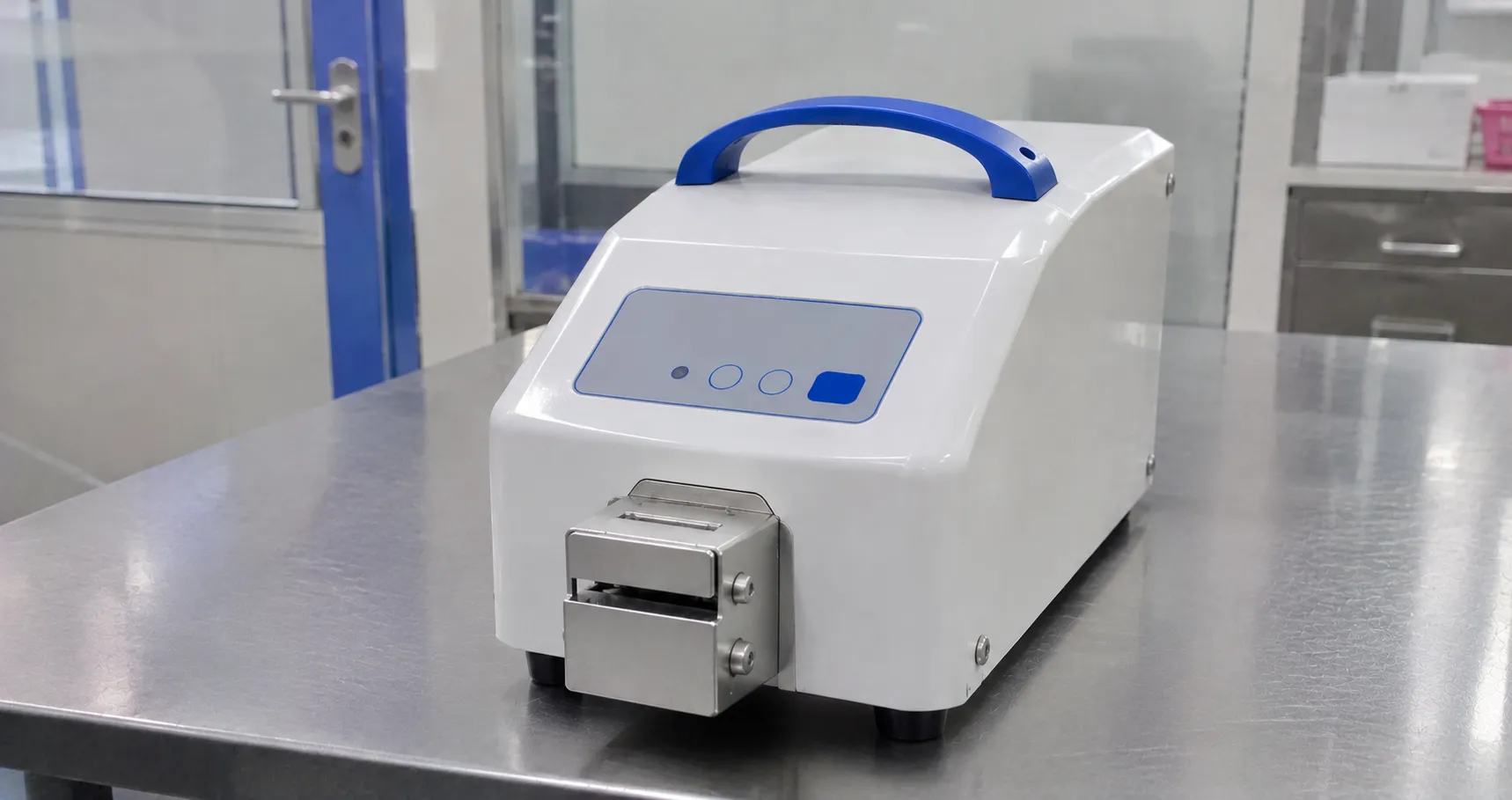
A blood bag tube sealer is a device that fuses the walls of the flexible PVC tubing on a blood bag set together to make a strong, leak-proof, hermetic seal, dividing the tubing into closed segments without opening the sterile system. It is used throughout donation and component processing to close off filled bags, create the numbered segments used for cross-matching and testing, and separate satellite bags after component preparation. For a blood-service or transfusion-laboratory buyer, a sealer is judged on seal strength and integrity, sealing speed, portability and how well it copes with wet or blood-filled tubing.
The whole point is to keep the blood system closed. A sealed segment stays sterile and preserves the component's full shelf life, whereas any open cut or connection would compromise both.
How Radiofrequency Sealing Works
Most blood bag tube sealers use radiofrequency (RF), also called dielectric, sealing. The tubing is placed between two electrodes; a high-frequency electromagnetic field — typically in the tens of megahertz range — makes the polar molecules in the PVC oscillate, generating heat within the plastic itself. The tubing walls soften and fuse together, and as the electrodes close they form a flat, welded seal across the tube. Because the heat is generated inside the material rather than applied from a hot surface, the seal is fast, even, and can be made through the fluid still in the tube. The result is a clean weld that does not leak and that separates cleanly when the segment is snapped off.
Why Segments Matter
The line of small tubing segments left attached to a blood unit is not waste — it is a sampling and identity system. Each segment holds a small volume of the unit's blood, sealed and numbered, so the laboratory can perform grouping and cross-matching, and later confirm the segment matches the unit at issue. A reliable sealer is what makes those segments possible: it must produce seals strong enough to survive handling and centrifugation, spaced to give usable segment lengths, and cleanly separable so a segment can be detached without disturbing the rest of the line.
Portable Versus Bench Sealers
Sealers come in two broad forms matched to where they are used:
-
Handheld and portable sealers are compact, often battery-powered units used at mobile donor sessions and at the donor chair to seal the line quickly as collection finishes. Portability, battery life and one-handed operation are the priorities.
-
Bench and processing sealers are mains-powered units used in the processing laboratory for high-volume segmenting and satellite-bag separation, where speed, duty cycle and consistent seal quality across many units matter most.
Many services run both: a rugged portable unit for collection and a fast bench unit for processing.
Sealing Wet or Filled Tubing
A defining requirement is the ability to seal tubing that contains blood, because the line is full during and after collection. RF sealing handles this well: the field heats the plastic even with fluid present, and a good sealer pushes the fluid aside as the electrodes close so the weld forms on empty, fused walls. Buyers should confirm the sealer is validated for sealing full tubing and produces consistent, leak-free seals with the specific tubing gauge and PVC formulation of their bag sets.
Seal Quality and Integrity
A weak or incomplete seal can leak, break during centrifugation, or allow contamination, so seal integrity is the headline quality measure. Look for consistent, full-width welds with no thin spots or burn-through, adjustable or automatically controlled sealing energy to suit tubing thickness, and clean separation. Some sealers cut as they seal; others seal only and the segment is snapped by hand along a clear separation line. The sealer must also cope with the range of tubing on your sets, since different manufacturers use slightly different tube diameters and wall thicknesses.
Speed, Duty Cycle and Ergonomics
In processing, throughput depends on seal time and how quickly the unit is ready for the next seal, so the duty cycle — how many seals it can make in succession without overheating — matters for busy laboratories. For portable use at the donor chair, weight, grip, seal-cycle time and battery endurance across a session are the practical concerns. Clear feedback that a seal is complete, and simple, tolerant operation, reduce errors and repeated attempts. A well-matched sealer keeps both collection and processing moving without becoming a bottleneck.
Cutting Versus Non-Cutting and Aseptic Considerations
Sealers differ in whether they part the tubing. A non-cutting sealer welds the tube and leaves it joined, so the operator snaps the segment along the seal by hand when needed — simple and robust. A cutting sealer welds and severs in one action, useful for quickly separating bags in processing. Whichever type, the seal itself keeps the system functionally closed, but cutting introduces an exposed tube end, so it is used where a bag is being finally separated rather than where sterility of the onward line must be preserved. For joining new tubing sterile-connection welders are used instead; a tube sealer only closes and divides, it does not join.
Consumables, Cleaning and Maintenance
RF sealers are largely consumable-free, which is a real advantage over older systems that needed metal clips: there are no clips to buy, store or worry about as a sharps and imaging hazard. Maintenance centres on keeping the electrodes clean and undamaged, checking calibration of the sealing energy, and battery care on portable units. Because a worn electrode or a mis-set energy level quietly degrades seal quality, periodic verification of seal strength should form part of the laboratory's quality checks.
Standards, Regulation and Safety
Blood bag tube sealers are medical devices carrying UKCA or CE marking, with electrical safety following the IEC 61010-1 family for laboratory equipment (or the relevant medical electrical standard where applicable), and RF emissions must meet electromagnetic-compatibility requirements so the device does not interfere with other equipment. Blood establishments operate under the Blood Safety and Quality Regulations overseen by the MHRA, and workplace electrical safety is covered by the Health and Safety Executive regime. Buyers should confirm the sealer's validation for seal integrity and its EMC compliance for their environment.
Procurement Checklist
Before choosing a blood bag tube sealer, confirm the following:
-
Seal integrity — consistent, hermetic, full-width welds validated on your tubing.
-
Tubing compatibility with the gauge and PVC formulation of your bag sets.
-
Ability to seal filled tubing reliably during and after collection.
-
Format — portable battery unit for collection, bench unit for processing, or both.
-
Seal speed and duty cycle matched to your donor-session and processing volumes.
-
Battery life and ergonomics for portable use across a full session.
-
Clean separation and clear seal-complete feedback to reduce re-work.
-
UKCA or CE marking, EMC compliance, service cover and spare electrodes.
Total Cost of Ownership
Because RF sealers use no clips or consumables beyond electrode upkeep, running costs are low and the main lifetime spend is service, battery replacement on portable units and occasional electrode renewal. The value lies in reliable seal integrity and uptime: a sealer that produces weak seals or fails mid-session costs far more in wasted units and repeated work than any price difference. Assess validated seal quality, duty cycle and support alongside purchase price. To compare tube sealers and related processing equipment, our team can help through MediGear buyer services.
Conclusion
Blood bag tube sealers make fast, hermetic radiofrequency seals across donation tubing, closing bags and forming the numbered segments that underpin cross-matching, all without opening the sterile system. Choose on seal integrity, tubing compatibility, format and duty cycle, and confirm UKCA or CE marking and EMC compliance. To specify the right sealer for your collection and processing workflow, contact MediGear.
Disclaimer
This article is for informational purposes only. It is published by MediGear (medigear.uk) for general information and procurement guidance, and is not clinical, diagnostic, treatment, technical, engineering, legal or regulatory advice, nor a product endorsement, guarantee or substitute for professional assessment. MediGear does not provide medical consultations. Buyers should consult their clinical, biomedical, estates and regulatory contacts, and the manufacturer's documentation, and independently verify all specifications, certifications, compatibility and suitability before purchase. Specifications, certifications and availability are correct at the time of publication and may change without notice. MediGear is a medical-equipment distributor and does not sell medicines or pharmaceutical products.