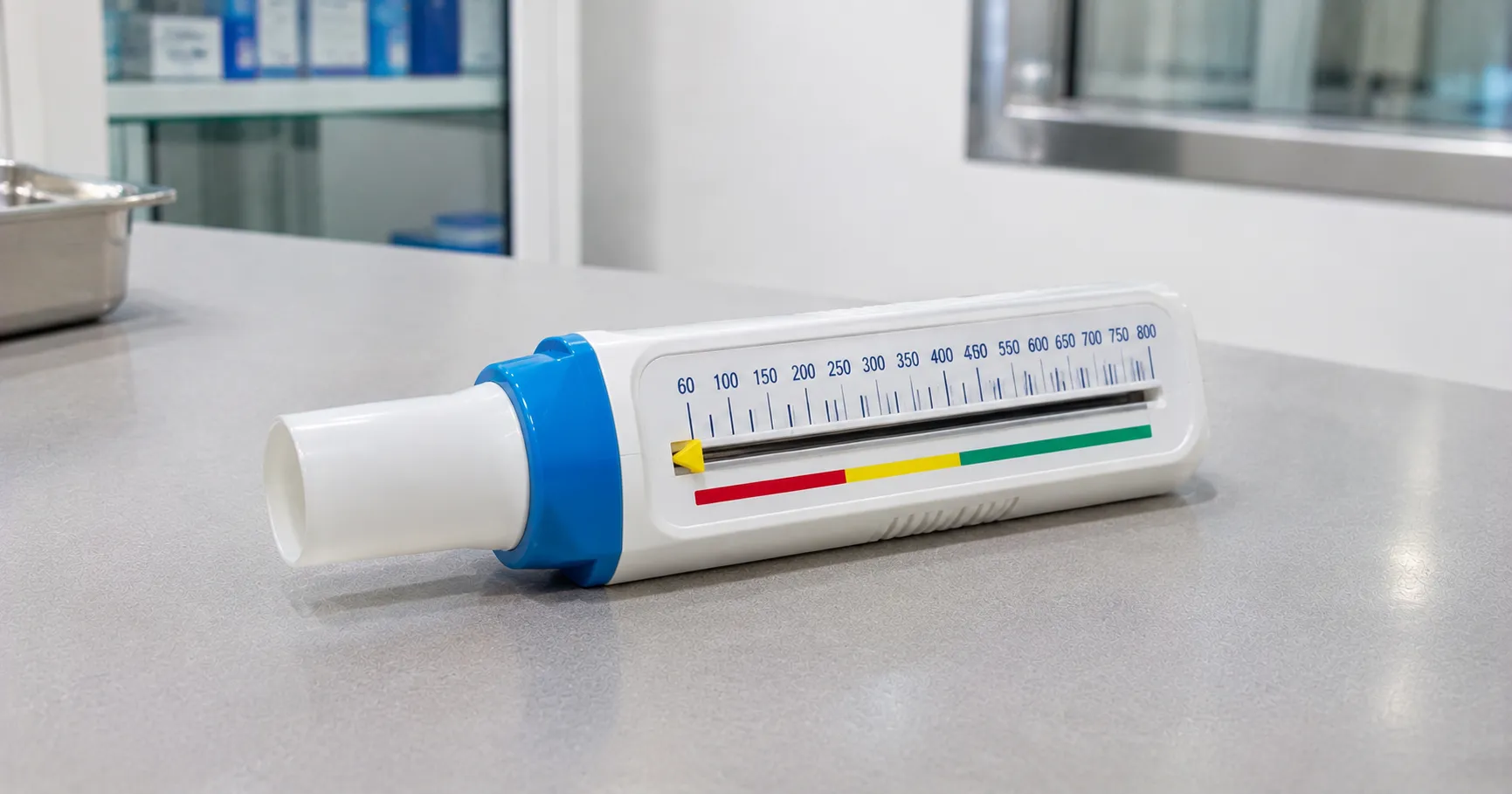
A peak flow meter is a small, hand-held device that measures peak expiratory flow — the fastest rate at which a person can blow air out of the lungs after a full breath in. The patient exhales hard into the mouthpiece and a marker moves along a scale to show the highest flow reached, in litres per minute. Tracked day to day, those readings reveal how open the airways are and warn of deterioration before symptoms become severe.
For a procurement lead buying for a GP practice, respiratory clinic or community service, the decisions are grounded and repeatable: mechanical or electronic, the correct measurement scale, single-use versus reusable mouthpieces, infection control, and the cost of stocking devices across many patients and settings.
How a peak flow meter measures airflow
Most mechanical meters work on a spring-loaded principle. Exhaled air pushes a piston or vane against a calibrated spring; the faster the flow, the further it moves an indicator along the scale before friction holds it at the peak value. The reading reflects effort over the first fraction of a second of a forced blow, which is why technique matters so much — a full inhalation, a tight lip seal and a short sharp blast. Electronic meters replace the mechanical movement with a flow sensor and display the value digitally, often storing a series of readings for later review. Both report the same physiological quantity, but they differ in how the number is captured and recorded.
Mechanical versus electronic meters
Mechanical meters
Mechanical meters are inexpensive, robust and need no power. They suit issuing to individual patients for home monitoring and remain the mainstay of routine asthma self-management. Their limitation is that the patient must read and record the number by hand, and the scale has finite resolution.
Electronic meters
Electronic meters add a digital display, memory and sometimes a spirometry-style measure of forced expiratory volume. Many pair with an app so readings sync automatically, which helps clinics track adherence and spot trends. They cost more, need charging or batteries, and require the same cleaning discipline. Choose according to whether the priority is low-cost wide distribution or richer data capture for a monitored cohort.
Measurement scales and standards
Peak flow meters must report on the EU/EN 13826 scale, the standard adopted across the UK and Europe. Older meters using the original Wright scale read differently, so mixing scales makes readings incomparable and can mislead a patient tracking their own trend. Confirm every meter you buy is EN 13826 compliant and that patient-held charts use the matching scale. As a medical device, each meter must carry valid UKCA or CE marking with instructions for use. The MHRA regulates devices in the UK, and clinical guidance on asthma monitoring is published by NICE. Standardising on one scale across a service prevents avoidable confusion.
Key specifications a buyer must check
Check the measuring range and make sure it spans both low adult readings and high healthy ones, and that a paediatric-range device is available for children whose flows are lower. Look at the scale resolution, the ease of resetting the indicator, and how clearly the numbers can be read by an older patient. For electronic models, examine memory capacity, battery life, data export format and app compatibility with your systems. Consider durability, whether the device can be washed, and whether the mouthpiece interface accepts a standard single-use filter. A meter that a patient finds fiddly or hard to read will simply not be used consistently.
Decontamination, single-use and infection control
Cross-infection control drives much of the purchasing decision. In a clinic where one meter serves many patients, a single-use mouthpiece with a built-in filter is essential, or the meter itself should be a single-patient device. Reusable meters must be cleaned according to the instructions for use, and many practices now issue a personal meter to each patient to remove shared-use risk entirely. Confirm the mouthpiece standard, stock filters as a routine consumable, and follow the manufacturer's cleaning method precisely — some meters tolerate washing while others do not. Guidance from the HSE and your infection-control team should frame local policy.
Technique, usability and training
A peak flow reading is effort-dependent, so the device only produces reliable numbers when the patient uses it correctly: a full breath in, a tight lip seal, and one short, sharp blast rather than a long slow blow. That makes usability a genuine procurement criterion. A clear, well-spaced scale, an indicator that resets easily, and a comfortable mouthpiece all raise the odds of consistent home readings. When you buy for a service, consider whether the supplier provides patient instruction leaflets and clinician training materials, because a meter used with poor technique gives misleading trends however accurate the instrument itself is. Standardising on one or two familiar models across a service also simplifies staff training and patient education, and makes it easier to compare a patient's readings when they move between clinics.
Use across care settings
In general practice, meters support diagnosis, monitoring and personalised action plans, and are often issued for the patient to keep. Hospital respiratory clinics may use electronic meters for detailed monitoring and to confirm technique. Community and school nursing services value cheap, robust mechanical meters that can be distributed widely. Occupational health uses serial peak flow recording to investigate work-related asthma, where a data-logging electronic meter earns its cost. Domiciliary use is the core scenario: a patient blowing morning and evening, charting the result and acting on their plan. Matching device type to setting keeps spending sensible.
What to check before you buy
-
Confirm the meter reports on the EN 13826 scale and matches the scale on your patient charts.
-
Check the measuring range covers your patient mix, with a paediatric option where needed.
-
Decide between single-use mouthpieces with filters and single-patient personal meters for infection control.
-
For electronic models, verify memory, battery life and app or record-system compatibility.
-
Assess how easily an older patient can read the scale and reset the indicator.
-
Confirm the cleaning method and whether the device tolerates washing.
-
Request UKCA or CE documentation and instructions for use before ordering in bulk.
Consumables, total cost of ownership and warranty
The headline unit price of a mechanical meter is low, but the real spend is often in mouthpieces and filters ordered by the thousand across a service. Electronic meters cost more upfront and add battery replacement and occasional device failure. When you buy at volume, model the annual figure: devices, consumables, replacements and the staff time to clean and issue them. Confirm the warranty term and the availability of matching mouthpieces long term, since a discontinued mouthpiece can orphan a fleet of meters. Ordering meters and consumables from one supplier keeps compatibility clean — register as a buyer or contact us to standardise your stock.
Conclusion
A peak flow meter is a simple device that only helps if it is the right scale, easy for the patient to use, and safe to share or personal to keep. Standardise on EN 13826, decide your infection-control model, and cost the mouthpieces and filters honestly before buying at volume. MediGear can supply meters and matching consumables so your service tracks asthma reliably without hidden compatibility problems.
Disclaimer
This article is for informational purposes only. It is published by MediGear (medigear.uk) for general information and procurement guidance, and is not clinical, diagnostic, treatment, technical, engineering, legal or regulatory advice, nor a product endorsement, guarantee or substitute for professional assessment. MediGear does not provide medical consultations. Buyers should consult their clinical, biomedical, estates and regulatory contacts, and the manufacturer's documentation, and independently verify all specifications, certifications, compatibility and suitability before purchase. Specifications, certifications and availability are correct at the time of publication and may change without notice. MediGear is a medical-equipment distributor and does not sell medicines or pharmaceutical products.