What Manometry Is and How Oesophageal Pressure Is Read
Manometry measures pressure inside a hollow organ. In its commonest clinical form, oesophageal manometry records the pressure waves the swallowing tube generates as it moves a swallow towards the stomach, and the behaviour of the muscular valves at each end. A thin catheter passed through the nose sits along the oesophagus, and an array of sensors reads the squeeze at many levels at once. For a buyer the decision rests on catheter technology, the analysis software, catheter durability and reprocessing, and the lifetime cost of the consumables.
Put plainly, the system reads oesophageal pressure by placing pressure sensors along a catheter inside the oesophagus and recording how hard the muscle squeezes at each point during a swallow, then translating those readings into a colour pressure map for the clinician to interpret.
The measurement principle in detail
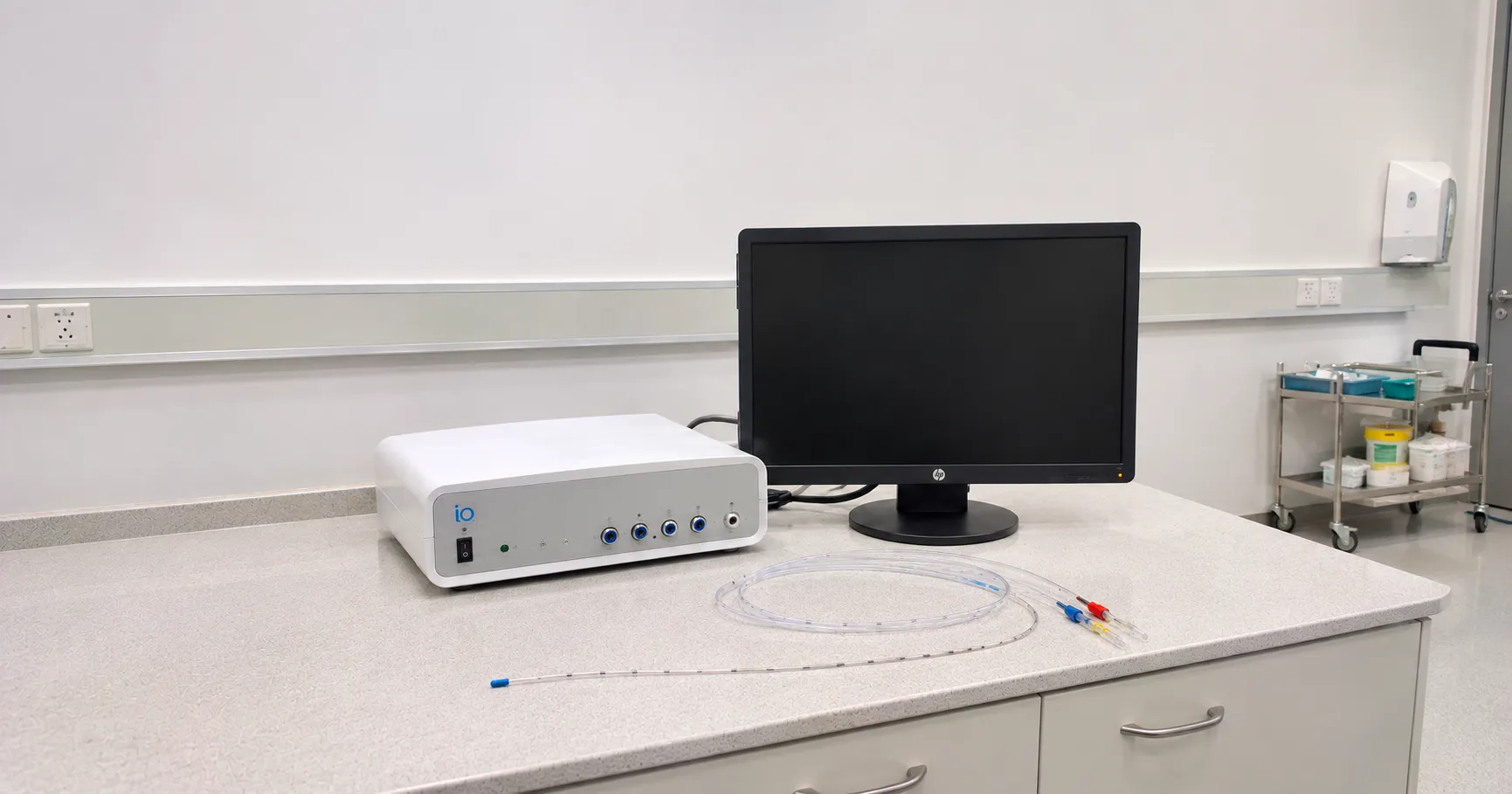
Muscle contraction generates pressure, and manometry converts that pressure into an electrical signal. Two technologies dominate. Water-perfused catheters push sterile water slowly through fine channels that open along the catheter; as the oesophageal wall squeezes a channel, resistance to the outflow rises and an external transducer reads the change. Solid-state catheters carry tiny pressure sensors built into the catheter itself, reading pressure directly at each point with no water needed. Either way, the raw output is a set of pressures at known distances along the oesophagus, sampled many times a second. Software plots pressure against position and time, and in high-resolution systems that becomes a continuous colour topography plot spanning the pharynx to the stomach.
Conventional versus high-resolution manometry
Older conventional systems used a handful of sensors spaced a few centimetres apart, and the catheter had to be pulled through in stages to map the whole oesophagus. High-resolution manometry packs closely spaced sensors — often more than thirty — along the full length, capturing the entire swallow in one static recording. The closely spaced data is rendered as a Clouse plot, the familiar colour pressure topography that has become the clinical standard and underpins the Chicago Classification used to categorise motility disorders. Most new purchases are high-resolution, and buyers should confirm the sensor count and spacing meet current diagnostic expectations.
Related manometry applications
The same principle serves other studies. High-resolution anorectal manometry assesses the pressures and reflexes of the anal sphincters and rectum. Antroduodenal and sphincter-of-Oddi manometry examine motility further down the gut. Impedance sensors are often combined with pressure sensors to track how a bolus moves as well as how the muscle squeezes. If your service runs more than oesophageal studies, check that one platform and its software support the range you need rather than buying separate systems.
Key specifications a buyer must check
Start with the catheter: sensor count, spacing, overall length and diameter, and whether solid-state or water-perfused suits your workflow. Check sampling rate and pressure range, and whether combined impedance is available. Review the analysis software — automated metrics, support for the current Chicago Classification, reporting templates and the ability to review raw traces, not just summaries. For water-perfused systems, confirm the pump specification and the perfusion manifold. Assess catheter durability and the quoted number of studies per catheter, because that figure drives running cost more than any other.
Standards, regulation and documentation
A manometry system and its catheters are medical devices that must carry valid UKCA or CE marking with instructions for use defining intended purpose, reprocessing and catheter lifespan. General electrical safety follows IEC 60601-1 with IEC 60601-1-2 for electromagnetic compatibility, and reprocessing of reusable catheters follows the ISO 17664 information-for-processing framework and your local decontamination standards. Ask for the declaration of conformity and confirm Great Britain registration. The MHRA is the UK device regulator and the route for safety reporting, with wider guidance on GOV.UK. Keep the instructions for use on file, because they set the only validated cleaning method and the maximum number of uses for a reusable catheter.
Calibration and routine maintenance
Pressure sensors must read true, so calibration is central. Solid-state catheters are calibrated against a known pressure, often in a pressure chamber, before a study and checked to a thermal reference; the sensors are delicate and mishandling shortens their life. Water-perfused systems need the perfusion pump primed and bubble-free, the transducers zeroed to a reference height, and the water supply kept sterile and degassed, since trapped air corrupts the reading. Follow the manufacturer's calibration schedule, log the checks for quality assurance, and arrange annual servicing of pumps and amplifiers.
Decontamination and single-use considerations
The catheter is passed transnasally and contacts mucosa, so reprocessing is a serious infection-control matter. Reusable catheters require validated manual cleaning followed by high-level disinfection per the instructions for use, with the cycle tracked and the catheter retired at its stated use limit. Single-use catheters remove the reprocessing burden and cross-infection risk at a higher per-study cost, and are increasingly chosen where decontamination capacity is limited. Disposable catheter sleeves and single-use accessories feature in some systems. Agree the reprocessing route with infection control before purchase, because the catheter type dictates both your decontamination workload and your consumable spend.
Care settings and workflow
Manometry is a hospital investigation, run in gastroenterology and physiology units, upper-GI surgical services and specialist motility centres; it is not a GP or domiciliary test. It commonly precedes anti-reflux surgery and helps investigate swallowing difficulty and non-cardiac chest pain. The study needs a trained physiologist, a quiet room and time per patient, so throughput planning matters. Confirm how reports leave the system: export to the endoscopy or physiology reporting platform and the electronic patient record, and networked storage so studies can be reviewed remotely by the reporting clinician.
Consumables, total cost of ownership and servicing
The catheter dominates lifetime cost. A reusable solid-state catheter is expensive to buy but spreads across many studies if handled well; a single-use catheter has a lower unit price but recurs every patient. Add perfusion water and manifolds for water-perfused systems, disinfectant and staff time for reprocessing, and periodic software and classification updates. Ask suppliers for warranty length, catheter warranty and expected lifespan, repair turnaround, loan-unit availability and the replacement cost of a damaged catheter, which is the part most likely to fail. A broken catheter can halt a clinic, so a spare and a fast supply route protect throughput. The MediGear buyers team can compare systems, or contact us to check current availability and support.
Procurement checklist
- Choose the catheter technology — solid-state or water-perfused — to suit your workflow and reprocessing capacity.
- Confirm sensor count and spacing meet high-resolution diagnostic expectations.
- Check whether combined impedance and anorectal or other studies are supported on one platform.
- Verify the software supports the current Chicago Classification and lets you review raw traces.
- Confirm UKCA/CE marking, IEC 60601 compliance, certificates and reprocessing instructions.
- Agree reusable-catheter high-level disinfection or single-use catheters with infection control.
- Get the quoted studies per catheter and the catheter replacement cost in writing.
- Confirm export to your physiology reporting platform and patient record.
Conclusion
Manometry turns the squeeze of a swallowing muscle into a pressure map a clinician can read, and buying well means matching catheter technology, sensor resolution and software to the studies your service performs. Weigh reusable catheters and their decontamination against single-use convenience, confirm the regulatory paperwork, and cost the consumables honestly, since the catheter drives the running total. Comparing verified specifications through MediGear helps your gastroenterology or physiology service buy a system it can rely on study after study.
Disclaimer
This article is for informational purposes only. It is published by MediGear (medigear.uk) for general information and procurement guidance, and is not clinical, diagnostic, treatment, technical, engineering, legal or regulatory advice, nor a product endorsement, guarantee or substitute for professional assessment. MediGear does not provide medical consultations. Buyers should consult their clinical, biomedical, estates and regulatory contacts, and the manufacturer's documentation, and independently verify all specifications, certifications, compatibility and suitability before purchase. Specifications, certifications and availability are correct at the time of publication and may change without notice. MediGear is a medical-equipment distributor and does not sell medicines or pharmaceutical products.