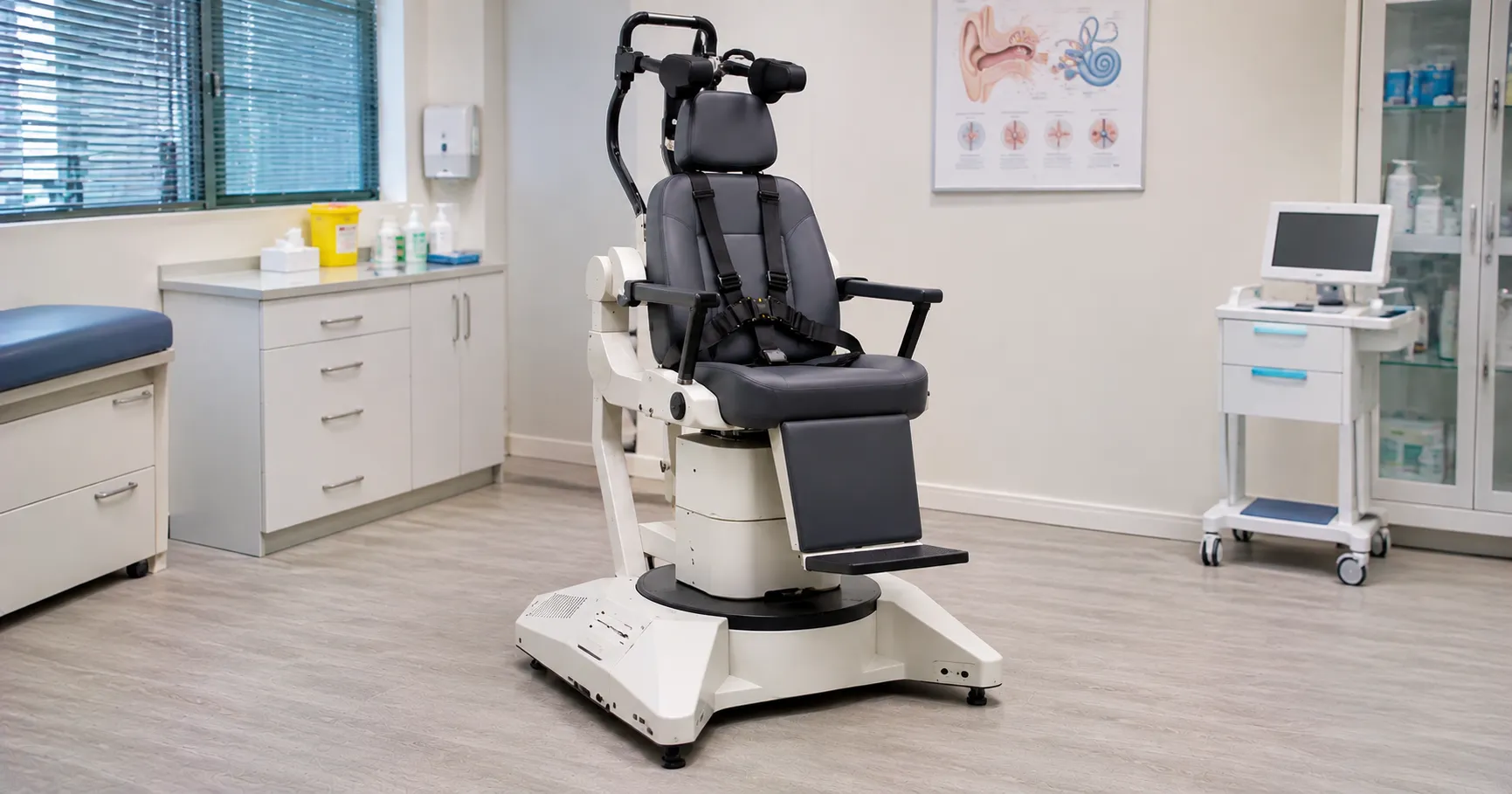
A vestibular testing chair, often called a rotary or rotational chair, is a motorised seat that turns a patient at precisely controlled speeds to test how the inner-ear balance organs and the eyes work together. It measures the vestibulo-ocular reflex by spinning the head in darkness and recording the compensatory eye movements. For a balance clinic buyer, the decisions come down to the drive system, the angular velocity and acceleration the chair can deliver, the eye-recording method it pairs with, room and installation demands, and the servicing behind a machine that will run for a decade or more.
The measurement principle
The horizontal semicircular canals sense rotation of the head. When the head turns, they drive the eyes in the opposite direction to keep an image stable on the retina, the vestibulo-ocular reflex. A rotary chair turns the whole patient in the dark at defined frequencies and accelerations, removing the visual cues that would otherwise let the eyes track a fixed point. Infrared cameras or electrodes record the resulting nystagmus, and software compares eye velocity against chair velocity. The three outputs that matter clinically are gain, the ratio of eye speed to head speed; phase, the timing relationship between them; and symmetry, whether responses to leftward and rightward rotation match. Because the chair sets the stimulus with high accuracy, the reflex can be characterised across a range of frequencies that bedside tests cannot reach.
Sub-types and how they compare
Sinusoidal harmonic acceleration chairs
These oscillate the patient back and forth across a band of low frequencies. They are the reference method for quantifying reflex gain, phase and symmetry, and suit clinics that need detailed, repeatable vestibular characterisation.
Step-velocity and velocity-step systems
These accelerate rapidly to a constant speed, hold it, then stop abruptly, measuring how quickly the response decays. They probe the time constant of the vestibular response and complement sinusoidal testing.
Compact multi-axis and off-vertical chairs
Higher-specification chairs tilt the axis of rotation to stimulate the otolith organs as well as the canals. These are found in tertiary neuro-otology and research centres; most district balance clinics do not need them, so avoid paying for axes you will never use.
Eye recording: the other half of the system
A chair is only as good as the eye-movement recording paired with it. Modern systems use lightweight infrared video goggles, videonystagmography, that image the pupil at a high frame rate in darkness. Older electronystagmography uses skin electrodes around the eyes. Video recording gives cleaner traces, avoids electrode application time and captures torsional movement, so most new installations specify it. Confirm the camera frame rate, whether both eyes are tracked, and how the goggle mount excludes stray light, because light leakage lets the patient fixate and suppresses the very reflex you are trying to measure.
Key specifications a buyer must check
Look at the maximum angular velocity and acceleration the drive can deliver, and the range of frequencies for sinusoidal testing, because these define which protocols you can run. Check the velocity accuracy quoted by the manufacturer, the smoothness of the servo drive at low speed, and the light-tightness of the enclosure or booth. Confirm the payload, the safe working load for the patient plus seat, and whether the chair accommodates larger patients and wheelchairs. Review the software: automated protocol libraries, gain, phase and symmetry reporting, normative data sets and export formats all affect daily throughput. Emergency stop, restraint harnesses, an intercom and a patient-release mechanism are safety essentials, not optional extras.
Standards and UK regulation
A powered vestibular chair is an electrical medical device with moving parts, so it must meet the IEC 60601-1 general safety standard, including the mechanical-hazard and patient-restraint provisions, and IEC 60601-1-2 for electromagnetic compatibility. Any device placed on the UK market needs appropriate UKCA or CE conformity marking and, where required, manufacturer registration. Ask for the declaration of conformity for the exact configuration. The MHRA publishes device safety information and field-safety notices, and you should confirm the machine's risk controls for entrapment and sudden stops. Clinical protocols for vestibular testing are set by professional audiovestibular and neuro-otology bodies rather than the equipment vendor.
Calibration, maintenance and decontamination
The eye-tracking system needs calibration at the start of each session against known target angles, and the chair's velocity servo should be verified periodically by your biomedical engineering team against the manufacturer's schedule. Routine electrical-safety testing applies as it does to any powered medical device. Mechanical items, the drive belt or gearing, bearings, harness and emergency stop, need scheduled inspection because a balance clinic depends on smooth, predictable motion. Decontamination is straightforward but constant: the seat, headrest, restraint straps and goggle cushions contact every patient, so specify wipeable surfaces and single-use or wipe-clean goggle covers, and hold a written cleaning routine between patients.
Care settings and room requirements
Rotary chairs live in dedicated balance or audiovestibular clinics, in ENT and neuro-otology departments, and in some falls and dizziness services. They are not domiciliary devices. The room itself is part of the purchase: the enclosure must exclude light completely, the floor must take the fixed base and dynamic load, and you need space to transfer patients safely, including from a wheelchair. Plan cabling, the operator workstation position, ventilation inside a sealed booth, and an unobstructed line for the intercom and observation. Because dizzy patients can be nauseated or unsteady, easy patient access and a rapid-release harness are practical priorities as much as clinical ones.
Integration, consumables and total cost of ownership
Confirm how the system exports reports into the patient record and whether results sit alongside your other balance tests such as videonystagmography and video head impulse testing, so a clinician reviews one coherent picture. Consumables are modest but real: disposable goggle cushions or covers, cleaning materials, and occasional electrode supplies where electronystagmography is retained. The larger lifetime costs are the drive servicing, software licences and updates, calibration and electrical-safety testing, and eventual replacement of mechanical wear parts. Ask suppliers for warranty length, whether software updates are included, repair turnaround, loan availability and the cost of major spares such as the motor, control board and goggles. A five-year view usually favours a well-supported system over the cheapest chair whose downtime idles a whole clinic room. The MediGear buyers team can help compare specifications, or you can contact us to check current availability and support.
Procurement checklist
-
Confirm maximum velocity, acceleration and the sinusoidal frequency range against your protocols.
-
Check the paired eye-recording method, camera frame rate and light exclusion.
-
Verify safe working load, restraint harness, emergency stop and patient-release.
-
Confirm UKCA or CE marking, IEC 60601 compliance and the declaration of conformity.
-
Assess room light-tightness, floor loading and safe patient transfer space.
-
Review reporting software, normative data and export into the patient record.
-
Agree calibration, electrical-safety testing and decontamination routines.
-
Get warranty, repair turnaround and spares cost in writing before ordering.
Conclusion
A vestibular testing chair delivers a precisely controlled rotational stimulus and records the eyes' reflex response, giving a balance clinic quantitative data no bedside test can match. Match the drive capability and eye-recording method to the protocols you actually run, plan the room and safety features as carefully as the machine, and confirm standards, calibration and servicing before you commit. Comparing verified specifications through MediGear helps a balance service invest in a chair it can rely on for years.
Disclaimer
This article is for informational purposes only. It is published by MediGear (medigear.uk) for general information and procurement guidance, and is not clinical, diagnostic, treatment, technical, engineering, legal or regulatory advice, nor a product endorsement, guarantee or substitute for professional assessment. MediGear does not provide medical consultations. Buyers should consult their clinical, biomedical, estates and regulatory contacts, and the manufacturer's documentation, and independently verify all specifications, certifications, compatibility and suitability before purchase. Specifications, certifications and availability are correct at the time of publication and may change without notice. MediGear is a medical-equipment distributor and does not sell medicines or pharmaceutical products.