
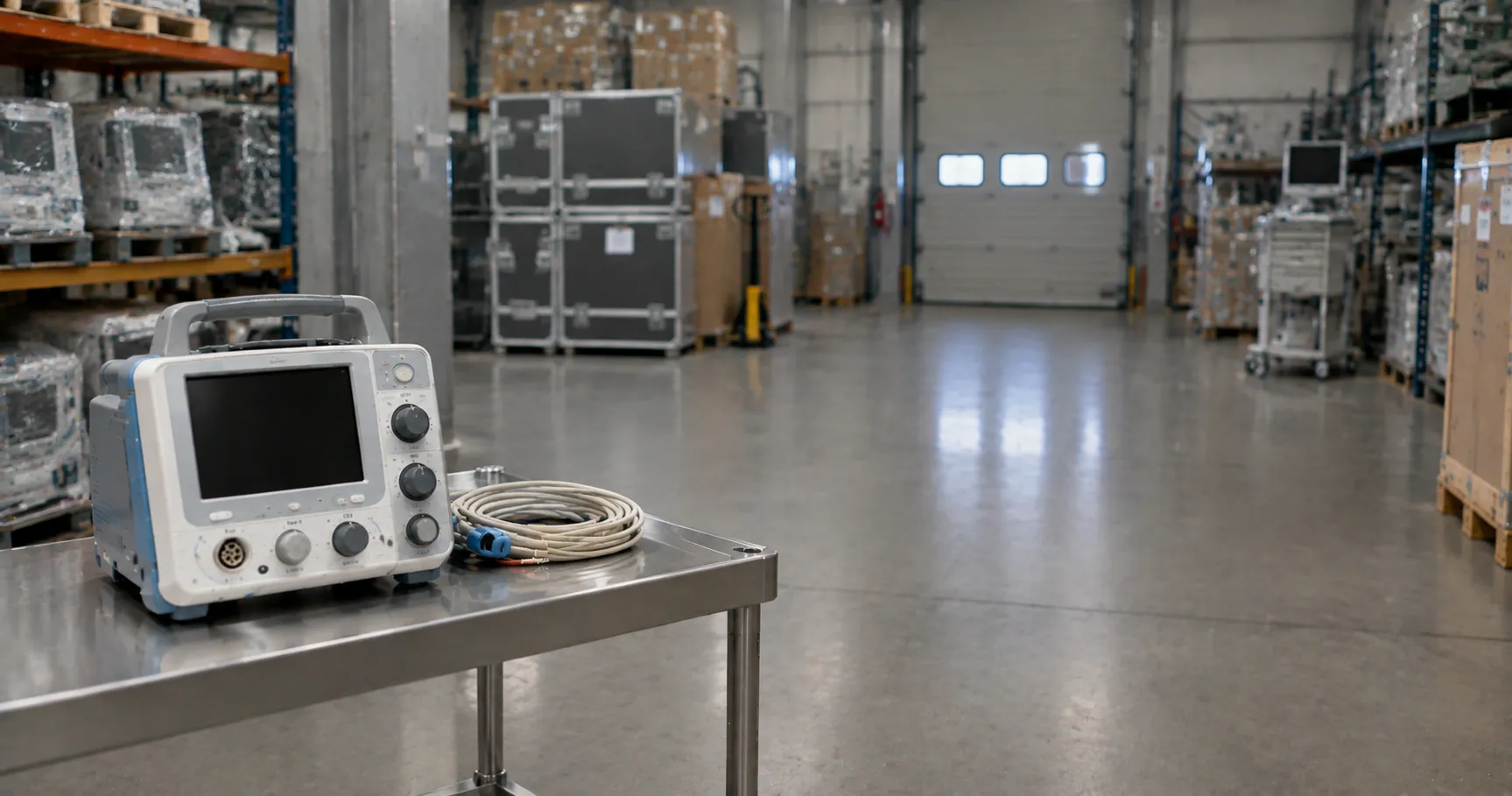
An external pacemaker generator is a battery-powered box that drives a temporary pacing wire, setting the rate, output (in milliamps), a nd sensitivity that tells it when to fire. In an emergency, it takes over a heart that is beating too slowly or has stopped conducting, delivering a paced impulse down the lead until a permanent solution is in place. The generator is the control unit; the pacing wire is a separate consumable. Getting its three core controls right is what keeps a patient safely paced.
The costly mistake is treating the generator as a set-and-forget box. It must be checked, understood, and ready, because a flat battery or a mis-set sensitivity turns a lifesaving unit into a dangerous one.
The three controls that keep a patient paced
Almost every external pacemaker generator comes down to three dials. Rate sets how many paced beats per minute the box will deliver if the heart does not manage them itself. Output, in milliamps, sets how strong each pulse is; it is turned up until the heart reliably captures each pulse, then left with a safety margin above that capture threshold. Sensitivity sets how readily the box detects the patient's own beats, measured in millivolts, so it knows when to hold back. Set sensitivity wrongly, and the generator either ignores real beats or is fooled by noise. A buyer should judge how clearly these three controls are laid out and how well they're protected against accidental knocks.
Single-chamber versus dual-chamber external pacemaker generators
External pacemaker generators come as single-chamber or dual-chamber units. A single-chamber box paces one chamber, usually the ventricle, through one wire, and it is the simpler, more common emergency device. A dual-chamber generator paces the atrium and ventricle through two wires. It can coordinate their timing, providing a more physiological rhythm and preserving the atrial kick that some patients depend on after cardiac surgery. Dual-chamber units cost more and demand more setup, so the choice follows the clinical caseload: a general acute service may standardise on single-chamber boxes. In contrast, cardiac surgery units need dual-chamber capability.
Rate range, output steps and overdrive pacing
Beyond the three headline controls, the ranges they cover matter. A generator should span from slow bradycardia rescue rates up to the faster rates used for overdrive pacing, where a fast organised rhythm is paced above its own rate to interrupt it. Output should adjust in fine steps at the low end, where the capture threshold usually sits, so the operator can set a sensible safety margin without jumping. Ask what rate range and output resolution a unit offers, because a box with coarse steps or a limited rate ceiling restricts what the team can do in an unusual case.
Demand pacing and the sensing that keeps it safe
Modern external pacemaker generators run in demand mode by default. Rather than firing at a fixed rate regardless of the patient, the box senses each intrinsic beat and only paces when the heart falls below the set rate. This prevents a paced pulse from landing on the heart's vulnerable recovery phase, the risk that fixed-rate pacing carries. Good sensing is therefore a safety feature, not a luxury, and it depends on both the generator's sensitivity setting and the quality of the pacing wire feeding it. When you compare generators, look at how the sensing threshold is displayed and how easy it is to confirm the box is sensing correctly at the bedside.
Batteries, lockouts and emergency readiness
An external pacemaker generator is often needed with no warning, so readiness is a design feature. A clear battery indicator, a battery that is easy to change without interrupting pacing, and a control lockout that stops settings being knocked in transit all matter. Some units offer a rapid emergency start that begins pacing at safe default settings at the press of a button. For a device that lives on a crash trolley, the practical questions are how long the battery lasts in use, whether spare batteries are stocked, and how the unit signals a low battery before it fails.
Display, alarms and bedside usability
An emergency device is only as safe as it is easy to read under pressure. A clear display of the set rate, output, and sensitivity; a visible pacing indicator that flashes with each delivered pulse; and sensible alarms for loss of capture or low battery all reduce the chance of a mistake at three in the morning: large, well-labelled controls and a logical layout help staff who use the box rarely. When you evaluate external pacemaker generators, put a unit in front of the clinicians who will actually use it and judge how quickly they can set it up correctly.
Where external pacing sits in the emergency pathway
An external pacemaker generator with a transvenous wire is one rung of the emergency bradycardia pathway. Before placing an invasive wire, teams may use transcutaneous pacing through pads on a defibrillator, or drugs, to buy time. Once a temporary wire is in, the external generator takes over, providing more stable and comfortable pacing as a bridge to a permanent pacemaker or recovery. Understanding where the box fits helps a procurement team equip the whole pathway, not just one part; pads, defibrillator, pacing, nd the external generator all line up.
Standards and safety: IEC 60601 for external pacemakers
An external pacemaker generator is active medical electrical equipment and is built to the IEC 60601-1 general safety standard, with the particular requirements for external pacemakers set out in IEC 60601-2-31. Those standards cover electrical safety, protection against the patient-connected current path and the reliability of pacing output. In Great Britain, the device is regulated under the UK Medical Devices Regulations 2002. It must carry a valid UKCA or recognised CE marking, with the Medicines and Healthcare products Regulatory Agency as the regulator. This overview is drawn from manufacturer documentation and UK regulatory guidance and is written for biomedical and procurement teams rather than for patients.
Connecting the generator to a temporary pacing wire
The generator is useless without a lead, and the connection between them must be correct. Transvenous pacing wires usually terminate in pins that clamp into the generator's terminals. In contrast, epicardial wires may need a bridging cable, so check that the box and wire are compatible. Correct polarity matters: the positive and negative terminals have to match the lead, or pacing fails. When you buy generators, confirm which connectors and adaptor cables they take and keep those cables stocked alongside the unit, because an incompatible connector on a crash trolley is exactly the failure you cannot afford.
Choosing an external pacemaker generator: a buyer checklist
Work through these before you commit to a model or standardise a fleet:
-
Decide whether you need single-chamber or dual-chamber capability based on your clinical caseload.
-
Check that the rate, output and sensitivity controls are clearly laid out and lockable against accidental changes.
-
Confirm demand-mode sensing with a clearly displayed sensitivity threshold.
-
Verify the battery type, in-use battery life, low-battery warning, a nd how quickly a battery can be swapped.
-
Confirm the terminals and bridging cables match your stocked temporary pacing wires.
-
Check the unit meets IEC 60601-1 and IEC 60601-2-31 and carries UKCA or CE marking.
-
Agree the service contract, calibration interval, spares and loan cover for crash-trolley units.
Servicing, spares and fleet standardisation
Because an external pacemaker generator is an emergency kit, its maintenance is a clinical-risk question, not paperwork. Units on crash trolleys need scheduled electrical-safety testing and function checks, a e right batteries, in stockand a plan for loan cover while a unit is away for service. Standardising on one or two models across a trust simplifies training, spares, and connector compatibility, and ensures staff follow the same controls in every emergency. As a UK medical-equipment distributor, MediGear helps biomedical and procurement teams shortlist verified suppliers of resuscitation and pacing equipment; start on the buyers page or review listed suppliers. For the wider resuscitation context, the NHS is the reference point.
Choosing well
An external pacemaker generator is judged on how clearly it presents rate, output, and sensitivity; how reliably it senses; and how ready it is when the trolley is opened. Match single- or dual-chamber to your caseload, confirm connector compatibility with your pacing wires, and treat battery and servicing readiness as core requirements. Choose on those terms and the generator does the one thing that matters: it maintains a safe rhythm the instant the heart cannot.
Disclaimer
This article is for informational purposes only. It is published by MediGear (medigear.uk) for general information and procurement guidance. It is not clinical, diagnostic, treatment, technical, engineering, legal or regulatory advice, nor a product endorsement, guarantee or substitute for professional assessment. MediGear does not provide medical consultations. Buyers should consult their clinical, biomedical, estates and regulatory contacts, and the manufacturer's documentation, and independently verify all specifications, certifications, compatibility and suitability before purchase. Specifications, certifications and availability are correct at the time of publication and may change without notice. MediGear is a medical-equipment distributor and does not sell medicines or pharmaceutical products.