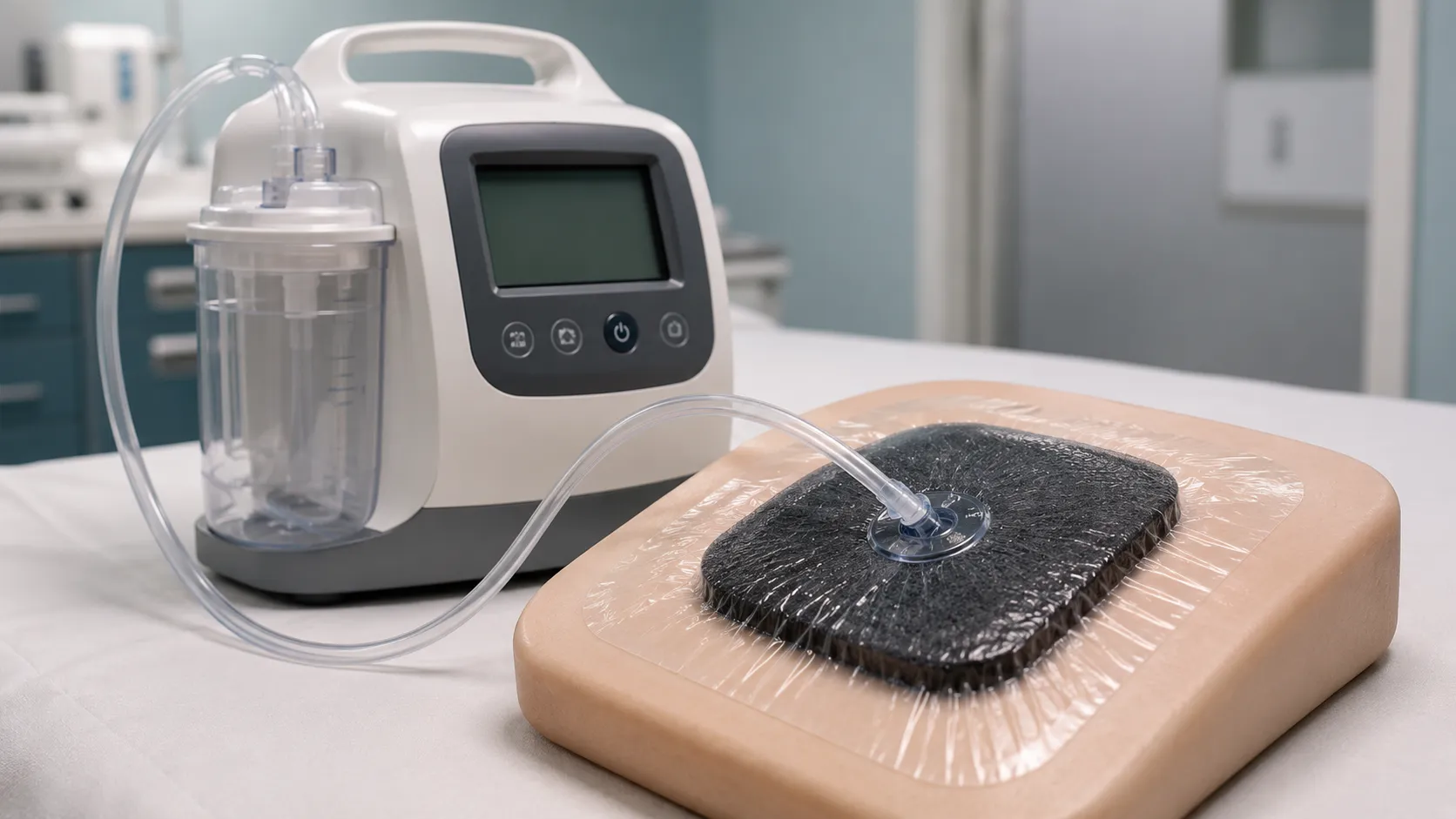
Wound vacuum therapy, more formally known as negative pressure wound therapy, applies controlled suction to a sealed wound to encourage healing. A film fills the wound, seals it airtight, and a pump draws the pressure below atmospheric, typically in the region of minus 125 y. That gentle vacuum pulls the wound edges together, removes fluid and creates conditions that favour new tissue.
This article explains the therapy itself: why negative pressure helps a wound heal, which wounds it suits and how the dressing interface is chosen. It is written for clinical and procurement readers who want to understand the mechanism before weighing up the equipment that delivers it.
How negative pressure aids healing
The benefit comes from several effects working together. First, the suction physically draws the wound margins inward, a mechanical pull often described as macrostrain that reduces the size of the cavity. Second, at the surface of the foam or gauze, the vacuum deforms the tissue in tiny amounts, a microstrain thought to stimulate cells to divide and lay down new granulation tissue. Third, the pump continuously removes exudate and inflammatory fluid that pool in an open wound, reducing the volume of exudate and breakdown products on the wound. Oedema is believed to improve blood flow to the tissue, bringing oxygen and nutrients to the site of repair across many wound types, creating a cleaner bed and faster formation of the granulation tissue that a wound needs before it can close or be grafted. A further practical benefit is that the sealed dressing contains exudate and odour and can stay in place for several days between changes, which reduces the disturbance to a healing wound compared with frequent conventional dressings. None of these effects works in isolation; it is the combination of pull, stimulation and fluid removal, sustained over time, that changes the trajectory of a stalled wound.
Continuous, intermittent and variable pressure
Therapy can be delivered as a steady vacuum or in cycles. Continuous pressure holds a constant level and is often used at the start or on wounds where a stable seal is hard to maintain. Intermittent and variable modes cycle the pressure up and down, which some evidence links to more vigorous granulation, though cycling can be less comfortable. The target level is set by clinicians for the wound, with lower pressures used where tissue is fragile. The point for a general reader is that the therapy is not one fixed setting; it is a prescription of level and mode chosen for the individual wound. A wound with a fresh graft may need a gentle, steady pressure to hold the graft without shear, while a deep, heavily exuding cavity may be run at a higher level to keep the bed clear. Reviewing the response and adjusting the setting over the course of treatment is part of using the therapy properly rather than fitting it and forgetting it.
The dressing interface: foam versus gauze
What fills the wound shapes how the therapy behaves. Open-cell foam distributes the negative pressure evenly and encourages rapid promotion, which makes it a candidate for larger cavities, but it can grow. However, the tissue, if left too long, is changed on schedule. Gauze interfaces conform readily to shallow or irregular wounds and tunnels and may be gentler on the wound bed, at some cost to the vigour of granulation. The choice depends on the wound's shape, depth and the state of the tissue. A sealing film and a port or pad connect the filler to the tubing, and a good seal is essential, because a leaking dressing loses the therapeutic pressure.
Which wounds the therapy suits
Negative pressure is used across a broad span of wounds. Chronic wounds such as pressure ulcers, venous and diabetic foot ulcers often respond well because the therapy manages heavy exudate and encourages granulation. Acute and traumatic wounds, and surgical wounds that have opened (dehisced), are common indications. It is also used to secure and improve the take of skin grafts and flaps, holding the graft against the bed while removing fluid beneath it. In each case the therapy is a means to prepare or close the wound, not an end in itself, and it is applied within a broader wound-management plan.
When it is not appropriate
Negative pressure is not suitable for every wound, and understanding the limits is part of understanding the therapy. It is generally avoided where the wound contains untreated infection or dead tissue that has not been debrided, where there is exposed blood vessel, organ or an unexplored fistula, and where malignancy is present in the wound. Applying it over these situations can cause harm, which is why clinical assessment always precedes therapy and why the equipment carries clear warnings. Any bleeding into the canister is treated as urgent. These issue cautions are clinical decisions, but a buyer should know they exist because they shape training and safe-use requirements.
Standards and safe use
A negative pressure wound therapy system is a medical device that must carry valid UKa CA bear a m and its electrical pump falls under the gis subjlocalcal safety standard IEC 60601-1. NICE publishes clinical guidance on wound care and on specific therapies; general information for the public is available through the NHS. The MHRA regulates the devices in the UK and issues safety information. Safe delivery depends as much on trained staff and correct dressing technique as on the pump, so any adoption should pair the equipment with competency-based training.
What this means for wound services
For a service planning to use the therapy, the mechanism explains the practical demands: a reliable airtight seal, appropriate filler for each wound, a prescribed pressure and mode, and vigilant monitoring of exudate and the wound bed. The therapy shortens the journey to closure or grafting for many difficult wounds, but only when applied to the right wound with good technique. Understanding how the therapy works- pressure- is the foundation for using it well and for judging whether a device fits a given care setting. Our team can help wound services scope therapy provision — register as a buyer or reach us through the contact page.
Checklist for understanding the therapy
-
Confirm the mechanism: edge approximation, tissue stimulation, exudate and oedema removal.
-
Know that pressure level and continuous, intermittent or variable mode are clinically prescribed.
-
Match the interface — foam for cavities, gauze for shallow or irregular wounds.
-
Recognise suitable wounds: chronic ulcers, dehisced surgical wounds, grafts and flaps.
-
Respect contraindications such as untreated infection, exposed vessels and malignancy.
-
Treat bleeding into the canister as an urgent event.
-
Pair any therapy with competency-based staff training and clinical oversight.
Conclusion
Wound vacuum therapy heals by combining a mechanical pull on the wound edges, gentle stimulation of the tissue, and continuous removal of fluid and swelling, which together build the granulation a wound needs to close. It suits a wide range of chronic, surgical and traumatic wounds. It helps secure grafts, but only within clear clinical limits and with a well-trained staff. With grasping, the mechanism is the good step; matching the right delivery device is the next. MediGear can help wound services understand the therapy and plan provision that fits the patients they treat.
Disclaimer
This article is for informational purposes only. It is published by MediGear (medigear.uk) for general information and procurement guidance, and is not cli. It is not diagnostic treatment, technical, engineering, legal, or regulatory advice, nor a product endorsement, guarantee, or substitute for professional assessment. MediGear does not provide medical consultations. Buyers should consult their clinical, biomedical, estates and regulatory contacts, and the manufacturer's documentation, and independently verify all specifications, certifications, compatibility and suitability before purchase. Specifications, certifications and availability are correct at the time of publication and may change without notice. MediGear is a medical-equipment distributor and does not sell medicines or pharmaceutical products.