
Endovascular surgery treats blood vessel disease from inside the vessel, working through a small puncture rather than a large open incision. The surgeon or interventional radiologist passes slim instruments through the arterial or venous system under X-ray guidance to reach the target, then repairs or reopens the vessel there. Because the approach avoids opening the body cavity, it generally means smaller wounds, faster recovery and treatment options for patients who could not tolerate open surgery.
For a buyer, endovascular work is defined by an imaging environment and a large, mostly single-use inventory of guidewires, catheters, sheaths and implants. This overview explains the approach and equipment categories involved so you can plan the estate and consumable supply chain around it.
How the endovascular approach works
Access begins with a needle puncture of an artery or vein, commonly at the groin or wrist. A sheath holds the entry point open, and through it the operator advances a guidewire, a fine, steerable wire that finds the route through the vessels. Catheters track over the wire to deliver contrast, exchange devices or carry a treatment to the target. Live X-ray imaging with contrast, called fluoroscopy and angiography, shows the vessels and the instruments throughout. The whole procedure is a sequence of exchanges over the wire, which is why compatibility between sizes and systems matters so much.
The imaging environment
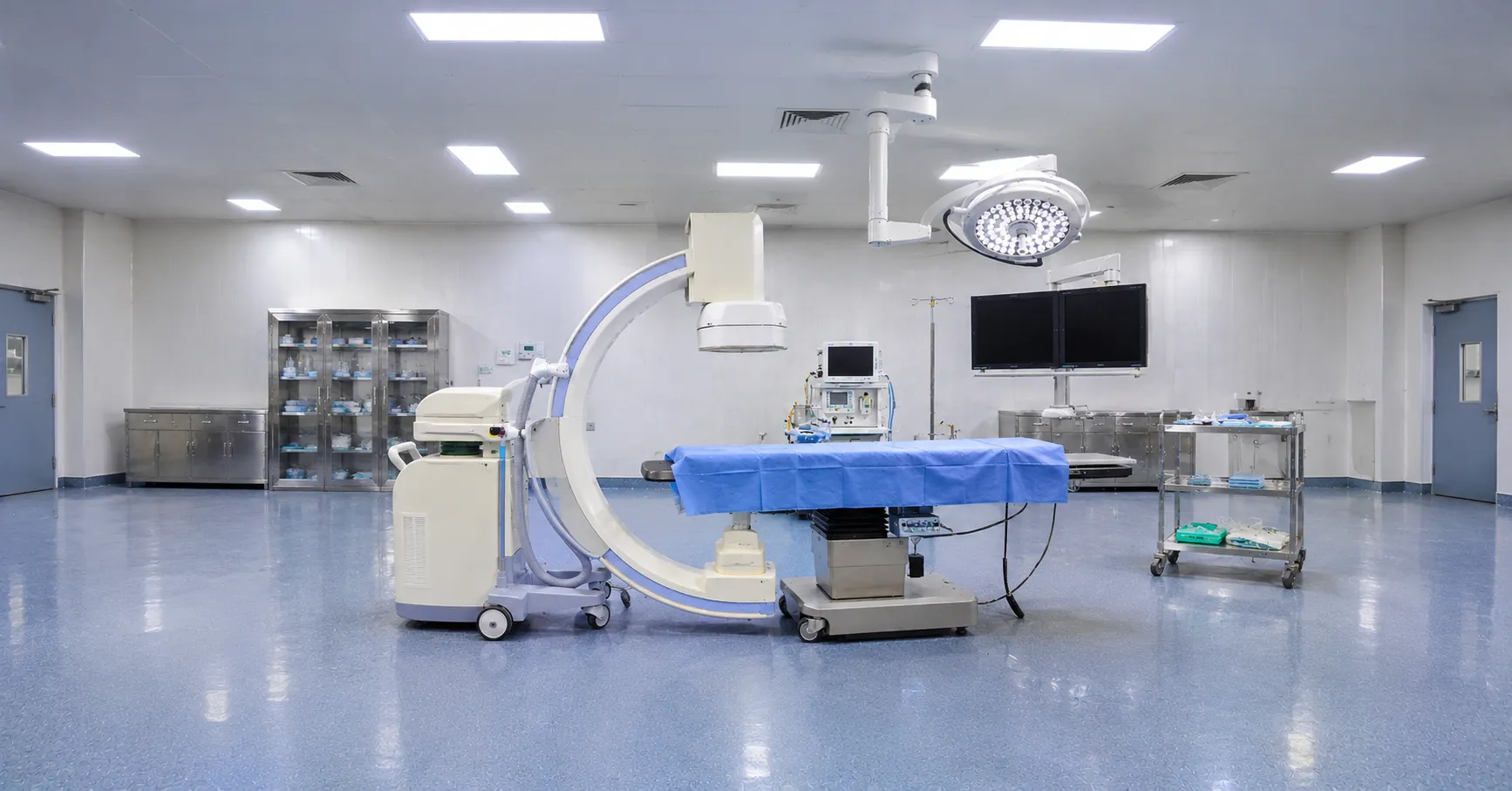
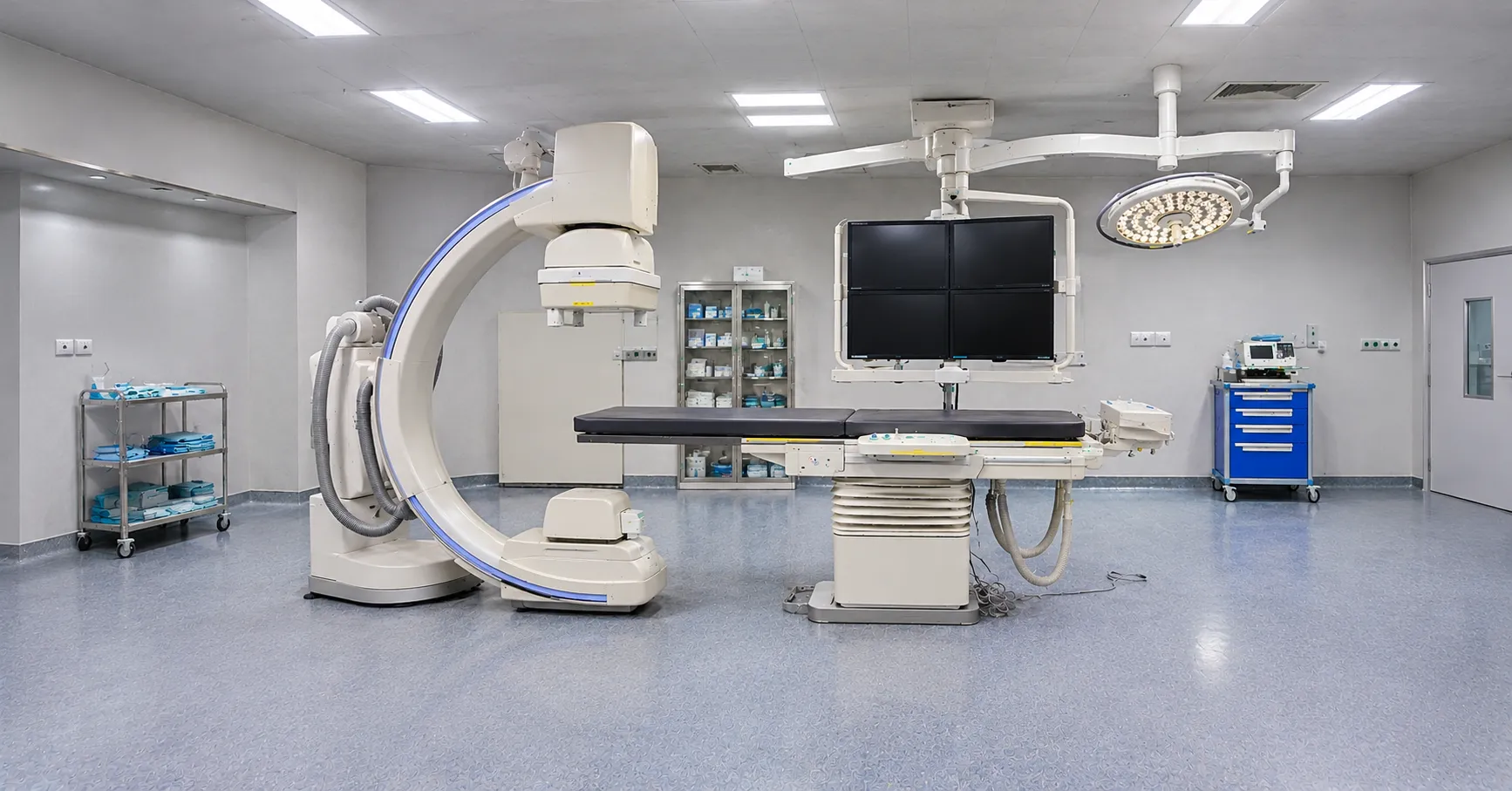
Imaging underpins vascular work. Fixed angiography suites and hybrid theatres use a high-specification C-arm or ceiling-mounted system with digital subtraction angiography, which removes background anatomy to show contrast-filled vessels clearly. C-arms serve lower-complexity or occasional work. Because these procedures use ionising radiation and iodinated contrast, radiation protection and dose management are central, and staff, room shielding and monitoring must meet UK radiation regulations—guidance and the MHoversguidance device and radiation safety expectations that estates and radiation protection teams should confirm.
Hybrid theatres
A hybrid theatre combines full open-surgery capability with fixed high-quality imaging in one room, so a case can switch between endovascular and open techniques without moving the patient. These are major capital and building projects involving imaging, theatre ventilation, shielding and integration, and they sit at the top of the endovascular estate. Because they serve several specialities, scheduling and utilisation need planning so an expensive room is not left idle, and the imaging, table, and integration should be specified against the mix of cardiac, vascular, and other work it will host.
The core consumable categories
The bulk of endovascular spend is disposable. Access sheaths and introducers maintain the entry point and come in a range of diameters, usually measured in French, and lengths. Guidewires vary by diameter, stiffness, tip shape and coating, each suited to different vessels and tasks. Catheters include diagnostic shapes for navigation and contrast injection, and guide catheters that provide a stable channel for delivering devices. Contrast media and injectors deliver a controlled bolus to opacify the vessels. This overview treats these as categories; individual device families such as angioplasty balloons are specialist subjects in their own right.
Implants and treatment devices
Beyond the navigation kit sit the devices that treat the disease. Stents hold a vessel open, and covered stent-grafts line and seal aneurysms, most notably in endovascular aneurysm repair of the aorta. Embolisation devices such as coils and plugs block abnormal or bleeding vessels. Retrieval and thrombectomy devices remove clot. Vessel closure devices seal the puncture at the end. Each family has its own sizing, compatibility and shelf-life considerations, and most are single-use, sterile and individually traceable.
Radiation and contrast safety
Two hazards shape every endovascular service. Ionising radiation from fluoroscopy exposes both patients and staff during procedures, so dose is actively managed through collimation, low-dose imaging settings, distance and shielding, and is monitored with personal dosimeters. Iodinated contrast, needed to make vessels visible, carries its own precautions around kidney function and reactions that the clinical team manages case by case. For a buyer, these are not abstractions: they translate into recurring purchases of lead aprons, thyroid shields, ceiling- and table-mounted screens, dosimetry services and contrast, and into a room design that meets UK radiation regulations. Building these running costs into the business case from the start avoids a suite that is imaging-capable but under-protected.
Specifications and compatibility a buyer must check
Endovascular inventory only works as a system. French sheath size, guidewire diameter (in inches), and catheter inner lumen must all match across the set you stock, or the device will not pass. Length compatibility matters too, since a catheter must be long enough to reach yet short enough to allow device exchange. When buying implants, confirm the deployment system, the sizing range against your typical caseload, and the imaging markers that make the device visible under fluoroscopy. Standardising on compatible families reduces the risk of an on-table mismatch and simplifies stock control.
The people and the room around the equipment
Endovascular equipment does not stand alone. Procedures need a team trained in catheter technique and radiation safety, a nursing and radiography workforce familiar with the inventory, and immediate access to open surgical backup for the minority of cases that must convert. From a buying view, this means the estate decision and the staffing model are linked: a hybrid theatre is wasted without the team and case volume to justify it, while a service leaning on a mobile C-arm needs to be honest about the complexity it can safely support. Staff radiation dose is managed with lead protection, ceiling-mounted shields and personal dosimetry, all of which are recurring commitments rather than one-off purchases.
Where endovascular work is delivered
Settings vary widely. Tertiary vascular and interventional radiology centres run fixed high-specification suites and hybrid theatres for complex aortic and neurovascular work. District general hospitals may deliver lower-complexity peripheral and access procedures with a mobile C-arm and a focused consumables range. Cardiacer laboratories overlap heavily in equipment but are configured around coronary and structural heart work. Matching the imaging platform, consumable breadth, and traceability system to the tier of service you actually run keeps the estate proportionate and the inventory manageable.
Stock control, traceability and cost of ownership
Because implants are traceable medical devices, you need a system that records batch or serial numbers against the patient, manages expiry dates on a large sterile inventory, and supports recalls. Consignment stock arrangements are common for high-value, low-frequency implants so capital is not tied up in shelf stock. Model total cost around procedure volume, consumable consumption per case and wastage, not just unit prices. Your procurement team should agree supply reliability, expiry management and traceability support with each supplier.
Procurement checklist
-
Confirm the imaging environment: mobile C-arm, fixed suite or hybrid theatre.
-
Verify radiation protection, shielding and dose monitoring meet UK rules.
-
Standardise compatible sheath, guidewire and catheter sizes across the set.
-
Check implant deployment systems, sizing range and radio-opaque markers.
-
Ensure UKCA or CE marking and MHRA registration on all devices.
-
Put implant traceability, batch recording and expiry management in place.
-
Model whole-life cost on case volume, consumable use and wastage.
Conclusion
Endovascular surgery is best understood as an imaging suite plus a carefully matched inventory of wires, catheters, sheaths, and implants, all governed by compatibility, traceability, and radiation safety. Plan the estate, the supply chain, and the stock system together rather than piece by piece. To source endovascular consumables and implants for a UK service through vetted suppliers, talk to MediGear.
Disclaimer
This article is for informational purposes only. It is published by MediGear (medigear.uk) for general information and procurement guidance. It is not clinical, diagnostic, treatment, technical, engineering, legal or regulatory advice, nor a product endorsement, guarantee or substitute for professional assessment. MediGear does not provide medical consultations. Buyers should consult their clinical, biomedical, estates, and other contacts, and the manufacturer's documentation, and independently verify all specifications, certifications, compatibility, and suitability before purchase. Specifications, certifications and availability are correct at the time of publication and may change without notice. MediGear is a medical-equipment distributor and does not sell medicines or pharmaceutical products.