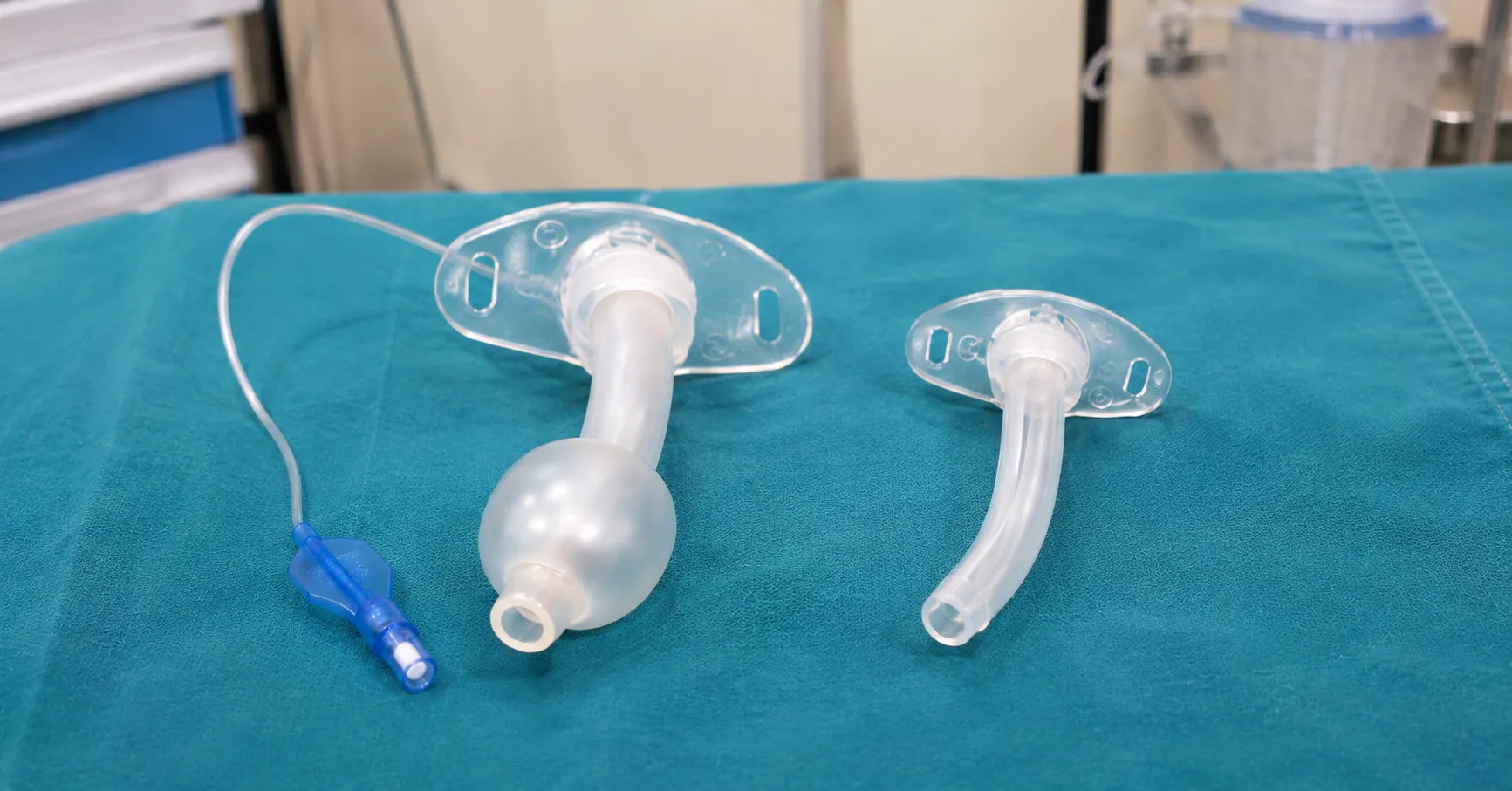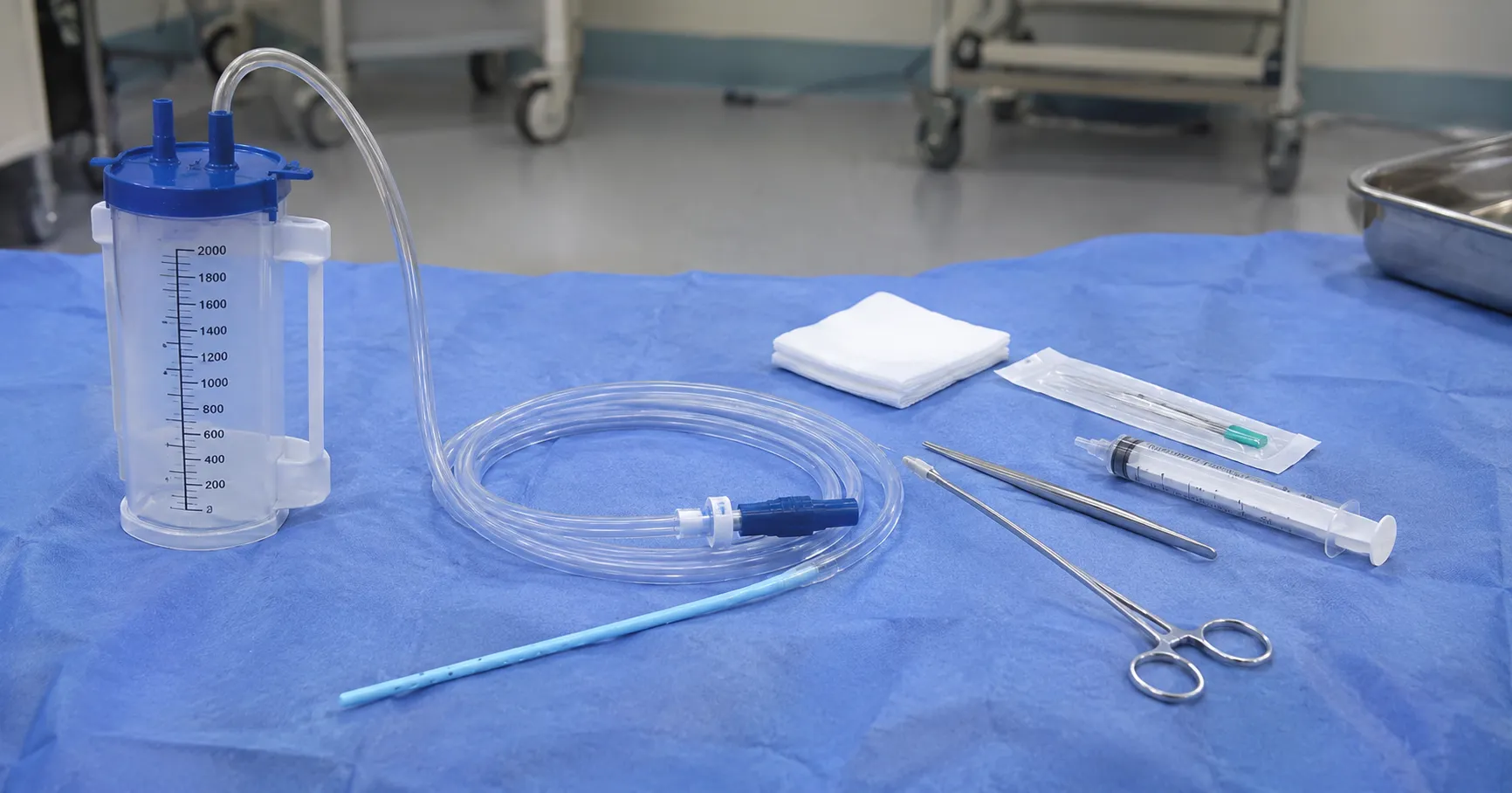

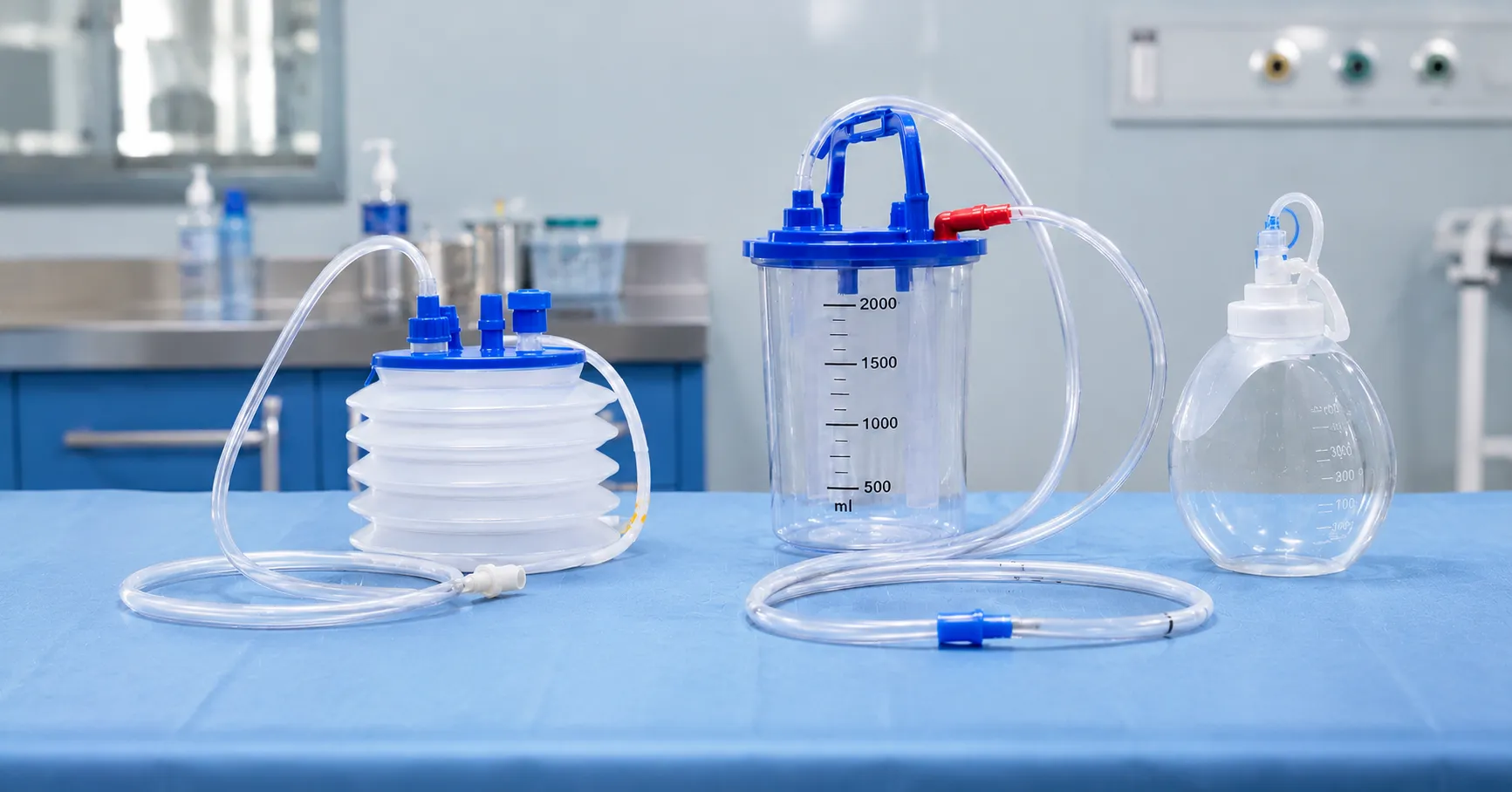
A surgical drain is a tube left in a wound or body cavity after an operation to remove serous fluid or pus that would otherwise collect. Removing that fluid obliterates dead space, lowers the risk of a haematoma or seroma forming and lets the surgical team monitor what is coming out. Drains fall into two broad families defined by how they move fluid: passive systems that rely on gravity and capillary action, and active systems that apply suction to pull fluid out.
For a procurement team, the choice is not one product but a small portfolio, sized and specified for different operations. This guide separates drain types, explains suction mechanisms, and sets out the specifications a buyer should confirm across general, orthopaedic, and breast surgery.
Passive drains
Passive drains let fluid escape along the path of least resistance without any applied vacuum. A corrugated drain presents ridged channels that guide fluid to a dressing or bag, while a soft tube drain relies on gravity to empty a cavity into a collection bag hung below the patient. These simple devices suit contaminated or infected spaces where a length of open tract is wanted, and where the low pressure of a passive route avoids drawing tissue into the drain. Their weakness is that output is harder to measure precisely and depends on patient position.
Active closed-suction drains
Active systems seal the wound and apply negative pressure so fluid is drawn out steadily and measured accurately. The widely used vacuum-bottle drain, often referred to by the trade name Redivac, connects a perforated tube to a rigid evacuated bottle that holds the vacuum. A concertina or bellows drain uses a hand-compressed spring or corrugated reservoir that re-expands slowly, generating suction as it recovers its shape. Because the circuit is closed, these closed-suction drains keep the exit site cleaner, collapse dead space effectively, and provide a gated volume reading, which is why they dominate clean elective surgery.
Sump drains
A sump drain adds a second lumen that lets filtered air enter as fluid leaves, preventing the suction from sucking tissue against the drain holes and keeping thick or particulate fluid moving. Use these when the output is heavy or viscous, such as some abdominal collections. The extra lumen means a larger overall bore and a specific connector, so confirm compatibility with your suction source.
Key specifications to check
The drain bore, quoted in French gauge, determines what fluid it can clear: a fine drain suffices for thin serous fluid after breast surgery, while a larger bore is needed for blood or debris. Look for a radiopaque line along the tube so the drain is visible on imaging, clearly graduated reservoirs for accurate output charting, and a secure, leak-free connector between the tube and reservoir. Reservoir capacity should match expected output so the container is not constantly at its limit. Material matters too: soft silicone is kinder to tissue than firmer PVC and is often preferred for longer dwell times.
Monitoring and removal
The Aidrain's value partly lies in the information it provides: nursing staff chart the volume and character of the output each shift, and a falling, non-bloody output usually signals that the drain has done its job. A well-designed reservoir makes this easy: clear graduations, a stable base and a way to empty and re-establish vacuum without breaking sterility. A reservoir that must be broken open to empty risks contaminating the circuit, so a sealed emptying port that re-establishes vacuum without exposing the contents is preferable. Decisions on when to remove a drain are clinical, but t. Still, either way, helpers can hinder monitoring, so buyers should favour reservoirs that are genuinely easy to read and record.
Standards, materials and single use
Surgical drains are sterile, single-use medical devices and must carry valid UKCA or CE marking with instructions for use. They are supplied terminally sterilised in a peel pouch, and the sterile barrier packaging should meet the recognised standard for such devices. Confirm the tube material, the presence of a radiopaque marker, and the biocompatibility statement in the instructions. As devices regulated by the MHRA, any failure such as a lost vacuum or a fractured tube should be reported. Drains are never reprocessed between patients.
Use across surgical settings.
General surgery uses tube and sump drains for abdominal collections; orthopaedic and spinal teams use closed-suction drains to clear the blood that a bony operation produces; breast and plastic surgery favour fine closed-suction drains to prevent seroma under skin flaps. Because expected output and fluid character differ so much, no single drain fits all, and a sensible store carries a small range of bores and reservoir sizes. Standardising on one or two families within each species, with specialist training and interchangeable connectors, simplifies the process and reduces the chance of a mismatched join when a drain is needed.
Fixation, exit-site care and safety features
A drain only works if it stays where it was placed and the circuit stays sealed. Fixation is usually a skin suture plus an occlusive dressing, and the tube design influences how securely it holds: a soft flange or suture wing gives the surgeon something to anchor to, while a radiopaque design reduces kinking. Buyers should consider whether the exit site is dressed and whether the manufacturer supplies a compatible anchoring device, because an accidental pull-out can mean a return to theatre or an unplanned procedure.
Safety detail at the reservoir end matters just as much. A one-way valve or anti-reflux design stops collected fluid tracking back toward the wound if the reservoir is raised above the patient. A clear indicator of whether the vacuum is still active- a compressed spring, a collapsed bellows or a marked bottle- tells staff at a glance that suction has not been lost. Non-return connectors and a spill-resistant closure make emptying safer. These features separate a well-engineered closed-suction drain from a basic tube, and are worth specifying rather than assuming, especially for drains that will stay in for several days.
Total cost of ownership
Individually inexpensive, drains add up through volume, so the practical levers are rationalising to dependable lines, matching reservoir size to real output to avoid waste, and ensuring connector compatibility so staff are not improvising joins. Because they are single-use and sterile, expired stock is pure loss, which rewards disciplined date rotation. Reliable supply matters more than headline unit price when a missing drain can hold up a theatre list.
Procurement checklist
-
Match drain type, passive tube, closed-suction or sump, to each speciality fluid.
-
Specify the French bore range needed for thin serous fluid through to blood and debris.
-
Confirm a radradiopaqueradiopaquey graduated, easy-to-read reservoir.
-
Check the reservoir vacuum type (rigid bottle or bellows) and its capacity against expected output.
-
Verify secure, compatible connectors between tube, reservoir and any wall suction.
-
Confirm tube material and biocompatibility, favouring soft silicone for longer dwell.
-
Request UKCA or CE documentation, sterile packaging and single-use confirmation.
Conclusion
Surgical drains are simple devices whose value depends on getting the type, bore and reservoir right for the operation, and on giving staff an accurate, readable measure of output. Buying well means carrying a considered range rather than a single default, insisting on radiopaque and dependable connectors, and keeping single-use stock in date. MediGear can help theatres and wards standardise their drain portfolio across specialities, register as a buyer, or reach the team via the contact page.
Disclaimer
This article is for informational purposes only. It is published by MediGear (medigear.uk) for general information and procurement guidance. It is not clinical, diagnostic, treatment, technical, engineering, legal or regulatory advice, nor a product endorsement, guarantee or substitute for professional assessment. MediGear does not provide medical consultations. Buyers should consult their clinical, biomedical, estates, and regulatory contacts and the manufacturer's documentation, and independently verify all specifications, certifications, compatibility, and suitability before purchase. Specifications, certifications and availability are correct at the time of publication and may change without notice. MediGear is a medical-equipment distributor and does not sell medicines or pharmaceutical products.