Tissue expansion is a surgical technique that grows extra skin and soft tissue by placing an inflatable silicone expander under the skin and gradually enlarging it over weeks. As the balloon is filled, the overlying skin stretches and generates new cells, creating a supply of well-matched tissue that can later cover a defect or accommodate a permanent implant. Its most common use is staged breast reconstruction, but the same principle also applies to burn-scar revision, correction of congenital lesions, and repair after removal of large skin lesions.
For a buyer, these are implantable devices with real traceability, sterility and compatibility obligations, not simple consumables. This guide outlinesguide outlines the components involved, the main expander types, and the specifications a procurement team should verify before ordering.
How the technique works
An empty or partly filled expander is implanted in a pocket beneath skin, fascia or muscle. Over the following weeks, the patient attends for serial inflations, when sterile saline is injected through a self-sealing port to add a defined volume each visit. The skin responds to the sustained mechanical tension by producing new tissue, a biological response rather than mere stretching, so the gain is durable. Once enough surface area has been generated, a second operation removes the expander and either closes the defect with the expanded skin or, in breast reconstruction, exchanges it for a permanent implant.
The core device: the expander
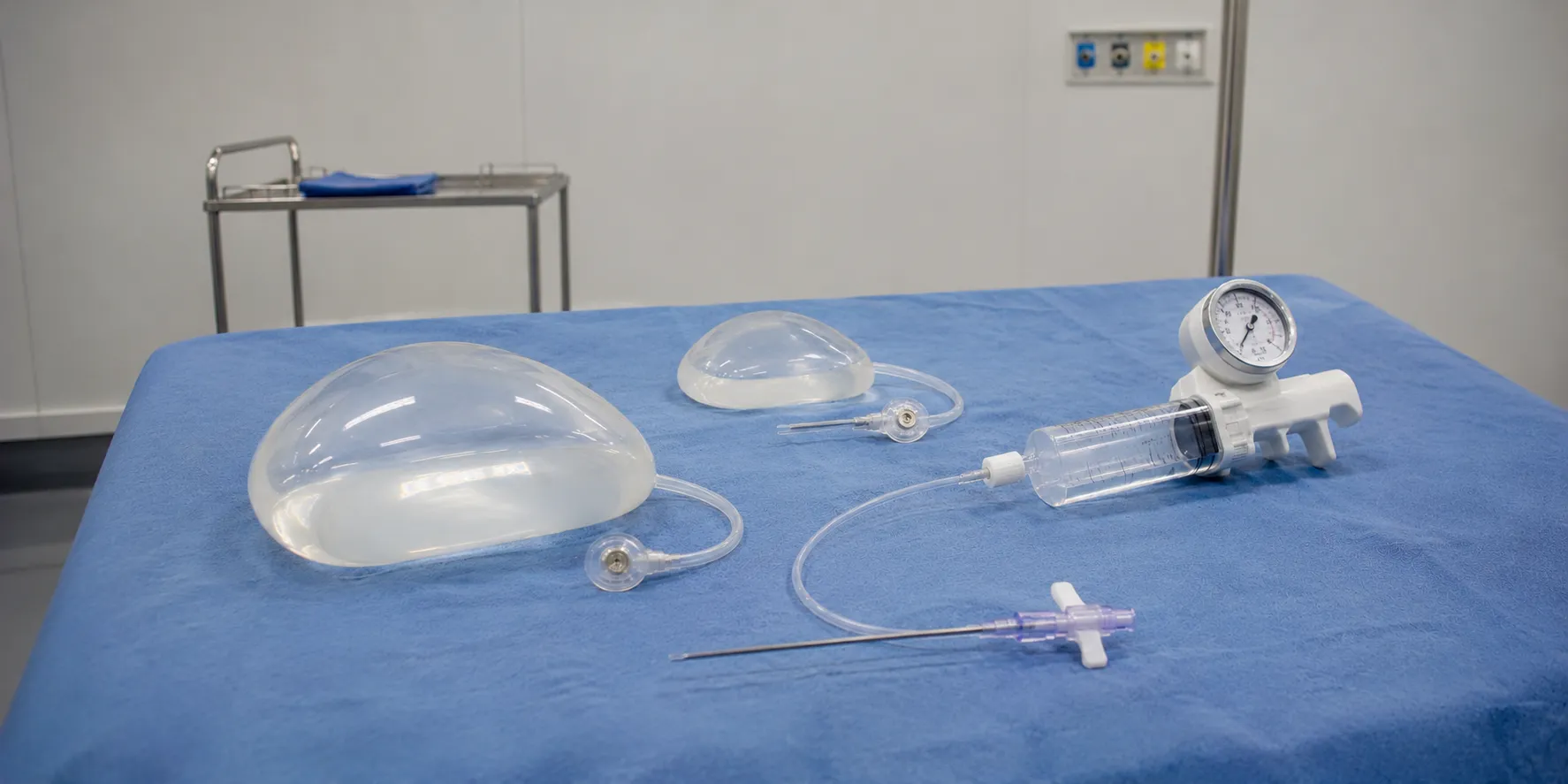
The expander itself is a silicone elastomer shell designed to hold saline under repeated inflation without leaking. Shells are offered with smooth or textured surfaces, and in a range of shapes, round, crescent, rectangular and anatomically contoured, so that the surgeon can match the expanded area to the reconstruction. Differential expanders are engineered to bulge preferentially in one zone, useful in breast work where lower-pole projection is wanted. The manufacturer specifies base dimensions, fill volume, and projection, and selecting the right combination is central to a good result.
Filling ports and access
Integrated versus remote ports
Saline is added through a valve that reseals after each needle puncture. An integrated port sits within the expander shell and is punctured directly through the skin, keeping the system compact but requiring accurate port placement. A remote port is a separate injection dome connected to the expander by tubing and placed away from the expansion site, useful where the skin over the expander is fragile, as in some paediatric and burn cases. Many integrated ports contain a metal base or magnet so a handheld magnetic locator can find them reliably before each fill.
Self-inflating osmotic expanders
A distinct class of osmotic expanders contains a hydrogel that draws in body fluid and swells over time, avoiding repeated injections. These are used in selected paediatric and specialised cases. They remove the injection schedule but give the surgeon less direct control over the rate of expansion, so they suit particular indications rather than routine breast reconstruction.
Consumables and ancillary kit
Beyond the expander, each programme needs sterile saline, fill sets with fine non-coring needles chosen to protect the self-sealing valve, and often a magnetic port locator. Some centres use a manometer to monitor pressure during filling. Buyers should treat the expander, its port, and the recommended fill accessories as a compatible system, since the manufacturer matches needle gauge and port design, and confirm what each kit aincludes nd what must be ordered separately.
Standards, traceability and regulation
Tissue expanders are sterile, single-use implantable medical devices and must carry valid UKCA or CE marking with full instructions for use. Because they are implants, lot and serial traceability matters: record the device identifiers so you can trace a patient in the event of a field safety notice, in line with the implant-tracking expectations the MHRA sets for the UK. Sterile barrier packaging should meet the recognised terminally sterilised packaging standard, and any electrical accessory such as a locator falls under the general medical electrical safety requirements. Check shelf life, since implants held in stock must be used within date.
Settings and case mix
Most expanders are used by plastic and reconstructive surgery teams. Breast reconstruction drives the largest volumes and favours anatomically shaped, textured or differential expanders with integrated ports. Burns and paediatric plastic surgery use round and rectangular expanders, often with remote ports to protect fragile skin, and are the main users of osmotic self-inflating devices. Knowing which specialities your trust serves tells you which shapes, sizes, and port types to stock, and how deep the range needs to be.
Planning volume and expansion, and known complications
Choosing the right expander is as much a planning exercise as a purchasing one. The final fill volume must generate enough surface area to cover the defect or accommodate the intended permanent implant, so surgeons work back from the target to select base dimensions and maximum volume, allowing headroom above the planned fill. Under-sizing leaves too little skin; over-sizing places needless tension on the flap. For breast reconstruction, the projection profile and base width match the opposite side, which is why a range of anatomical and differential shapes is worth stocking rather than a single round option.
Expansion is not without risk, and the device features that mitigate those risks are a fair procurement concern. Recognised problems include shell rupture or deflation, port failure or flipping, exposure through thin skin, infection and pain during filling. A robust, well-bonded valve, a clearly locatable port and a durable shell all reduce these events, so ask manufacturers about shell construction, valve design and any published reliability data. Where skin is fragile, a remote port that keeps needle punctures away from the expanded area is the safer configuration, which again shows why one design does not fit every case.
Total cost of ownership
Expanders are relatively high-value single-use implants, so the spend is dominated by the devices themselves plus the fill consumables and the theatre time for two operations. A wide size range ties up capital on the shelf, so many teams agree on consignment or just-in-time supply with a distributor rather than holding every size. Wastage from expired stock is the main avoidable cost, which again argues for disciplined date control and a supply arrangement that flexes with case numbers.
Procurement checklist
-
Confirm the shape, base dimensions, fill volume, and projection match the reconstructions your surgeons perform.
-
Decide integrated versus remote ports, and check for a magnetic locator where port finding is difficult.
-
Stock osmotic self-inflating expanders only where a speciality genuinely needs them.
-
Treat expanders, rt and fill needles as a matched system and confirm needle gauge compatibility.
-
Verify UKCA or CE marking, sterile packaging and full instructions for use.
-
Capture lot and serial numbers for implant traceability and field safety notices.
-
Control shelf life and consider consignment supply to limit capital tied up in a size range.
Conclusion
Tissue expansion turns a silicone balloon, a resealing port, and a schedule of saline fills into a supply of the patient's own skin, which is why device choice, port type, and traceability all warrant close attention. Buying well means matching shapes and sizes to the reconstructions actually performed, treating the expander and its fill accessories as one system, and keeping tight control of implant traceability and shelf life. MediGear can help reconstructive teams compare expander ranges and arrange dependable supply; register as a buyer or use the contact page.
Disclaimer
This article is for informational purposes only. It is published by MediGear (medigear.uk) for general information and procurement guidance. It is not clinical, diagnostic, treatment, technical, engineering, legal, or regulatory advice, nor a product endorsement, guarantee, or substitute for professional assessment. MediGear does not provide medical consultations. Buyers should consult their clinical, biomedical, and regulatory contacts and the manufacturer's documentation, and independently verify all specifications, certifications, compatibility, and suitability before purchase. Specifications, certifications and availability are correct at the time of publication and may change without notice. MediGear is a medical-equipment distributor and does not sell medicines or pharmaceutical products.