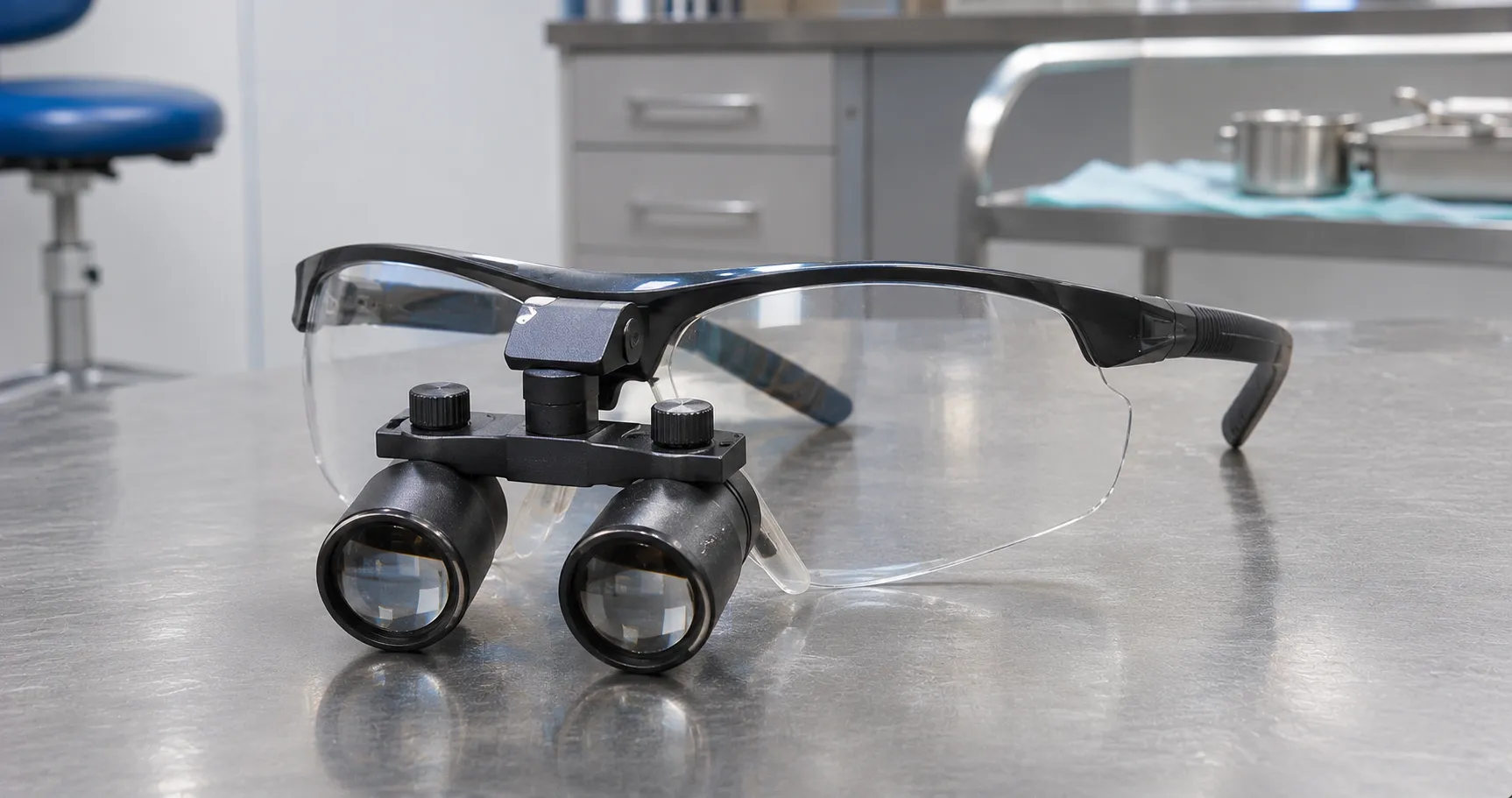
Surgical loupes are wearable magnifying lenses mounted on a spectacle frame or headband that enlarge the operative field, typically between 2.5x and 6x. They give surgeons and dental clinicians a bigger, brighter, closer view than the naked eye while keeping the hands free and the head mobile. Unlike a fixed microscope, loupes move with the wearer, which suits long lists and fine open work.
For a buyer, loupes are a personal, precision optical purchase. The right magnification, working distance, optical design, illumination and custom fit decide whether a clinician wears them all day or leaves them in a drawer. This guide explains each factor and how to procure sensibly.
How magnified visualisation works
Loupes use paired optical systems, one per eye, to converge two magnified images at a set point in space. The wearer sees a single enlarged, three-dimensional field. Because the eyes are already converging and focusing at close range, well-specified loupes actually reduce eye strain and let a clinician sit or stand upright rather than stooping—an ergonomic gain that matters over a career, not just a single case.
Magnification ranges and when to choose them
Higher magnification narrows the field of view and shrinks depth of field, so more is not automatically better. As a rough guide, 2.5x suits general surgery, wound work and routine dentistry with a wide field; 3.0x to 3.5x balances detail and field for most fine procedures; and 4.5x to 6x serves microsurgery, endodontics and detailed vascular or plastic work where the smallest structures must be seen. Buyers should map magnification to the actual procedures rather than over-specifying.
Working distance and declination angle
Working distance is the gap between the eyes and the operative field at which the image stays sharp. It must match the clinician's height and posture—too short forces a stoop, too long strains reach. Because it is personal, loupes are usually built to a measured working distance. The declination angle, how far the optics tilt down, lets the wearer look into the field while holding the head upright, protecting the neck. Both are ergonomic specifications, not optional extras.
Through-the-lens versus flip-up designs
Through-the-lens (TTL)
TTL loupes mount the optical barrels directly into the carrier lens, custom-set to the wearer's interpupillary distance, working distance and declination. They are lighter, give a wider field, and sit in a fixed, repeatable position. The trade-off is that they are built to one person and one prescription, so they cannot be shared or easily re-angled.
Flip-up
Flip-up loupes hinge the optics on an adjustable bracket in front of the carrier lens. They can be flipped clear without removing the frame, re-angled, and adjusted more readily, which suits shared use or a clinician whose needs may change. They are usually a little heavier and offer a slightly smaller field than TTL of the same power.
Field of view and depth of field
Two specifications decide how usable a given magnification feels. Field of view is how much of the operative site is visible at once; a wider field lets the clinician see surrounding structures without constantly repositioning. Depth of field is the range of distance that stays acceptably sharp without refocusing by moving the head, which matters enormously for comfort and for procedures where the working plane shifts. Both shrink as magnification rises, and good optical design partly offsets that loss. When comparing two pairs at the same nominal power, ask suppliers for the field-of-view and depth-of-field figures and, ideally, arrange a trial, because these numbers often separate a comfortable all-day pair from one that induces fatigue.
Optical design: Galilean versus prismatic
Lower-power loupes, around 2.5x to 3.5x, generally use a Galilean design—simple, light and compact. Higher powers use prismatic (Keplerian) optics, which fold the light path with prisms to deliver a wider field and better clarity at 4x and above, at the cost of extra weight. Lens coatings and quality glass reduce reflections and colour distortion, so optical quality, not just stated magnification, is worth comparing between suppliers.
Illumination and fit
A coaxial LED headlight clipped to the frame removes shadows cast by the surgeon's own head and dramatically improves what the magnified field reveals. Check the light's colour temperature, adjustable intensity, weight and battery runtime, and whether it balances the frame. Fit is the final make-or-break: interpupillary distance, frame weight and balance, adjustable nose pads and a secure headband all decide whether long-day comfort holds. Prescription inserts should be available for clinicians who wear glasses.
Frames, weight and durability
Loupes are worn for hours, so the frame is not cosmetic. Sports-style wraparound frames give a stable, secure fit and some eye protection, while lightweight titanium frames reduce fatigue for all-day wearers. Weight distribution matters more than the headline figure: a well-balanced pair feels lighter than a nominally lighter set that pulls at the nose. Adjustable, sprung temple arms and a rear headstrap keep heavier prismatic loupes stable during movement. Because loupes take knocks in a clinical environment, ask about the robustness of the optical mounts, scratch-resistant lens coatings, and whether individual barrels can be re-secured or realigned if they drift, rather than the whole unit being a cost of ownership and servicing.g
The lenses are only part of the spend. An LED headlight consumes rechargeable batteries that degrade and eventually need replacing, and bulbs or LED modules have a service life. Factor in the cost of prescription inserts, protective cases, cleaning supplies and any realignment or repair over a working life that can run many years. Because loupes are individually fitted, a change of clinician usually means a new pair or a costly remake, so consider how staff turnover affects the fleet. Buyers who model these lifetime costs—alongside the initial optics—compare quotes far more accurately than those looking at the sticker price alone.
Standards, procurement and care
Loupes and their light sources sold in the UK should carry UKCA or CE marking, with any medical LED illumination meeting the relevant electrical safety and photobiological safety standards; the MHRA regulates medical devices placed on the market. Because loupes are individually built, confirm the measurement and fitting process, lead times, adjustment and remake policy, warranty on frame and optics, and the cost and availability of replacement batteries and bulbs. A structured comparison through an equipment buyer service keeps competing quotes on the alignment timeline and specifications
-
Match magnification to the procedures—wide field at 2.5x versus fine detail at 4.5x plus.
-
Specify measured working distance and declination angle per wearer.
-
Decide TTL for lightweight fixed use or flip-up for adjustability and sharing.
-
Compare optical quality and coatings, not just the stated power.
-
Check the LED headlight's weight, colour temperature, intensity and runtime.
-
Confirm UKCA or CE marking and the supplier's electrical safety, fitting, return policy, warranty and spare batteries or bulbs.
Conclusion
Surgical loupes reward careful specification. The best purchase matches the wearer—right magnification for the work, working distance and declination for their posture, TTL or flip-up for their pattern of use, and illumination that suits the field. Because they are personal optical devices, the fitting process, remake policy and after-sales support matter as much as the lenses. Facilities that compare optical quality, ergonomics and service—rather than headline magnification alone—equip clinicians with loupes they will actually wear. You can review loupe options and arrange fitting through MediGear.
Disclaimer
This article is for informational purposes only. It is published by MediGear (medigear.uk) for general information and procurement guidance. It is not clinical, diagnostic, treatment, technical, engineering, legal or regulatory advice, nor a product endorsement, guarantee or substitute for professional assessment. MediGear does not provide medical consultations. Buyers should consult their clinical, biomedical, estates, and regulatory contacts and the manufacturer's documentation, and independently verify all specifications, certifications, compatibility, and suitability before purchase. Specifications, certifications and availability are correct at the time of publication and may change without notice. MediGear is a medical-equipment distributor and does not sell medicines or pharmaceutical products.