A vascular clamp is a hinged instrument that temporarily occludes a blood vessel to stop or control flow so a surgeon can open, repair, anastomose, or graft an artery without losing the field to bleeding. Unlike artery forceps, a vascular clamp grips thegrips the vessel wall firmly enough to seal it but gently enough not to crush the delicate intima, which is why its jaws carry fine, atraumatic serrations rather than sharp teeth. This guide explains the main clamp types, how they achieve controlled occlusion, and the specifications and standards a buyer must weigh — the clot-removal catheters used inside the vessel are a separate subject.
For a theatre or vascular service, clamps are reusable capital instruments bought to last through years of decontamination cycles; therefore, pattern, spring behaviour, and material quality determine their real value.
How a vascular clamp controls flow
Control comes from two things working together: the occluding force and the atraumatic jaw. The jaws close on the vessel with just enough pressure to stop flow, and a ratchet or a spring holds that closure so the surgeon is free. The jaw faces carry rows of fine, shallow serrations, often in a longitudinal or cross-hatch pattern designed to hold the wall without cutting or fracturing the inner lining. Damage to the intima can seed thrombosis or later narrowing; a non-traumatic design is the defining feature that separates a true vascular clamp from a general haemostat.
The main types you will compare.
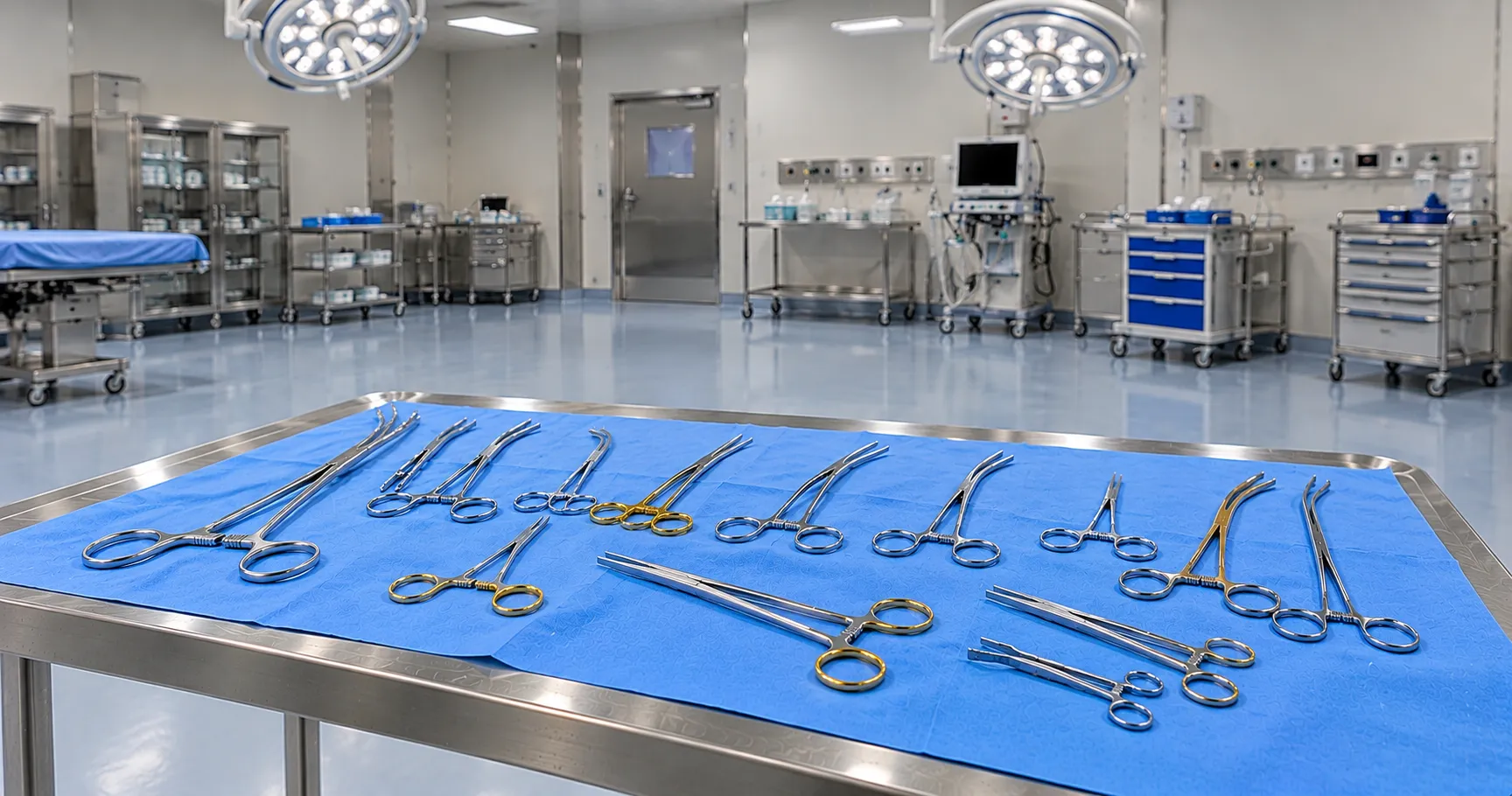
Bulldog clamps
Small, self-closing spring clamps that hold a vessel shut by their own tension, applied and removed with an apply forceps. They suit smaller arteries and situations where a low profile keeps the clamp out of the surgeon’s way; they come in a range of lengths and jaw pressures for different vessel calibres.
Cross-clamps and angled clamps
Larger ratcheted clamps, often named after the surgeons who designed them, occlude major vessels such as the aorta or iliac arteries. Straight, curved and angled patterns let the surgeon reach and occlude a vessel at the right angle without obscuring the repair. The handle ratchet lets the operator dial in and lock the closing force.
Side-biting and partial-occlusion clamps
A partial-occlusion clamp, such as a Satinsky pattern, grips a portion of a large vessel wall while leaving the rest of the lumen open, so flow continues while an anastomosis is sewn onto the clamped segment. This is how left-sided clamps can be used to join an artery without stopping circulation entirely.
DeBakey-jaw instruments
Many vascular clamps use the DeBakey atraumatic jaw pattern, a fine multi-row serration recognised for holding tissue securely with minimal trauma. The pattern appears across clamp sizes and is a common reference point when comparing jaw quality.
Matching jaw pressure to vessel
The occluding force a clamp applies is not a single value across a set. A clamp intended for a soft, thin-walled vein or a small artery is designed to close with a lighter pressure than one built to hold a thick-walled, calcified major artery, and applying too heavy a clamp to a delicate vessel risks the intimal injury the atraumatic jaw is meant to prevent. Some manufacturers publish a graded range of jaw pressures so a service can pick the right instrument for each calibre. When you assemble a set, think of it as a graded family — light bulldogs through to firm cross-clamps — rather than a single design stretched across every vessel.
Key specifications a buyer must check
Beyond the type, several details decide whether a clamp performs. Check the jaw length and the serration pattern, which must match the vessel calibre you work on. Consider the shaft shape — straight, curved or angled — and the reach needed for the anatomy. Assess the closing mechanism: a spring bulldog versus a ratcheted handle, and how finely the ratchet lets you control force. Consider overall length for the depth of field, and the profile, since a low profile keeps the clamp clear of the working area. Material and finish matter for longevity, and the instrument must sit within your existing trays and sterilisation cycles.
Materials, jaw inserts and finish.
Vascular clamps are made from surgical-grade stainless steel chosen for corrosion resistance and spring memory, so they keep their clamping force over years of use. Some patterns use replaceable atraumatic jaw inserts, which can be renewed when worn rather than scrapping the whole clamp. The surface finish—satin or matte to cut glare, or a passivated finish for corrosion resistance— and smooth box joints affect service life and how easily the instrument cleans; when comparing suppliers, ask how they inspect jaws and occlusion, because a clamp with poorly meeting jaws will leak or grip unevenly.
Decontamination, inspection and maintenance
Reusable clamps go through a validated decontamination process between uses: cleaning, inspection, jointlubrication, and and steam sterilisation. The atraumatic jaws deserve particular attention, because bent teeth, misalignment or a weak spring reduce occlusion and can injure a vessel. Keep them ready for the next case.
Standards, regulation and provenance
Surgical clamps are medical devices and should carry valid UKCA or CE marking, supported by the manufacturer's and sterilisation instructions. The MHRA oversees medical devices in the UK. Reusable surgical instruments are processed to recognised sterilisation and decontamination standards, and instrument steel is typically specified against ISO material standards for surgical instruments; ask a supplier to state the grade and provenance rather than accept an unmarked product. Because these instruments handle blood, sharps, and body fluids, safety requirements apply to use and reprocessing. Retain the instructions for use and any conformity documentation with your asset records.
Use across settings and buying well.l
A full vascular set spans clamp types, from bulldogs for small vessels to large cross-clamps and partial-occlusion clamps for major arteries, and the mix depends on the service. A tertiary vascular unit needs the whole range in depth; a general theatre doing occasional vascular access needs a smaller, well-chosen set. Because clamps are durable capital items, the buying decision favours proven jaw quality, consistent occlusion and long-term availability of matching instruments and spare inserts over the lowest headline price. Standardising jaw patterns across a set also simplifies training and tray assembly.
-
Match jaw length and serration pattern to the vessel calibre you operate on.
-
Choose straight, curved or angled shafts for the anatomy and reach required.
-
Confirm the occluding mechanism — spring bulldog or ratcheted handle — suits the case.
-
Check jaws meet cleanly and occlude evenly across the full jaw length.
-
Prefer patterns with replaceable atraumatic inserts where lifetime cost matters.
-
Verify surgical-grade steel, UKCA or CE marking and supplied reprocessing instructions.
-
Ensure compatibility with your existing trays and sterilisation cycles.
Conclusion
Vascular clamps give a surgeon controlled, temporary occlusion so an artery can be opened and repaired without losing the field, and their value lies in the atraumatic jaw that holds firmly without crushing the intima. Buying well means matching clamp type and jaw pattern to your vessels, insisting on proven steel and clean occlusion, and securing long-term supply of instruments and spare inserts. To assemble or extend a vascular instrument set, register as a buyer or contact the MediGear team.
Disclaimer
This article is for informational purposes only. It is published by MediGear (medigear.uk) for general information and procurement guidance. It is not clinical, diagnostic, treatment, technical, engineering, legal or regulatory advice, nor a product endorsement, guarantee or substitute for professional assessment. MediGear does not provide medical consultations. Buyers should consult their clinical, biomedical, estates, and regulatory contacts, and the manufacturer, and verify all specifications, certifications, compatibility, and suitability before purchase. Specifications, certifications and availability are correct at the time of publication and may change without notice. MediGear is a medical-equipment distributor and does not sell medicines or pharmaceutical products.