Surgical hemoclips used in endoscopy are small metal clips deployed through a flexible scope to grip a bleeding vessel or tissue defect and hold it closed, stopping haemorrhage inside the gastrointestinal tract without open surgery. Delivered down the working channel of a gastroscope or colonoscope, the clip is positioned over a bleeding point — an ulcer with a visible vessel, a post-polypectomy site, a diverticular bleed or a small perforation — and released to pinch the tissue together. This guide covers the endoscopic clip specifically: how through-the-scope and over-the-scope clips work, the specifications a buyer checks, and the sterility, MRI and standards points that matter. Open-surgical ligature clips and their appliers are a separate topic.
For an endoscopy unit, these clips are sterile, single-use consumables, and compatibility, jaw span, rotation, and reliable supply determine whether the haemostasis trolley is genuinely ready when a patient bleeds.
How endoscopic clips achieve haemostasis
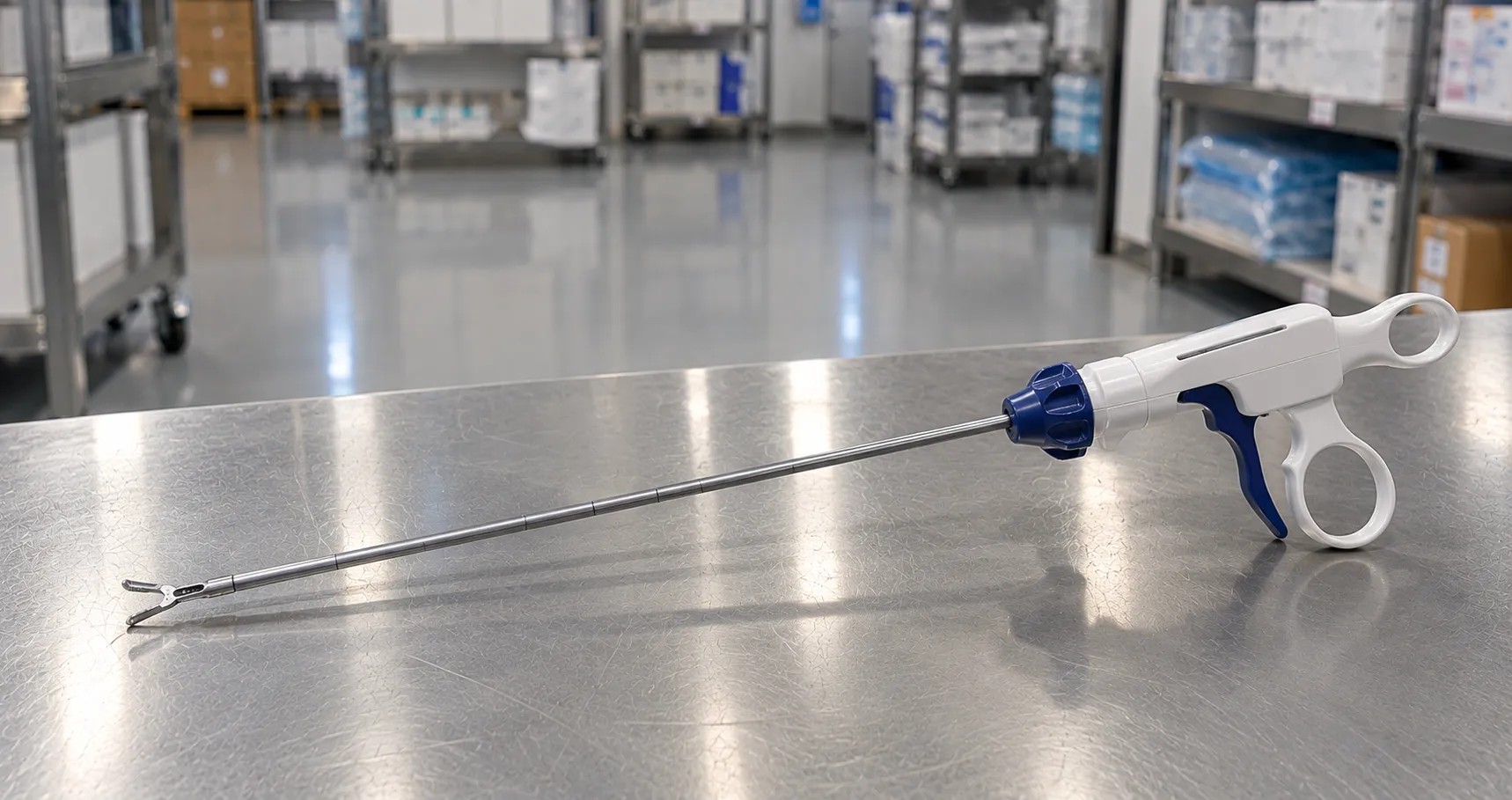
The mechanism is mechanical rather than thermal. The clip has two or more sprung arms that, once released, close on the tissue and hold it under tension, compressing the vessel and approximating the wound edges so bleeding stops. Because it relies on mechanical compression, it avoids the collateral heat of cautery, which matters near a thin or already-injured wall. The operator carries the clip to the target on a delivery catheter passed through the scope’s working channel; they open the arms, orient them across the target, then close and deploy. The clip then stays in place, holds the tissue while healing begins, and naturally separates and passes out of the body in time.
Through-the-scope versus over-the-scope clips
Through-the-scope (TTS) clips
The everyday workhorse. A TTS clip is loaded on a catheter that passes down the working channel, so no scope withdrawal is needed and multiple clips can be placed in sequence. Modern designs open and close repeatedly before final deployment, letting the operator reposition until placement is right, and many rotate so the arms align with the vessel. They handle most routine GI bleeding and defect closure.
Over-the-scope clips (OTSC)
A larger clip mounted on a cap fitted to the scope tip, released like a band to capture a bigger bite of tissue with greater compressive force. These are used for larger vessels, refractory bleeding that resists standard clips, and closure of perforations or fistulae where a stronger, full-thickness grip is needed. They apply more force over a wider area than a TTS clip, so a unit stocks both for different jobs.
Where clips sit among haemostasis methods
Mechanical clips are one tool on a therapeutic endoscopy trolley, not the only one, and a buyer equips the whole shelf rather than a single product. Injection therapy, thermal methods such as heater probes and bipolar coagulation, and topical haemostatic powders sit alongside clips, and clinicians often use them in combination. Clinicians use clips to secure a discrete bleeding vessel, a visible vessel in an ulcer base, or to close a small defect after resection, where a mechanical grip is preferable to heat near a thinned wall. Because the choice is made in the moment, the practical implication for stock is breadth: a unit needs clips available in the same place as its injection needles, thermal accessories, and powders, all in date, so the endoscopist can reach for whatever the situation calls for without leaving the room. That combined-stock view is what keeps a therapeutic list running safely.
Key specifications a buyer must check
Several details separate one clip system from another. Jaw span, the open width of the arms, determines how wide a lesion the clip can bridge, and units often stock more than one span. Rotation and repositioning capability make placement quicker and more accurate. Compatibility is critical: the delivery catheter must pass the working-channel diameter and length of your endoscopes, so confirm the clip fits the scopes you run. Consider the deployment mechanism and how intuitive it is, the number of clips likely needed per case, and whether the design is single-preloaded or a reloadable handle. For over-the-scope systems, check the cap sizes against your scope tips.
MRI safety and imaging
Because clips stay in the patient after the procedure, their material behaviour in imaging matters. Many endoscopic clips are MRI-conditional and designed to detach over time, but conditions vary by product, so check and record the manufacturer’s MRI compatibility statement. Some clips are engineered specifically to minimise imaging artefact. When comparing products, confirm the stated MRI conditions and any waiting period, and ensure radiology has this information, because a patient may need a scan while a clip is still in place.
Sterility, single-use, and supply
Endoscopic clips are sterile single-use devices supplied in an intact sterile barrier, and they must never be reprocessed. Check the sterilisation method, expiry dating, and batch traceability, and rotate stock so nothing on the haemostasis trolley expires unnoticed. Because a bleeding patient allows no time to source stock, the practical priority is holding a sensible range — different jaw spans, and both TTS and over-the-scope options — in dependable supply. Standardising on a system your endoscopists know also cuts hesitation during an urgent case.
Standards, regulation and records
Endoscopic haemostasis clips are single-use medical devices and must carry valid UKCA or CE marking, with the manufacturer’s instructions for use supplied and followed. The MHRA regulates these devices in the UK, and clinical societies that inform NICE guidance describe where mechanical clipping sits among haemostasis options. Because endoscopy involves body fluids and decontaminated reusable scopes, the HSE framework applies infection-control and safe-handling duties around the procedure. Record the clip batch number against the patient episode and keep the MRI-conditional information accessible for future imaging.
Use across settings and total cost.
Endoscopic clipping is used across acute endoscopy units, from district general hospitals to tertiary centres, and in both elective and emergency lists. A busy unit doing therapeutic endoscopy and out-of-hours bleeding work needs a deeper, broader stock than a unit doing mainly diagnostic scopes. The recurring cost is the clips themselves, and several may be used in one case, so model consumption against your therapeutic caseload rather than total procedure numbers. When weighing value, compare unit price against placement reliability, repositioning capability,y and dependable supply, because a clip that seats on the first try and holds is worth more than a marginally cheaper one that needs several attempts.
-
Confirm the delivery catheter fits your scopes' working-channel diameter and length.
-
Stock a range of jaw spans to bridge both small and wide lesions.
-
Hold both through-the-scope and over-the-scope options for different bleeding jobs.
-
Favour designs that reposition and rotate for accurate first-time placement.
-
Check and record the MRI-conditional status for each clip you stock.
-
Check each clip arrives in an intact sterile single-use barrier, with clear expiry dating and batch traceability.
-
Confirm UKCA or CE marking and keep the instructions for use to hand.
Conclusion
Endoscopic hemoclips stop gastrointestinal bleeding by mechanical compression delivered through a scope, and a well-stocked unit carries the right jaw spans, both through-the-scope and over-the-scope systems, and clips proven compatible with its endoscopes. Buying well means checking channel compatibility, repositioning capability and MRI status, and securing dependable supply so haemostasis is never delayed. To equip an endoscopy service with the right clip range, register as a buyer or speak to the MediGear team.
Disclaimer
This article is for informational purposes only. It is published by MediGear (medigear.uk) for general information and procurement guidance. It is not clinical, diagnostic, treatment, technical, engineering, legal or regulatory advice, nor a product endorsement, guarantee or substitute for professional assessment. MediGear does not provide medical consultations. Buyers should consult their clinical, biomedical, estates and regulatory contacts, and the manufacturer's documentation, and independently verify all specifications, certifications, compatibility and suitability before purchase. Specifications, certifications and availability are correct at the time of publication and may change without notice. MediGear is a medical-equipment distributor and does not sell medicines or pharmaceutical products.