A cricothyrotomy is an emergency surgical airway created through the cricothyroid membrane in the front of the neck when a patient cannot be intubated or oxygenated by any other route. The kit needed is deliberately simple and fast: a scalpel, a bougie, nd a small tracheal tube for the surgical technique, or a pre-packaged cannula set for the needle or Seldinger approach. Speed and reliability matter more than sophistication.
For anyone equipping resuscitation areas, theatres, or emergency response bags, the buying question is not glamour but readiness—does the kit sit where it is needed, is it complete, and can a team open it and act in seconds under pressure. This guide explains the procedure and the kit that supports it.
When a surgical airway is used
Cricothyrotomy is the final step in the “can’t intubate, can’t oxygenate” emergency, when facemask, supraglottic, and tracheal intubation have all failed, and the patient is at risk of fatal hypoxia. The cricothyroid membrane is chosen because it is superficial, relatively avascular, nd easy to locate between the thyroid and cricoid cartilages. It is a rescue procedure, performed rarely but under extreme time pressure with a patient who is minutes from harm, which is exactly why the equipment must be pre-assembled and instantly to hand rather than gathered from separate drawers.
The scalpel–bougie–tube technique
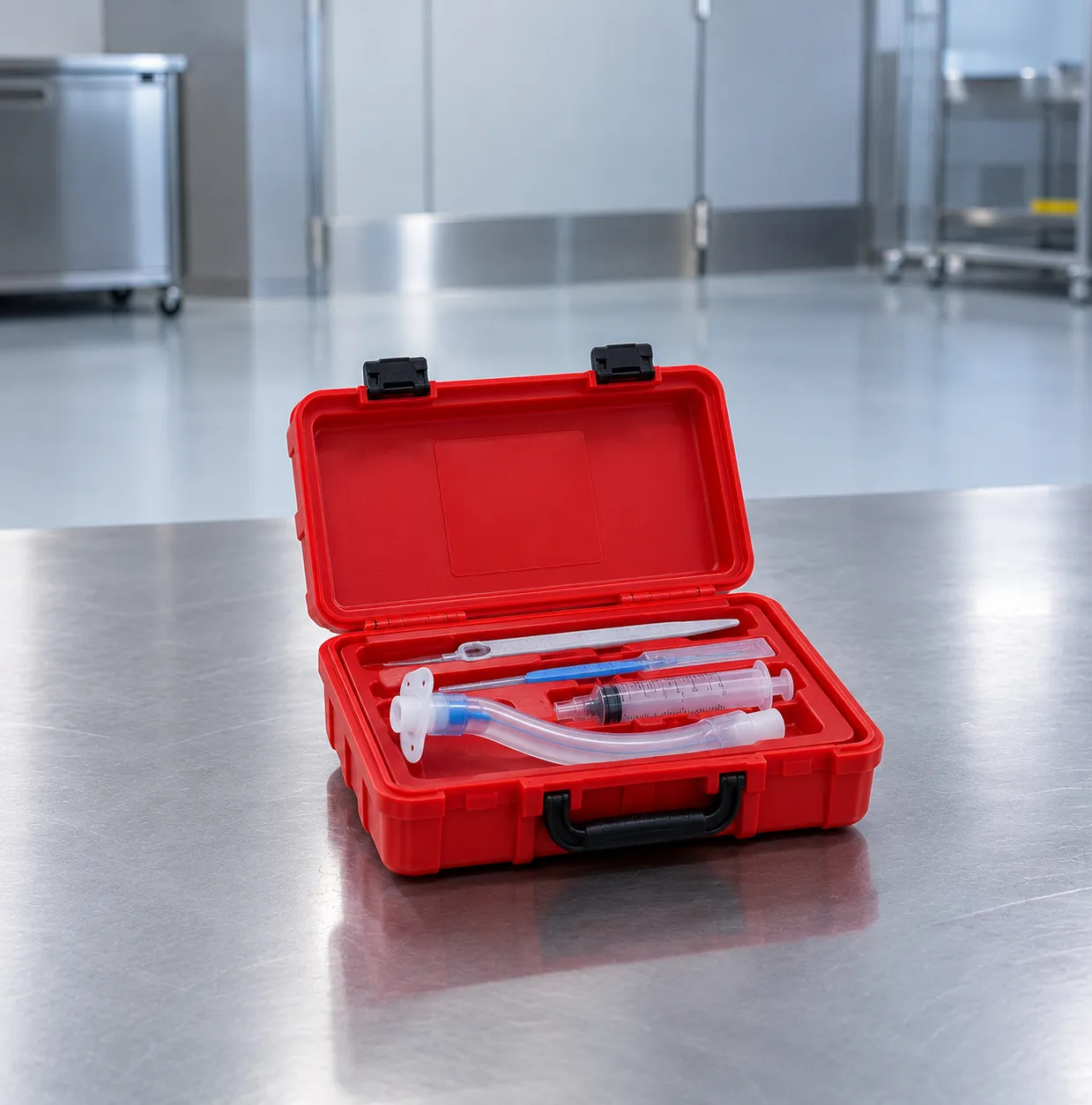
The widely taught surgical method uses three items a team already knows: a number 10 scalpel to incise the membrane, a bougie to railroad through the incision into the trachea, and a cuffed tracheal tube—often a size 6.0—passed over the bougie. Its strength is that it relies on familiar equipment and simple, robust steps that hold up when a team is under acute stress and fine motor control is degraded. A basic surgical cricothyrotomy kit therefore centres on a scalpel, a bougie or tracheal introducer, a small cuffed tube and a syringe to inflate the cuff, plus tape or a tube holder to secure it. Some services add a tracheal hook and blunt dilator to help hold the incision open while the tube is passed, and stocking the scalpel with a fixed, non-detachable blade avoids losing a loose blade in a chaotic resuscitation.
Needle and Seldinger cannula kits
Commercial kits offer two other routes. A needle (cannula-over-needle) cricothyrotomy inserts a wide-bore cannula through the membrane for oxygenation, often as a bridge in specific situations. A Seldinger kit uses a needle, guidewire, nd dilator to place an airway cannula in a controlled, staged way, and many pre-packaged sets are built around this method with all components in one sterile tray. Buyers weighing these should consider which technique their clinicians are trained and credentialed in—the kit must match the taught drill, not dictate a new one.
Confirming placement and supporting equipment
Placing the tube is only part of the task; the team must confirm it sits in the trachea and then ventilate. That means the airway kit rarely stands alone. Waveform capnography to verify tube position, a self-inflating bag or ventilator circuit, suction, and a reliable oxygen supply all need to be immediately available at the same location. A buyer provisioning for emergency surgical airways should therefore think of the kit as one element of a difficult-airway response station rather than an isolated pack. Checking that the tube connector matches the facility's breathing circuits and capnography is a small compatibility detail that prevents a dangerous fumble at the critical moment.
What a complete kit contains
Whether assembled locally or bought pre-packaged, a cricothyrotomy kit typically includes the airway device (tube or cannula), the means of insertion (scalpel and bougie, or needle, wire and dilator), a syringe, a securing method and, often, a tracheal hook and gauze. Pre-packaged sterile sets have the advantage of completeness and a single expiry to track; locally built kits can be cheaper and tailored but risk missing items when it matters. Whichever is chosen, the contents list should be printed on the pack for a rapid final check.
Storage, checking and human factors
A cricothyrotomy kit is only as good as its availability. It should live in a known, fixed location on the difficult-airway trolley, in resus and in pre-hospital response bags, ideally alongside a cognitive aid or airway algorithm so any team member can follow the steps. Regular checking is essential: confirm the kit is present, sealed, in date, and complete at each equipment check, and replace it immediately after use or breach. Because the procedure is rare, familiarity comes from training on the exact kit stocked, so standardising one design across a facility reduces confusion in a crisis.
Paediatric and setting-specific considerations
The surgical technique is generally reserved for adults and older children, because the small, pliable paediatric airway makes an open approach hazardous; needle techniques with age-appropriate equipment are usually preferred in the very young. A facility that treats children should provision accordingly and never assume an adult kit will simply scale down. Setting matters too: a busy emergency department, an operating theatre and a pre-hospital response bag each need the kit sited where a crisis unfolds. Weight and packaging count in the field, while a resus bay can hold a fuller tray. Mapping which kit sits where, for which patient group, is a core provisioning decision.
Training, familiarity and resupply
Because a cricothyrotomy may be attempted only rarely in a career, competence rests on regular simulation training using the exact kit stocked. Procurement supports this by standardising one design and supplying training or dummy kits so teams can rehearse without depleting live stock. After any use—real or in training—the kit must be replaced at once, which makes dependable, fast resupply a genuine safety feature rather than a logistics nicety. Agreeing stock levels, expiry monitoring and a rapid replenishment route with the supplier keeps every airway trolley genuinely ready.
Standards, regulation and procurement
Airway devices and pre-packaged kits sold in the UK must carry UKCA or CE marking with a declaration of conformity, and the MHRA regulates them as medical devices; tracheal tubes and connectors follow recognised ISO airway standards. Guidance from bodies such as NICE and specialist anaesthetic and resuscitation organisations informs how difficult-airway equipment is provisioned. For procurement, prioritise a kit that matches local training, has a clear shelf life, is quick to open, and is backed by reliable resupply. A structured comparison through an equipment buyer service keeps competing kits on the same specification.
Cricothyrotomy kit procurement checklist
-
Match the kit technique to what clinicians are trained and credentialled in.
-
Confirm the airway device size range—for example, a 6.0 cuffed tube.
-
Choose pre-packaged sterile sets or a standardised locally built pack.
-
Check that every component, syringe, and securing method is included and listed.
-
Store in a fixed location on the airway trolley with a cognitive aid.
-
Verify UKCA or CE marking, ISO airway compliance, and a clear expiry date.
-
Confirm rapid resupply and immediate replacement after any use.
Conclusion
A cricothyrotomy is a rare, high-stakes rescue, and the kit that supports it succeeds or fails on readiness. Buying well means choosing a technique that matches local training, ensuring the pack is complete, sterile, in date, instantly to hand, and standardising one design so any team can act without hesitation. Regulatory conformity, a clear shelf life and dependable resupply turn a box of parts into a reliable emergency airway. You can compare cricothyrotomy kits and airway equipment specifications and arrange resupply through MediGear.
Disclaimer
This article is for informational purposes only. It is published by MediGear (medigear.uk) for general information and procurement guidance, and is not clinical, diagnostic, treatment, technical, engineering, legal or regulatory advice, nor a product endorsement, guarantee or substitute for professional assessment. MediGear does not provide medical consultations. Buyers should consult their clinical, biomedical, estates and regulatory contacts, and the manufacturer's documentation, and independently verify all specifications, certifications, compatibility and suitability before purchase. Specifications, certifications and availability are correct at the time of publication and may change without notice. MediGear is a medical-equipment distributor and does not sell medicines or pharmaceutical products.