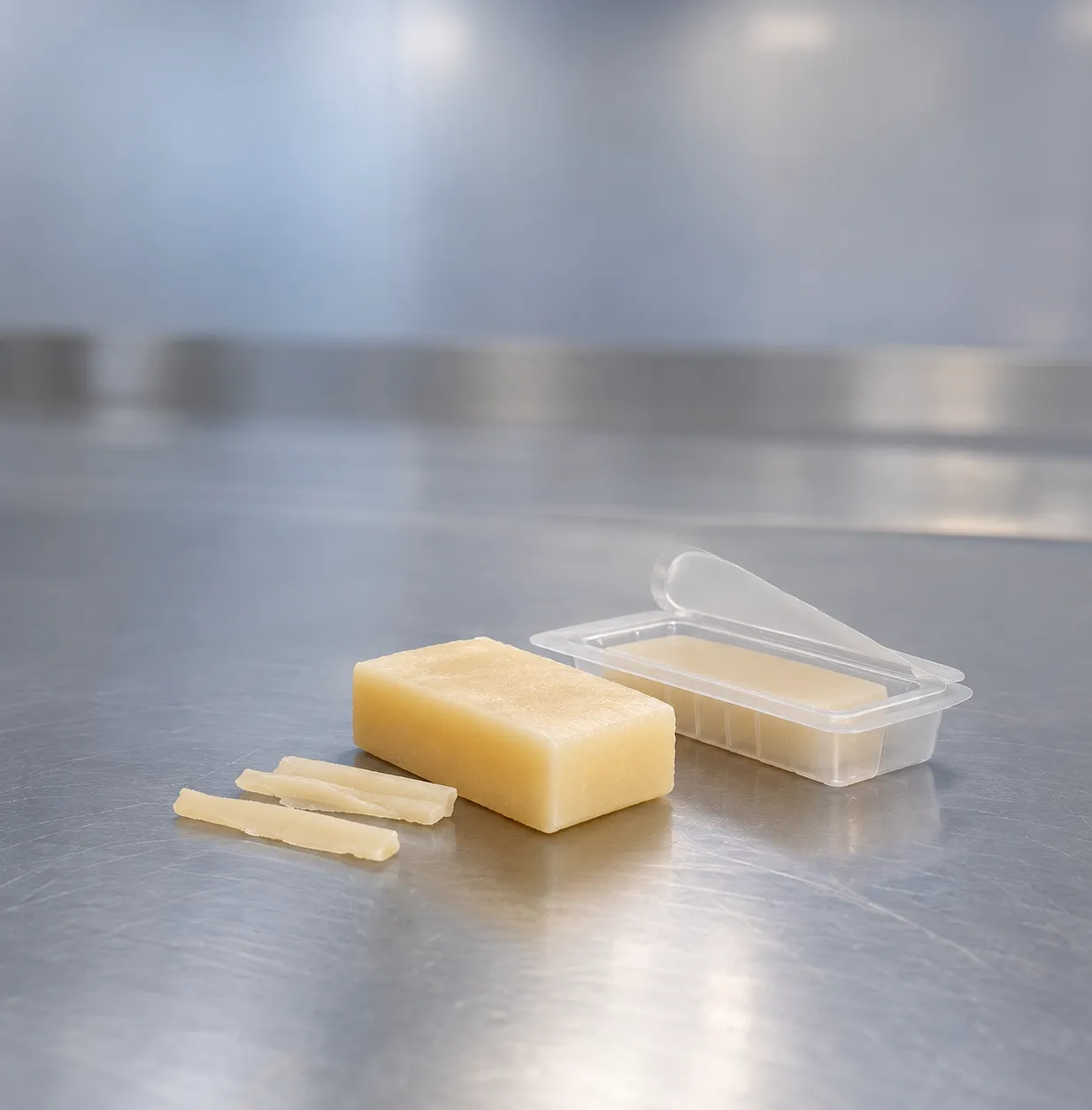
Bone wax is a soft, sterile paste that a surgeon presses into the cut or bleeding surface of bone to stop oozing. It works purely by mechanical means: the pliable material fills the tiny channels in cancellous bone and seals the divided vessels, rather than triggering any clotting reaction. In orthopaedic, spinal, cardiac, cranial and dental work, it remains a quick, cheap answer to the slow, diffuse bleeding that a bone surface produces and that sutures or cautery cannot easily reach.
For a procurement lead,d the product looks trivial:l, a few grams of wax in a foil sachet, yet the material, its sterilisation and its clinical trade-offs all deserve scrutiny. This guide explains how bone wax behaves, the resorbable alternatives now competing with it, and the specifications worth checking before you add it to a theatre pack.
What bone wax is made from
Traditional bone wax is a blend of refined beeswax with a softening agent, commonly a paraffin or isopropyl palmitate, that keeps it malleable at room temperature so it can be moulded onto bone with a fingertip or instrument. It sets no chemical process in motion; the haemostasis is entirely a tamponade effect. That simplicity is its strength and its weakness. It stops bleeding instantly and predictably, but the wax is not broken down by the body and lingers as an inert foreign material at the site.
Why the foreign-body question matters
Because classic bone wax is not resorbed, it can sit between bone edges and physically hinder the knitting of new bone. Reports have long linked it with impaired osteogenesis, a mild chronic foreign-body reaction and, where infection takes hold, a nidus that is hard to clear. None of this rules it out; surgeons use it safely every day, but it explains why teams often apply the smallest effective amount and why resorbable substitutes have a following in settings where bony union is the whole point of the operation.
Resorbable and water-soluble alternatives
A second family of products aims to keep the mechanical sealing action while disappearing over days to weeks. These are typically based on water-soluble alkylene oxide copolymers or on gels and pastes that soften at body temperature and then dissolve. They are marketed for spinal fusion and other cases where leaving inert wax across a healing surface is undesirable. They tend to cost more per gram, and their handling feel differs from beeswax, so any switch should be trialled by the surgeons who will use it rather than decided on price alone. Stock both if your case mix spans routine sternotomy and demanding fusion work.
Formats and handling
Bone wax is supplied as a single sterile strip or ribbon, usually around 2.5 g, sealed in a peel-open foil sachet and intended for one patient only. The practical differences between brands are the softening point and the tack: a wax that is too firm is awkward to spread on a cold operating field, while one that is too soft smears and is hard to place precisely. Ask for samples so the team can judge pliability at theatre temperature. Because it is applied by hand, the material must arrive sterile and stay sterile until the moment of use, which puts the spotlight on packaging integrity.
Sterilisation, packaging and standards
Bone wax is a medical device and must carry valid UKCA or CE marking with instructions for use that state the intended purpose and any warnings about impaired bone healing. Sterile presentation is usually achieved by gamma irradiation or ethylene oxide, and the sterile barrier packaging should meet the recognised standard for terminally sterilised device packaging (the ISO 11607 family). Check the sterilisation method, the expiry dating and the lot number on every sachet, and confirm the sterile barrier is a genuine peel pouch rather than a simple wrap. The MHRA regulates these devices in the UK and is the route for reporting any adverse incident such as a packaging failure or a suspected reaction.
Where it is used across settings
Orthopaedic and spinal teams use bone wax on cut iliac crest donor sites, decorticated vertebrae and osteotomy surfaces. Cardiac surgeons apply it along the divided sternum after a median sternotomy. Neurosurgeons use it on cranial bone edges and at burr holes, and ENT and maxillofacial teams use it on the mastoid and facial bones. It also has a place in veterinary orthopaedic surgery. The clinical caution about bony union is most relevant where fusion or graft incorporation is the goal, and least relevant where the bone is simply a bleeding edge to be sealed, which is worth bearing in mind when you decide how much resorbable product to carry.
How it compares with other bone haemostats
Bone wax is not the only way to control bleeding from bone, and knowing the alternatives helps a buyer stock a sensible mix. Flowable haemostatic matrices, oxidised regenerated cellulose and gelatin-based agents work biochemically by supporting clot formation and are resorbed, but they are less effective at the pure mechanical sealing of a weeping cut bone surface, where wax excels. Conversely, on a raw soft-tissue bed those biological agents outperform wax, which has no place there. Some teams reserve wax for the classic bone-edge bleed, the sternum, the iliac crest, a burr hole, and reach for a resorbable matrix where bony union must not be compromised.
Cost per case follows this logic. Bone wax is by far the cheapest option per gram, so where it is clinically appropriate it keeps haemostasis spend low. The resorbable waxes and biological agents cost several times more, which is justified only where their properties genuinely matter. A buyer who maps each product to the bleed it is best at avoids both clinical compromise and needless spend, and can hold a lean range rather than duplicating overlapping products across theatres.
Total cost and stock control
Unit cost is low, so the real spend is driven by usage volume, wastage and the premium paid for resorbable lines. Because each sachet is single-use and sterile, part-used strips cannot be kept, and buying a larger strip that is routinely half-wasted is false economy; match the strip size to typical use. Watch expiry dating across the store, since bone wax is used in bursts and stock can age between busy periods. Rationalising to one or two dependable brands simplifies training and keeps the theatre packs predictable.
Procurement checklist
-
Confirm the material type: traditional beeswax-based wax or a resorbable, water-soluble alternative, and stock to match your case mix.
-
Request samples to judge softening point and tack at theatre temperature.
-
Verify UKCA or CE marking and instructions for use, including any warning on bone healing.
-
Check the sterilisation method, sterile peel-pouch packaging and clear expiry and lot marking.
-
Match strip weight to typical single-case use to limit sterile wastage.
-
Confirm single-patient use and that part strips are discarded, not stored.
-
Agree resupply terms and monitor expiry across intermittent usage.
Conclusion
Bone wax succeeds through sheer simplicity, a mouldable seal that stops bone bleeding on contact, but that same inertness carries a bone-healing trade-off that shapes when resorbable alternatives earn their place. Buying well means choosing the right material for each specialty, insisting on proper sterile packaging and UKCA or CE documentation, and controlling stock so nothing is used past date. MediGear can help theatres compare traditional and resorbable haemostatic waxes and keep packs reliably supplied; register as a buyer or reach us through the contact page.
Disclaimer
This article is for informational purposes only. It is published by MediGear (medigear.uk) for general information and procurement guidance, and is not clinical, diagnostic, treatment, technical, engineering, legal or regulatory advice, nor a product endorsement, guarantee or substitute for professional assessment. MediGear does not provide medical consultations. Buyers should consult their clinical, biomedical, estates and regulatory contacts, and the manufacturer's documentation, and independently verify all specifications, certifications, compatibility and suitability before purchase. Specifications, certifications and availability are correct at the time of publication and may change without notice. MediGear is a medical-equipment distributor and does not sell medicines or pharmaceutical products.