Surgical skin markers are sterile pens used to draw on a patient's skin before and during a procedure, marking the planned incision, anatomical landmarks, the surgical site for safety checks, and lines for reconstruction or symmetry. They seem trivial next to major theatre equipment, yet they underpin correct-site surgery, tissue planning and clean, deliberate incisions. Choosing the right marker is a small decision with real workflow implications.
For a theatre buyer, the interest is in specification: ink type and durability, tip size, sterility, whether a marker is single-use, and how it behaves after skin preparation. This article explains what skin markers do, the variants available, and the practical criteria that separate a good marker from a frustrating one.
What skin markers are used for
Marking serves several distinct jobs. First, identification: the operating surgeon marks the intended site as part of the surgical safety process. Hence, the mark is visible and remains until the sterile drapes go on. The second is incision planning and drawing: the line the blade will follow, especially when a cosmetically placed or curved incision is wanted. It is needed for anatomical and reconstructive marking: flaps, symmetry lines, landmarks and measurement points in plastic, breast, ophthalmic and dermatological surgery, where millimetres matter. Each job places slightly different demands on line width, ink persistence and precision.
Ink types and how they behave
Gentian violet ink
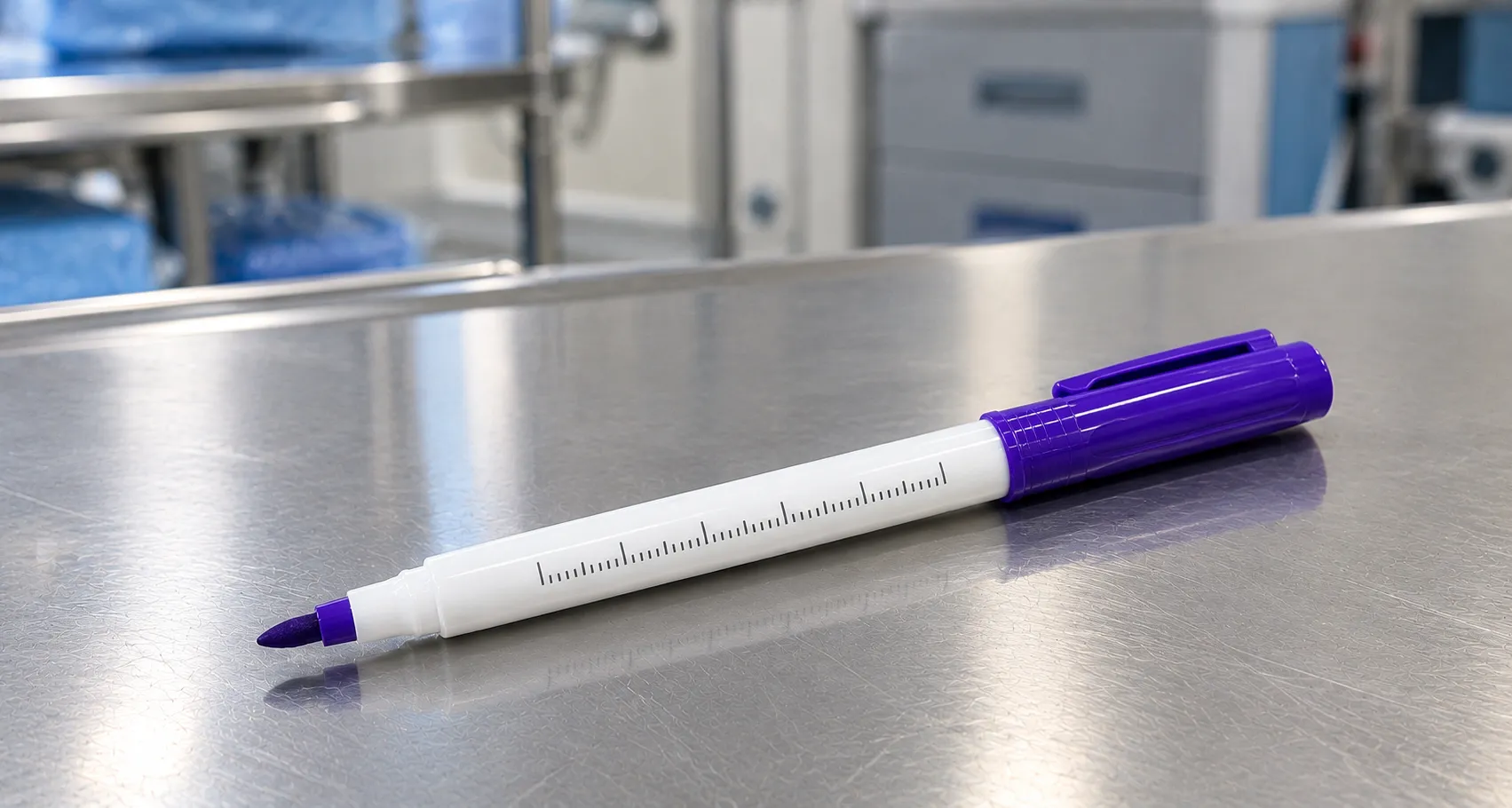
The traditional surgical marking ink is gentian violet, a deep purple dye valued for strong contrast against most skin tones and reasonable persistence through skin preparation. It is the workhorse for general marking and is well understood in theatres. Ink formulation and density vary between products, which affects how crisply a fine line holds.
Alcohol-resistant and prep-resistant inks
A common frustration is a mark that washes away when the site is prepped with an alcohol-based antiseptic. Prep-resistant alcohol-resistant markers are formulated to survive skin preparation, which matters when the mark must remain visible after the site is cleaned and draped. Where a mark needs to last, prep resistance is worth specifying explicitly.
Other formulations
Some markers use different dyes for particular specialities, using finer inks for ophthalmic and delicate work. The key point for a buyer is to match ink persistence to the procedure rather than assume every marker behaves identically after prep.
Tip designs and line precision
Tip choice governs how fine or bold a line the marker draws. Fine and ultra-fine tips suit precise planning in plastics, ophthalmic and dermatological surgery where accurate, thin lines are essential. Regular or dual tips give a bolder, more visible mark for general site marking. Many markers are dual-ended, pairing a fine and a broad tip in one pen, which is efficient for teams that need both. Some kits include a sterile ruler or flexible measuring tape, useful for symmetry and measured markings in reconstructive work. Consistent ink flow and a tip that does not fray on skin make them pleasant and reliable to use.
Sterility, single-use and packaging
Because markers touch a prepared surgical field, most theatre skin markers are supplied sterile and single-use, individually packaged, and intended to be discarded after use. This removes any question of cross-contamination and reprocessing, which is the sensible default for a device used on the operative field. Non-sterile markers exist for pre-operative marking away from the sterile field, for example on the ward before transfer. Still, the sterile theatre standard is asterila sterile-use mmarkermarker thatcleanly onto a sterile tray, with clear labelling of sterility status and expiry. Any accompanying ruler should share the same sterility status.
What separates a good marker in use
In daily use, the differences between markers show up quickly. Consistent, skip-free ink flow from the first stroke matters when a surgeon draws a single decisive line. A tip that keeps its shape rather than splaying gives repeatable line width. The mark should read clearly against a range of skin tones and under theatre lighting, and it should neither smudge before the procedure nor prove impossible to remove afterwards. Drying time, odour and how the ink sits on prepped skin all shape the experience. These practical qualities, more than headline specifications, often decide whether a team is satisfied, which is why trialling a candidate on a real list before committing to volume is sensible.
Documentation, safety and correct-site surgery
Skin marking is woven into surgical safety practice. Marking the intended site before the procedure, and confirming it during the team's safety checks, defends against wrong-site surgery, so the mark must survive preparation and stay legible under drapes. Local policy usually sets who marks, when, and how the mark is verified against the consent form and imaging. A marker that fades at the wrong moment undermines that process, which is why prep resistance and clear, durable lines are safety features rather than conveniences. Buyers specifying markers should understand the surgical safety workflow the product supports and choose one that reinforces it.
Biocompatibility, standards and regulation
A skin marker applied to intact skin, and potentially near an incision, is a medical device and should carry valid UKCA or CE marking with a declaration of conformity and instructions for use; UK oversight rests with the MHRA. Because the ink contacts skin, biocompatibility assessed under the ISO 10993 series for skin-contact materials is the relevant assurance, and buyers should confirm the ink is intended for skin marking rather than a general-purpose pen. Sterile products are sterilised and labelled to recognised standards, with a stated method and expiry. Because these are inexpensive, high-volume consumables, certification is easy to overlook; the same verification discipline applies as to any device. Broader guidance on devices is published on GOV.UK.
Use across specialities.
Marking needs vary by speciality, and reconstructive surgery is the most demanding, relying on fine tips, measured lines and prep-resistant ink for flap and symmetry planning. General and orthopaedic surgery mainly need clear, durable site marks to verify safety; ophthalmic surgery uses very fine markers for corneal and periocular reference points. Dermatology marks lesion margins before excision. Pre-operative marking on the ward, part of surgical safety practice, may use a simpler marker, while intra-operative planning demands sterility and precision. Stocking a small range, a fine dual-ended sterile marker for planning and a bolder one for site verification, usually covers most lists efficiently.
Procurement checklist
-
Match ink persistence to the procedure and specify prep-resistant where needed.
-
Choose tip size by task, fine for planning, bolder for site verification.
-
Consider dual-ended markers to cover fine and broad lines in one pen.
-
Default to sterile, single-use markers for anything touching the sterile field.
-
Confirm the ink is skin-marking grade with ISO 10993 biocompatibility.
-
Check UKCA or CE marking, sterility labelling and expiry on each pack.
-
Confirm packaging opens cleanly onto a sterile tray and any ruler is sterile.
-
Stock a small range rather than one pen for all specialities
Surgical skin markers are low-cost consumables that carry a high-value job: supporting correct-site surgery and precise incision planning. The decisions that matter are ink persistence through skin prep, tip precision, sterility and single-use status, and confirmed biocompatibility and certification, all matched to the specialities lists. A sensible two-marker range usually covers planning and site verification without overstocking. Treat these pens with the same verification discipline as any device, and they will earn their place. To specify sterile skin markers for your theatres, contact our team or register as a buyer with MediGear.
Disclaimer
This article is for informational purposes only. It is published by MediGear (medigear.uk) for general information and procurement guidance. It is not clinical, diagnostic, treatment, technical, engineering, legal or regulatory advice, nor a product endorsement, guarantee or substitute for professional assessment. MediGear does not provide medical consultations. Buyers should consult their clinical, biomedical, estates and regulatory contacts, and the manufacturer's documentation, and independently verify all specifications, certifications, compatibility and suitability before purchase. Specifications, certifications and availability are correct at the time of publication and may change without notice. MediGear is a medical-equipment distributor and does not sell medicines or pharmaceutical products.