
A tracheostomy tube is a curved airway device inserted through a neck stoma into the trachea to keep the airway open, deliver ventilation, and clear secretions. Tubes differ in several defining ways, including whether they have an inflatable cuff, whether they are fenestrated, whether they carry an inner cannula, and their size, length, and material. Matching those features to the patient and the ventilation setup is the whole point of tube selection.
This guide is about the tubes themselves, not the wider care kit. It covers the variants, how sizing works, why the inner cannula matters, and the materials, so a buyer can specify a range that meets clinical needs and stays compatible with the equipment already in use.
Anatomy of a tracheostomy tube
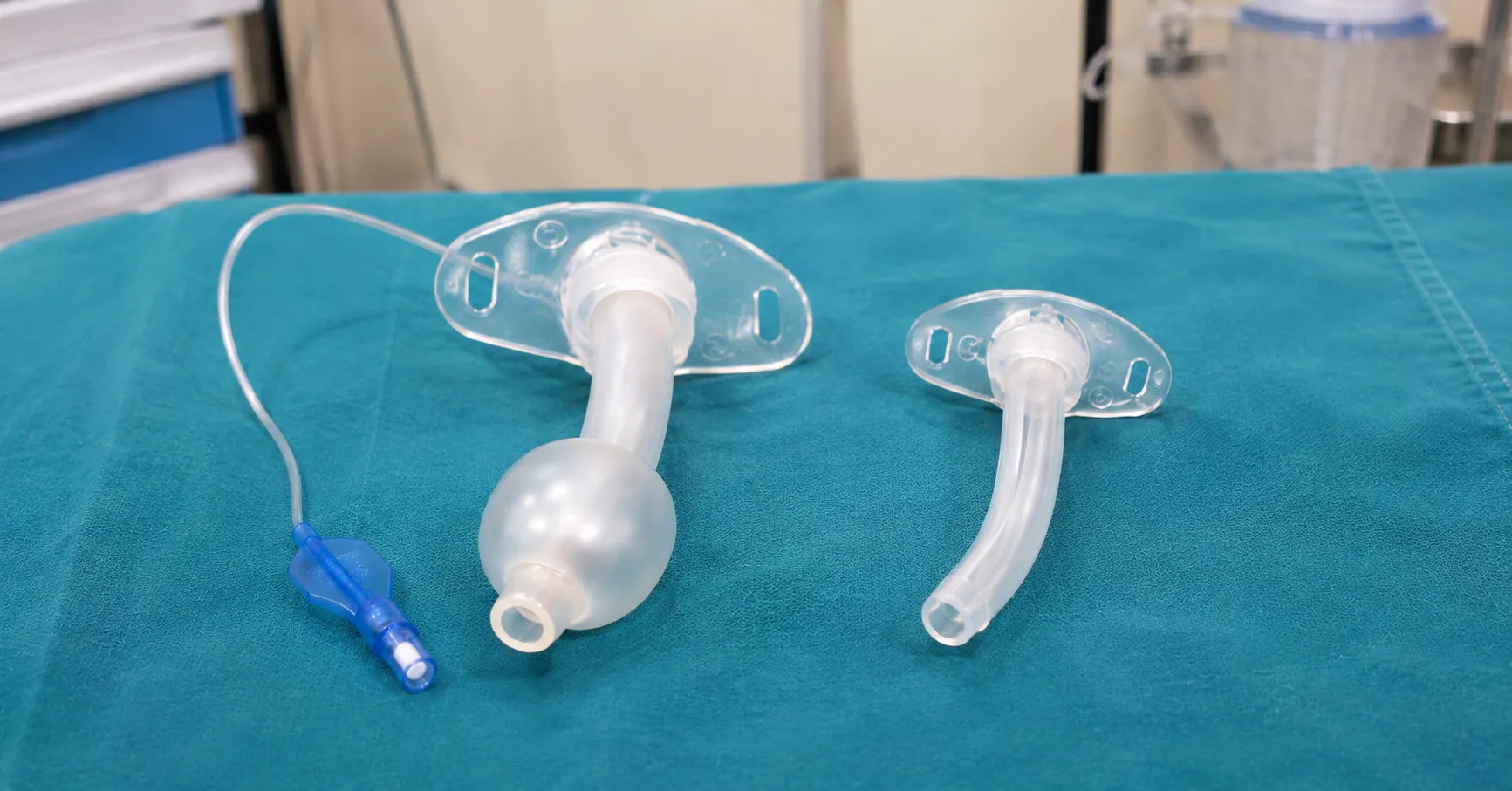
Most tubes share a common structure: an outer cannula that forms the airway and sits in the trachea; a flange or neck plate that rests against the skin and holds the ties; a 15 mm connector at the proximal end for ventilator and circuit attachment; and often a removable inner cannula. An obturator is supplied for insertion, providing a smooth, rounded tip that is withdrawn once the tube is seated. Cuffed tubes add an inflatable cuff and a pilot balloon line. Understanding these parts is the basis for comparing models.
Cuffed versus uncuffed tubes
Cuffed tubes
A cuffed tube has an inflatable balloon near the tip that, when inflated, seals the trachea. This allows positive-pressure ventilation and reduces aspiration of secretions past the tube, which is why cuffed tubes dominate in critical care and early after formation. Modern cuffs are high-volume, low-pressure designs intended to seal without exerting excessive pressure on the tracheal wall; cuff pressure must not exceed the mucosa. Some cuffed tubes add a separate subglottic suction line to remove secretions pooling above the cuff.
Uncuffed tubes
An uncuffed tube has no balloon and does not seal the airway. It is used when the patient is breathing spontaneously, and airway protection is less critical, often as the patient progresses toward decannulation, and commonly in paediatric practice, where a snug fit in a small airway makes a cuff unnecessary and potentially harmful. Uncuffed tubes allow air to pass around the tube, which supports vocalisation.
Fenestrated versus non-fenestrated tubes
A fenestrated tube has one or more openings in the outer cannula wall. With a matching fenestrated inner cannula in place, and often with the cuff deflated and the tube capped or fitted with a speaking valve, air can pass up through the fenestrations and the larynx, helping the patient speak and breathe through the upper airway. Swapping in a plain, non-fenestrated inner cannula closes the fenestration for ventilation or suction. Non-fenestrated tubes have a continuous wall and are the default where speech is not the priority or where positive-pressure ventilation must be reliable. Fenestrated designs are valued in rehabilitation and weaning, but they demand careful inner-cannula management to avoid suctioning through a fenestration.
The inner cannula and why it matters
Many adult tubes use a dual-cannula design: a removable inner cannula sits inside the outer cannula and can be taken out for cleaning or replacement without disturbing the tube in the trachea. This is a major safety feature, because if secretions crust and narrow the lumen, the inner cannula can be removed and cleared quickly, restoring the airway. Inner cannulas come as reusable items for cleaning or single-use disposables, and they carry the 15 mm connector. Single-cannula tubes have a larger internal diameter for their outer size but offer no quick way to clear a blockage, so the dual-cannula trade-off between lumen size and safety is a real procurement decision.
Sizing: internal diameter, outer diameter and length
Tube size is defined chiefly by internal diameter in millimetres, which governs airflow resistance and the largest suction catheter that will pass, alongside outer diameter, which must suit the stoma and trachea. Length matters as much as diameter: standard-length tubes suit typical anatomy, while extra-length tubes come in proximal (extended neck plate to tube distance, for deeper-set stomas and larger necks) and distal (longer intratracheal portion, for tracheal pathology) versions. Some tubes have an adjustable flange so the effective length can be set at the bedside. Getting internal diameter, outer diameter and length right together is what makes a tube fit and function, and a range should span the sizes a service actually treats, including paediatric where relevant.
Materials and specialist features
Most modern tubes are made from PVC or silicone. PVC tubes soften at body temperature to conform to the airway and are often single-use. Silicone is flexible, kinder to tissue over long-term use and can tolerate repeated cleaning in some reusable designs. Metal tubes, historically silver, are still occasionally used for long-term uncuffed care. Specialist features to weigh include subglottic suction ports, adjustable flanges, spring-loaded or armoured designs, and compatibility with speaking valves and heat and moisture exchangers. Radiopaque lines aid position checks on imaging. The right material and feature set depends on whether the tube is for short-term critical care or long-term community use.
Speaking valves, heat and moisture exchangers and accessories
Several accessories connect to the 15 mm hub and shape day-to-day use. A one-way speaking valve, fitted to an uncuffed or cuff-deflated tube, directs exhaled air up through the larynx to enable speech. Heat and moisture exchangers clip on to warm and humidify inspired gas for patients off active humidification. Decannulation caps occlude the tube during weaning trials, and tube holders, ties, and stoma dressings secure and protect it. None of these is the tube itself, but each must be compatible with it, so when specifying a tube range, a buyer should confirm which valves, exchangers, and caps mate with each tube's connector and inner-cannula arrangement rather than assuming they interchange.
Standards, compatibility and single-use status
Tracheostomy tubes are medical devices that require KCA or CE marking, a declaration of conformity, and instructions for use, with MHRA oversight in the UK. Dimensions and terminology follow the ISO 5366 series, and the 15 mm proximal connector follows the standard conical fitting so tubes mate with ventilators, catheter mounts, speaking valves and humidification. Reprocessing: The manufacturer dictates reprocessing, and inner cannulas are single-use and must be. The manufacturer dictates reprocessing, while some designs are validated for cleaning or a set number of reuses. Buyers should confirm the instructions rather than assume, and check valve and humidifier compatibility. General device guidance is available on GOV.UK.
Procurement checklist
-
Specify cuffed and uncuffed options to cover critical care through to weaning.
-
Decide where fenestrated tubes are needed and stock matching inner cannulas.
-
Prefer dual-cannula designs where quick lumen clearance is a priority.
-
Confirm the range of diameters, outer diameters and lengths, including extra-length tubes.
-
Confirm the compatibility with the E15 Connector and speaking valve, and that the material suits the use: C for short-term, silicone for long-term.
-
Confirm UKCA or CE marking and ISO 5366 conformance on every line.
-
Verify single-use versus reusable status from the instructions for use.
Conclusion
Tracheostomy tubes vary in cuff, fenestration, cannula design, size and material, and each choice ties directly to the patient's stage of care and the ventilation setup. A well-planned range covers cuffed tubes for ventilation and airway protection; uncuffed and fenestrated options for weaning and speech; sensible size and length spans; and materials matched to short- or long-term use, all backed by standard connectors and clear reuse instructions. Specify against genuine clinical need and verify certification and compatibility before committing. To build a tracheostomy tube range for your service, contact our team or register as a buyer with MediGear.
Disclaimer
This article is for informational purposes only. It is published by MediGear (medigear.uk) for general information and procurement guidance, and is not. It is not diagnostic, treatment, technical, engineering, legal or regulatory advice, nor a product endorsement, guarantee or substitute for professional assessment. MediGear does not provide medical consultations. Buyers should consult their clinical, biomedical, estates, and regulatory contacts, a manufacturer's documentation, and independently verify all specifications, certifications, compatibility, and suitability before purchase. Specifications, certifications and availability are correct at the time of publication and may change without notice. MediGear is a medical-equipment distributor and does not sell medicines or pharmaceutical products.