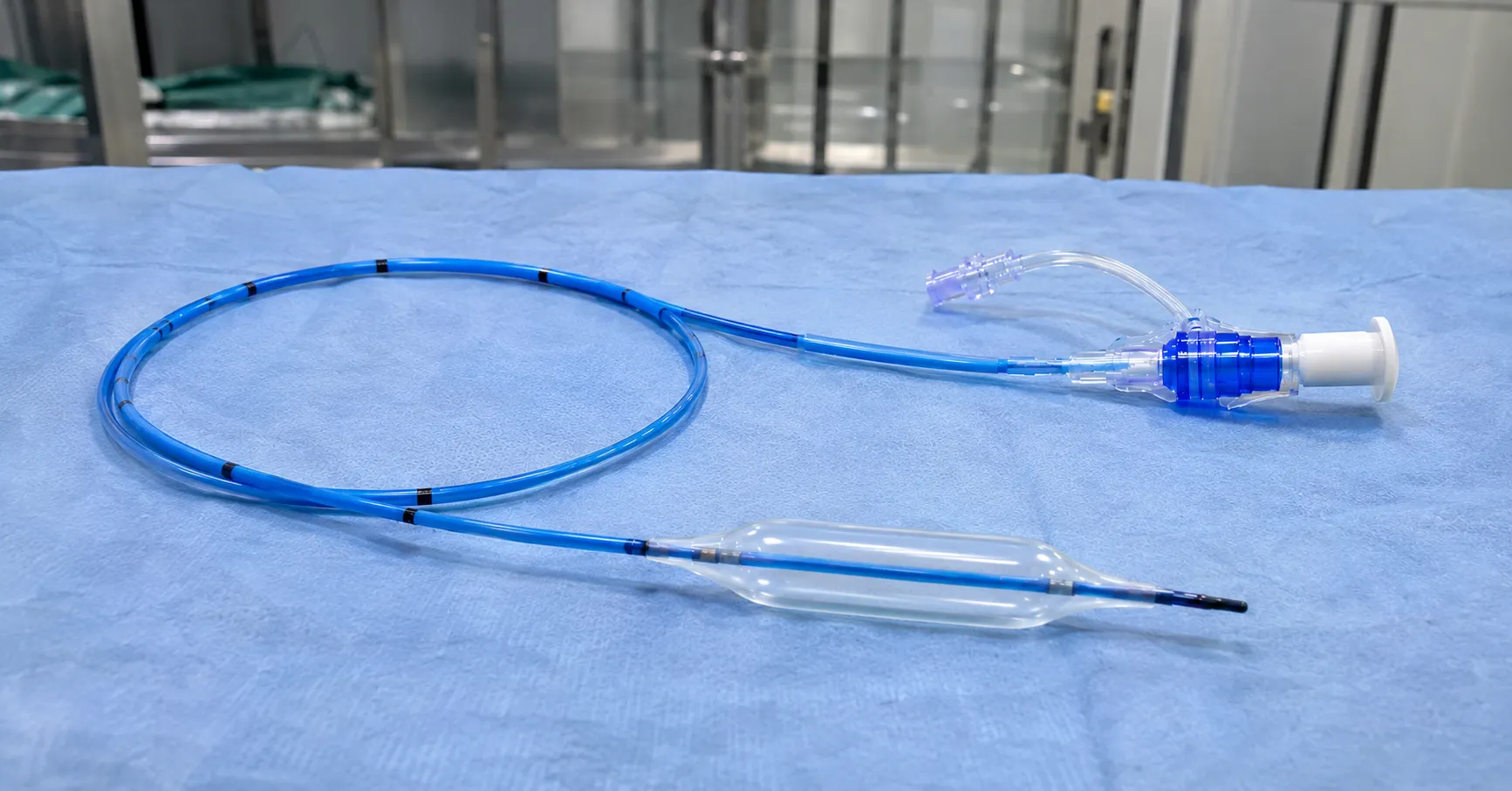
A balloon catheter for angioplasty is a long, thin tube with an inflatable balloon near its tip, used to widen a narrowed or blocked blood vessel. The deflated balloon is advanced to the diseased segment over a guidewire, then inflated to a controlled pressure to press the narrowing outward and restore the channel. Once the vessel is opened, the balloon is deflated and withdrawn. It is one of the most-used devices in interventional cardiology and peripheral vascular work.
For a buyer, balloon catheters are a high-turnover, single-use inventory where diameter and length sizes, pressure ratings, and balloon material define fit and performance. This guide focuses on the balloon catheter itself, its variants and the specifications that decide what you stock.
How an angioplasty balloon works
The balloon is a folded segment of tough polymer bonded to the catheter shaft. A separate inflation lumen runs the length of the shaft and connects to a syringe-like inflation device that fills the balloon with dilute contrast. Hence, its position and expansion are visible under X-ray. The operator raises pressure gradually to a target measured in atmospheres, holds it while the narrowing yields, then aspirates to deflate. Radio-opaque marker bands under the balloon show its working length precisely so that it can be positioned exactly across the lesion.
Compliance: the key balloon property
Balloons are grouped by how their diameter changes as pressure rises. A non-compliant balloon holds its stated diameter even at high pressure, providing predictable sizing and force for resistant lesions and for ending stents. A compliant or semi-compliant balloon grows more with pressure, which suits gentle initial dilatation. Two pressure figures describe every balloon: nominal pressure, at which it reaches its labelled diameter, and rated burst pressure, the pressure the balloon is validated to withstand. Both belong on the label and matter for safe use.
The main balloon catheter types
Several designs share the basic principle. Plain balloons perform straightforward dilatation. Drug-coated balloons carry a medication on the balloon surface that is transferred to the vessel wall during inflation, aiming to reduce re-narrowing without leaving an implant. Cutting or scoring balloons have small blades or wires that score tough or calcified lesions, so they dilate more evenly at lower pressure. Stent-delivery balloons carry a balloon-expandable stent that is deployed as the balloon inflates. Which families you stock depends on the caseload your interventional teams run.
Over-the-wire and rapid-exchange shafts
Two shaft designs govern how the catheter moves over the guidewire. An over-the-wire design runs the guidewire through the full length of the catheter, providing strong support and wire exchange but requiring a long wire and often two operators. A rapid-exchange, or monorail, design has the wire enter only near the tip, so one operator can exchange devices quickly. Coronary work favours rapid-exchange; some peripheral and complex cases prefer over-the-wire support. Stocking both where your teams need them avoids delays.
Sizing and specifications a buyer must check
Balloon diameter, quoted in millimetres, must match the target vessel, and balloon length must cover the lesion without over-treating healthy segments, so a broad size matrix is essential. Check the crossing profile, the smallest diameter the folded balloon presents, because a lower profile crosses tight lesions more easily. Confirm guidewire compatibility, usually stated in inches, and the minimum guide-catheter or sheath size the balloon needs to pass through. Shaft length must reach the target from the access site. Nominal and rated burst pressures should suit the lesions you treat, and every device must carry clear radiopaque markers.
Predilatation, postdilatation and lesion preparation
Balloons are used at more than one point in a procedure, and the role changes the balloon you choose. A smaller balloon may be used first to predilate a tight lesion and allow stent placement, a task that suits a lower-profile, compliant balloon. After a stent is placed, a plain-compliant balloon is often used to postdilate, expanding the stent fully and pressing it against the vessel wall at high pressure without overstretching the vessel beyond the stent. Heavily calcified lesions may need dedicated preparation with a scoring or cutting balloon, or other calcium-modifying tools, before a plain balloon or stent will work. Understanding this sequence explains why a service holds several balloon types rather than a single design, and why the size and compliance mix on the shelf reflects the steps of a real case.
Standards, storage and single-use rules
Angioplasty balloons are sterile, single-use devices and must never be reprocessed for reuse. Each carries a valid UKCA or CE marking under current UK rules, with the MHRA overseeing device regulation, and each has a batch or lot number that must be recorded against the patient for traceability and recalls. Storage is straightforward, but expiry management across a wide size range is not, since you must hold enough of each diameter and length without letting stock time out. Drug-coated balloons may carry additional handling and shelf-life conditions to protect the coating.
Coronary versus peripheral use
The same principle applies to different vessels and which pieces you stock. Coronary balloons are small in diameter, work on rapid-exchange shafts through guide catheters, and are used in large numbers as part of a group. Peripheral balloons span a far mucher size range, from small below-the-knee vessels up targe iliac arteries, co; theye in longer lengths and longer shafts to reach distant targets, and more often use over-the-wire designs for support. A service covering both needs two overlapping but distinct inventories, and the sizing matrix for peripheral work is considerably broader. Being clear about which caseload you are equipping stops you from running short on a needed size or tying up budget in stock you rarely open.
Inflation devices and accessories
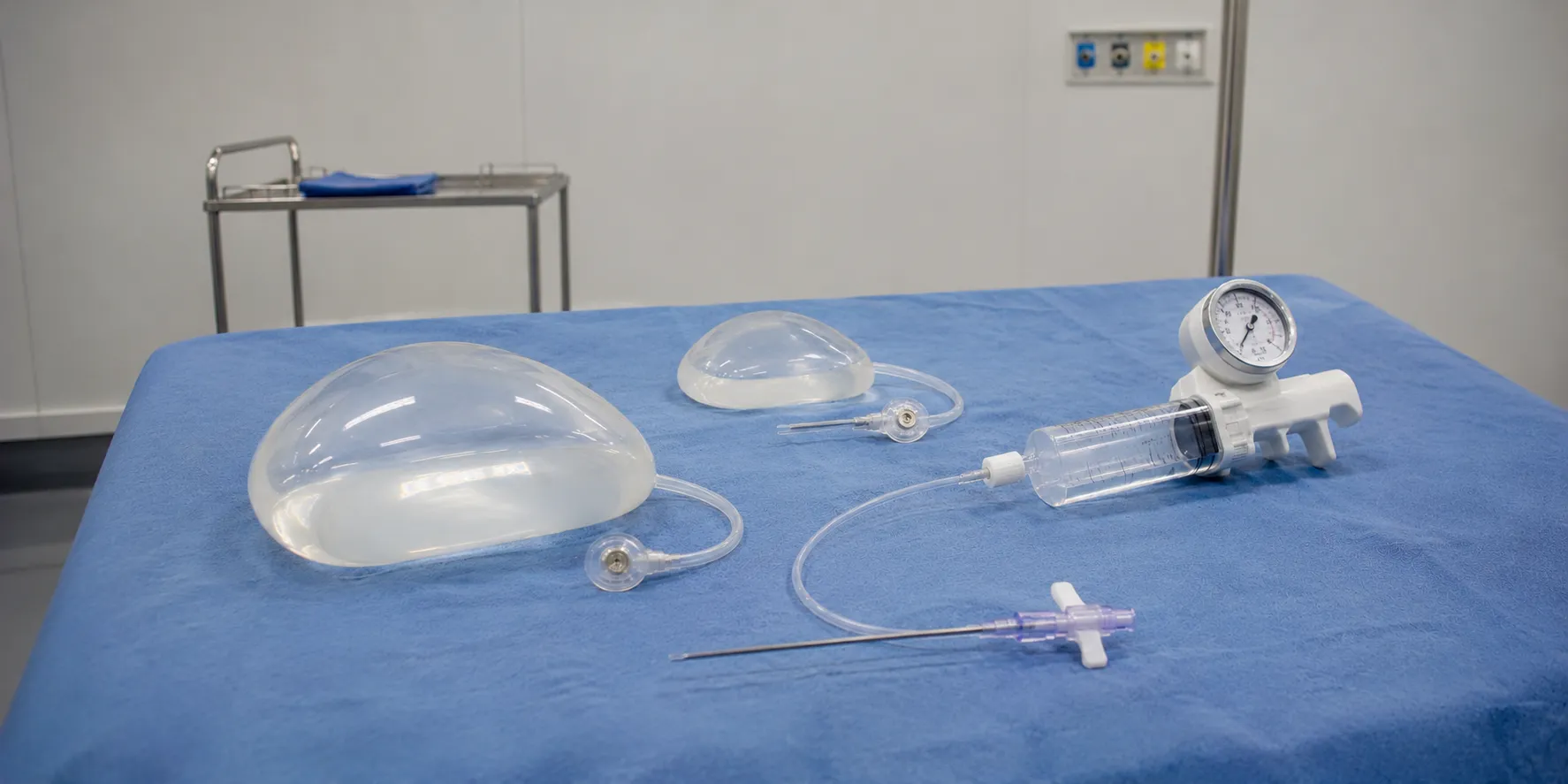
A balloon does not work alone. Each case uses an inflation device, the handheld syringe with a pressure gauge that raises and holds the balloon at a set pressure and lets the operator read it precisely. Guidewires, haemostatic valves, contrast flush, and flush all come in the same disposable set. When comparing balloon suppliers, look at the whole consumable bundle rather than the balloon in isolation, because accessory cost and compatibility affect both the per-case price and how smoothly the procedure runs. Confirm that inflation devices reach the pressures your non-compliant balloons need and read in the same units your team works to.
Stock control and total cost of ownership
The buying challenge is breadth. A working service needs many diameter-and-length combinations on hand, plus the specialist balloons for calcified or restenotic lesions, and each is single-use. That argues for standardising on a small number of compatible families with a full size matrix, backed by reliable resupply and expiry rotation. Model cost on real case volume and the mix of plain against premium balloons, and factor in the inflation devices and accessories each case consumes. Your procurement team should confirm supply lead times and expiry support before committing.
Procurement checklist
-
Stock a full matrix of balloon diameters and lengths for your caseload.
-
Match compliance type to the task: non-compliant for resistant lesions and stents.
-
Check nominal and rated burst pressures against the lesions you treat.
-
Confirm guidewire size, crossing profile and minimum sheath compatibility.
-
Choose over-the-wire or rapid-exchange shafts to suit your operators.
-
Record batch numbers for traceability and manage expiry across sizes.
-
Standardise on compatible families with reliable, fast resupply.
Conclusion
Balloon catheters look simple but demand careful buying: the right compliance, pressure ratings, sizing matrix and shaft type decide whether the device performs and whether your stock holds up under real caseloads. Standardise on compatible families, manage expiry tightly, and price on genuine consumption. To source angioplasty balloon catheters and accessories for a UK service through vetted suppliers, contact MediGear.
Disclaimer
This article is for informational purposes only. MediGear (medigear.uk) publishes it for general information and procurement guidance. It is not clinical, diagnostic, treatment, technical, engineering, legal or regulatory advice, nor a product endorsement, guarantee or substitute for professional assessment. MediGear does not provide medical consultations. Buyers should consult their clinical, biomedical, regulatory contacts, and the manufacturer's documentation, and independently verify all specifications, certifications, and compatibility before purchase. Specifications, certifications and availability are correct at the time of publication and may change without notice. MediGear is a medical-equipment distributor and does not sell medicines or pharmaceutical products.