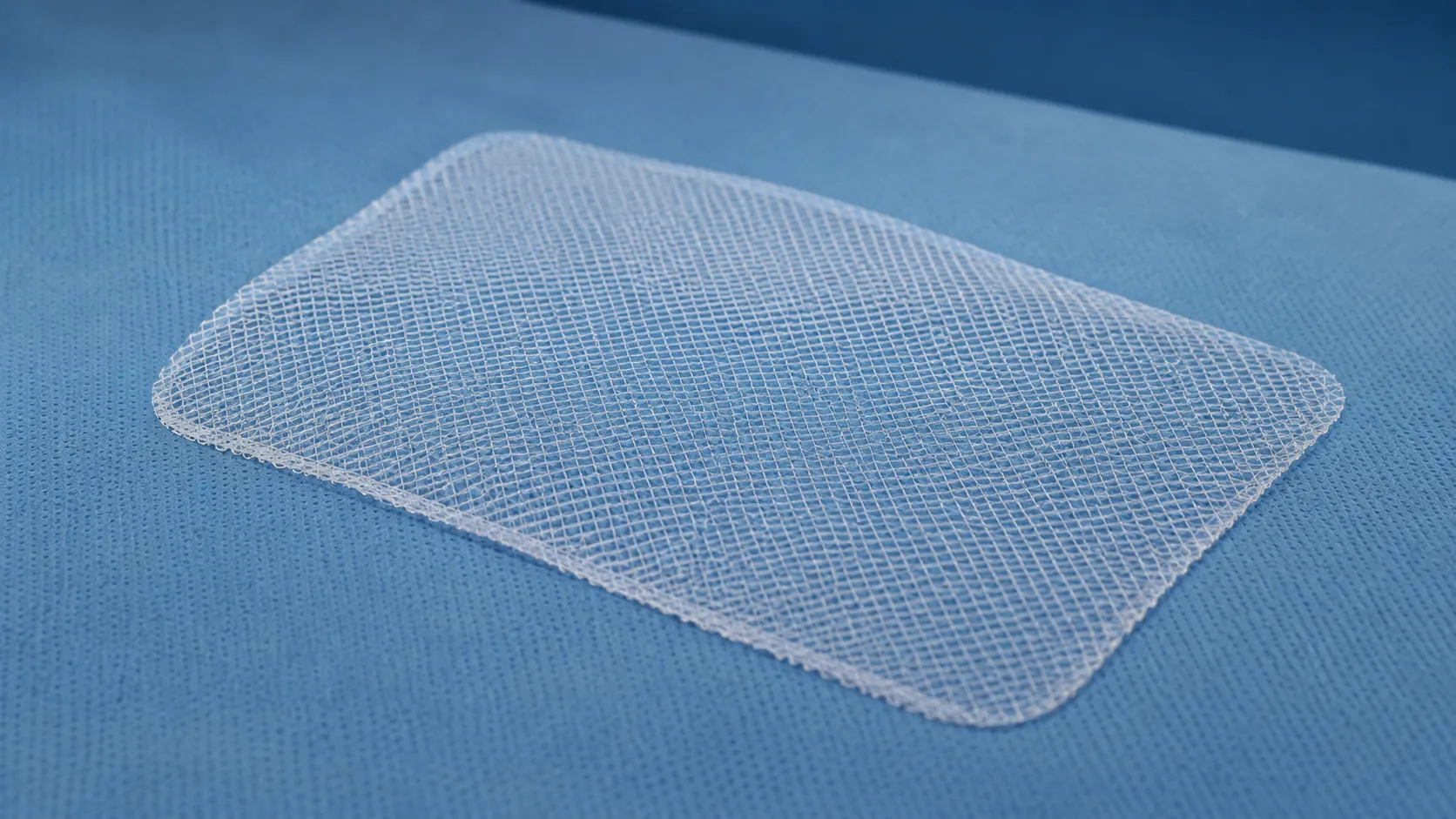
Surgical mesh is a flat implant, most often a knitted or woven sheet, placed to reinforce weakened tissue during hernia repair. It bridges or covers the defect in the abdominal wall so the repair carries less tension and the hernia is less likely to return than with suture-only techniques. Meshes differ in material, weight, pore size and whether they are designed to sit against bowel, and those differences drive both clinical behaviour and price.
For a procurement lead, mesh is a high-scrutiny implant with a lengthy regulatory approval process. Hence, the decision is as much about traceability and documentation as it is about the fabric. This guide sets out the main mesh types, the specifications that matter and the checks a UK buyer should make.
What mesh does in a repair
Placed over or within the layers of the abdominal wall, mesh provokes a controlled healing response in which the body deposits collagen through and around the fabric, incorporating it into the tissue. That integration is what gives the repair its durability. The surgeon fixes the mesh with sutures, tacks, glue or self-gripping features, and positions it according to the technique — onlay, sublay or intraperitoneal — each of which asks something different of the material. A mesh meant to lie against the bowel, for example, needs a barrier surface that a simple onlay mesh does not. The reinforcement works because a healed, mesh-supported repair distributes load across a wide area of incorporated tissue rather than concentrating it on a line of sutures, which is why recurrence rates are lower than with tension-based suture repair for most defects. How well that integration proceeds depends on the fabric, the placement and the patient, so the same mesh can behave differently in different repairs.
Synthetic mesh materials
Polypropylene
Polypropylene is the most widely used permanent synthetic, valued for its strength, durability, and long clinical track record. It is knitted in various weights and pore sizes and is the default for many open and laparoscopic repairs where the mesh does not contact viscera.
Polyester
Polyester meshes are also permanent and hydrophilic, which some surgeons prefer for tissue integration. Their behaviour differs from polypropylene in that of handling and long-term response, so they are chosen deliberately rather than interchangeably
ePTFE and composite meshes
Expanded PTFE and composite constructions pair a strength layer with a barrier layer, allowing the mesh to permit bowel to pass intraperitoneally during placement safely and reducing adhesions to the fabric. These coated or laminated products cost more and are specified when the technique requires an anti-adhesive face.
Absorbable and biological meshes
Absorbable synthetic meshes are broken down by the body over months, providing temporary reinforcement while native tissue strengthens, and are used in spe. They are used in situations such as contaminated fields or for scaffolding. Biological meshes, derived from processed animal or human tissue, are designed to be remodelled into the patient's own tissue and are reserved for complex or contaminated repairs where a permanent synthetic may be unsuitable. Both are considerably more expensive than standard polypropylene and are stocked for defined indications rather than routine use, so match them to your surgeons' actual case mix.
Weight, pore size and tensile strength
Beyond material, three fabric properties shape performance. Weight describes how much polymer is in the mesh: heavyweight meshes are strong but stiffer, while lightweight, large-pore meshes aim for a more flexible repair and less foreign material. Pore size influences tissue ingrowth and flexibility, with larger pores generally favoured for integration. Tensile strength must exceed the forces the abdominal wall generates; these properties trade off against each other, so buyers should hold a considered range rather than a single product and let surgeons select per case. A lighter, more flexible mesh may feel more natural to the patient but must still carry the load; a heavier mesh provides reassurance and strength at the cost of stiffness and more implanted material. Confirm the manufacturer states these values clearly in the instructions for use, and that any comparison between products is made on the same measurement basis rather than marketing labels alone.
Fixation and format
Mesh is supplied flat, pre-shaped for specific hernia sites, or as self-gripping fabric with micro-hooks that hold without additional fixation. Some products are configured for particular anatomical locations. Fixation devices — absorbable or permanent tacks, sutures and tissue, glues — are related consumables; compatibility and the chosen fixation method matter for both the total cost and the fixation method. Consider how each format is packaged and whether it suits open or laparoscopic delivery, because a mesh that does not pass cleanly through a port complicates minimally invasive surgery.
Regulation, traceability and UK scrutiny
Surgical mesh is an implantable medical device and must bear a valid UK marking with full documentation of intended use and materials. Mesh has been the subject of significant patient-safety attention in the UK, so implant traceability is a central procurement duty: every m. Every would be logged with lot and batch details so any field-safety notice can be acted on. The MHRA regulates these devices and issues safety alerts and clinical guidance on NICNIC—ENICE issues clinical guidance on hernia management. The MHRA requires declarations of conformity, Great Britain registration and batch traceability, and confirms that recall processes are in place. This is not paperwork for its own sake; it is how a facility protects patients if a problem emerges after implantation.
Storage, sterility and total cost
Mesh is supplied sterile with a defined shelf life, so stock rotation and storage conditions matter and expired implants must be withdrawn. The purchase cost of the mesh itself is only part of the picture: fixation devices, the barrier-coated products for intraperitoneal use and biological meshes for complex cases all raise the per-case figure, while standard polypropylene is comparatively economical. Model against the mix of mixes your surgeons perform, and confirm consignment or stock to ensure sizes are available without tying up capital. MediGear can help compare mesh ranges and suppliers against your case mix — register as a buyer or use the contact page.
Procurement checklist
-
Match material — polypropylene, polyester, ePTFE or composite — to the surgical technique and placement.
-
Stock a range of weights and pore sizes rather than a single product.
-
Confirm barrier-coated mesh for any intraperitoneal, against-bowel placement.
-
Reserve absorbable and biological meshes for defined contaminated or complex cases.
-
Check fixation compatibility and include tacks, sutures or glue in the cost.
-
Verify UKCA or CE marking, declarations of conformity and Great Britain registration.
-
Ensure full lot and batch traceability to the patient for safety-alert response.
-
Manage sterile shelf life with stock rotation and withdrawal of expired implants.
Conclusion
Surgical mesh reinforces a hernia repair by integrating with the abdominal wall, and choosing it well means matching material, weight and pore size to the technique while never losing sight of barrier requirements against bowel. As a high-scrutiny implant, mesh demands rigorous traceability, valid UKCA or CE documentation and a clear recall pathway. Model the true per-case cost across your surgeons' real range of repairs, and hold a considered selection rather than a single default. MediGear can help facilities compare mesh products and suppliers so that well-documented, appropriately specified implants support hernia surgery.
Disclaimer
This article is for informational purposes only. It is published by MediGear (medigear.uk) for general information and procurement guidance, and is not cli. It is not diagnostic treatment, technical, engineering, legal, or regulatory advice, nor a product endorsement, guarantee, or substitute for professional assessment. MediGear does not provide medical consultations. Buyers should consult their clinical, biomedical, estates and regulatory contacts, and the manufacturer's documentation, and independently verify all specifications, certifications, compatibility and suitability before purchase. Specifications, certifications and availability are correct at the time of publication and may change without notice. MediGear is a medical-equipment distributor and does not sell medicines or pharmaceutical products.