A dermatome is a surgical instrument that shaves a thin, even sheet of skin from a donor site for transplantation to a wound elsewhere on the body. The graft it takes is usually a split-thickness graft: the epidermis and part of the dermis, leaving enough dermis behind for the donor site to heal on its own. Precise, uniform thickness is the whole point, because a graft that is too thin will not survive. One that is too thick harms the donor area. For theatre burns units, dermatomes range from a simple hand knife to a powered oscillating machine, and the right choice depends on graft size, how often grafting is done,e and the budget for consumables. This guide explains the main types, how depth is set and what to verify before purchase.
How a dermatome takes a graft
Every dermatome works on the same principle: a sharp blade moves across lubricated skin at a set depth while the operator advances it steadily. A depth control- how far the blade sits below the guard, determining graft thickness- and a width guard or plate determine how broad the strip will be. The donor site is prepared and lubricated so the blade glides rather than digs, and the freed sheet is lifted as it is cut. The difference between instruments is how the blade is driven and how tightly the depth is held, which is exactly what separates a beginner-friendly powered unit from a knife that rewards experience.
The main types and how they compare
Skin-graft knives
Hand knives such as the Humby and Watson pattern are long blades with an adjustable roller that sets depth. They are inexpensive, need no power and are reliable in skilled hands, but even thickness across a wide graft depends entirely on the surgeon's technique and a steady sweep. They remain useful for smaller grafts and in settings without reliable power.
Drum dermatomes
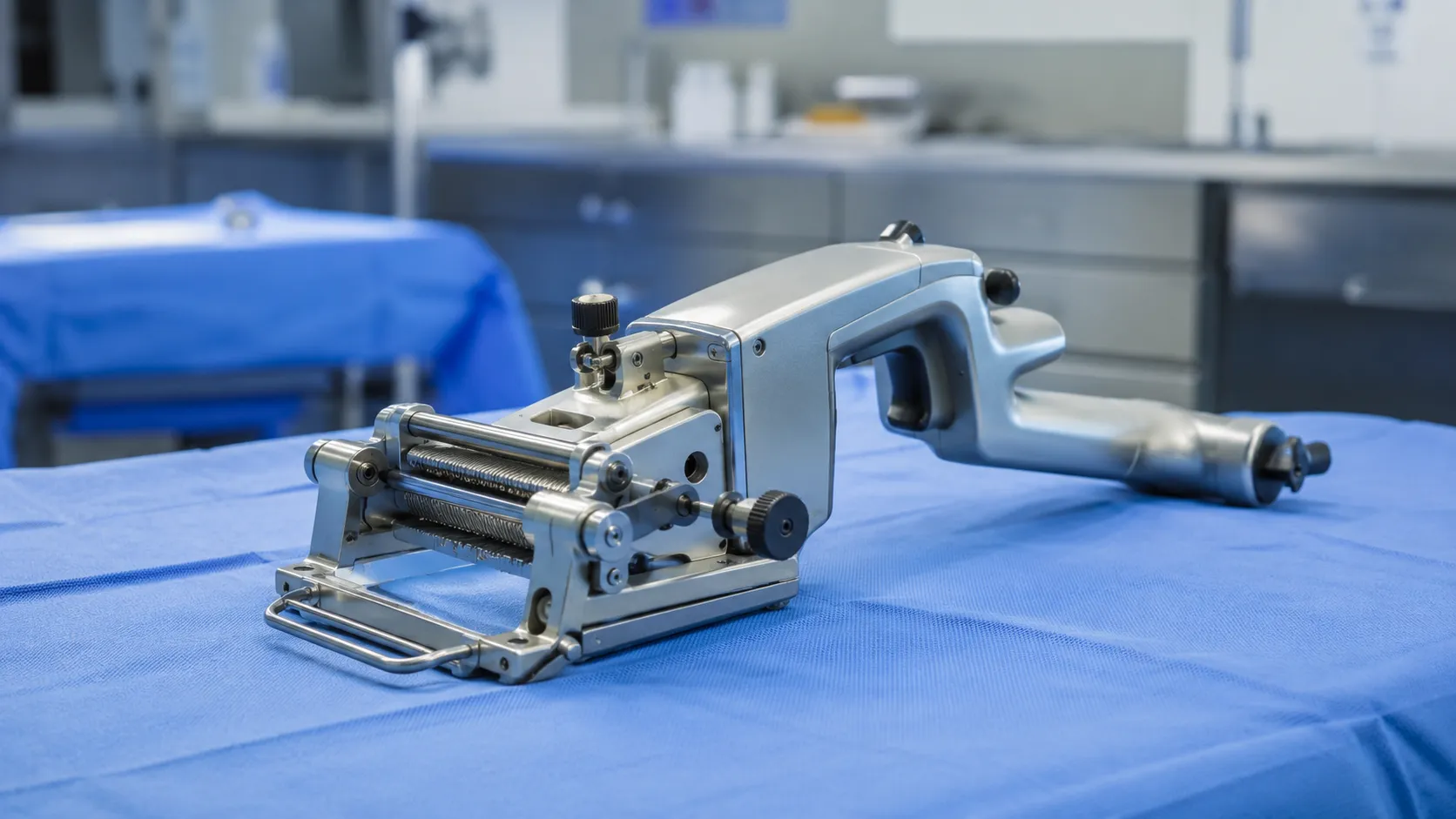
The drum pattern, associated with the Padgett design, uses adhesive to fix skin to a rotating drum while a blade cuts a graft of preset width and pre-setness. It gives good control of shape and thickness for medium grafts, but it is slower to set up and has a steeper learning curve.
Powered dermatomes
Electric or compressed-air dermatomes drive an oscillating blade, so the operator only controls and glides while the machine performs the cut. They produce consistent, reproducible grafts quickly and are the workhorse for burns and large reconstructive work. The trade-offs are real cost, a power or gas supply, and single-use blades. Air-driven models need a medical air or nitrogen source at the correct pressure; electric models need a sterilisable motor or a single-use handpiece.
Setting graft thickness and width
Thickness is set in fractions of a millimetre, and the calibrated depth dial is the most important control on the instrument. Split-thickness grafts are typically harvested in a thin band of dermis, and the surgeon selects the exact figure clinically, but the machine must deliver what the dial promises. Width: Interchangeable gauge plates should offer a range of widths to accommodate both small and large defects. Buyers should confirm that the depth calibration is verifiable and that the dial holds its setting against the vibration during cutting, because vibration produces an uneven graft. A thin graft takes more readily but is fragile and gives a poorer cosmetic result, whe. In contrast, a thicker graft is more robust but leaves a donor site that heals more slowly, so the surgeon balances take against donor-site morbidity for each patient. The instrument's job is to deliver the set thickness faithfully and across the full width of the cut.
Meshing the graft
A harvested sheet is often passed through a separate skin mesher, which cuts a regular pattern of small slits so the graft can be expanded like a net to cover a larger area and allow fluid to drain through it. The mesher uses a carrier board and a ratio roller, and expansion ratios are selectable. Although the mesher is a distinct instrument from the dermatome, the two are usually bought and used together, so factor the mesher, its carriers and its blades into the same procurement decision.
Blades, calibration and decontamination
Dermatome blades are single-use and sterile, and blade sharpness is non-negotiable: a dull blade tears rather than shaves and produces a poor graft, so blades are never re-sharpened or reused. Powered handpieces and knife bodies that are reusable are decontaminated and sterilised strictly in accordance with the manufacturer's validated method between patients, and sterile-services teams should confirm that pathway before adoption. Depth accuracy should be checked periodically as part of biomedical maintenance, because a worn depth mechanism undermines the whole procedure. Keep the blade type matched to the specific instrument, as blades are not interchangeable across designs.
Standards, regulation and settings of use
A dermatome is a medical device and must carry a valid UKCA or CE marking, with instructions for use that cover its intended purpose, blade fitment, and the validated reprocessing route for reusable parts. Powered electric units fall under the general medical electrical safety standard IEC 60601-1, while air-driven units must be matched to a compliant medical gas supply at the specified pressure. Dermatomes are concentrated in burns units, plastic and reconstructive theatres and major trauma centres; hand knives may appear in smaller units and in the field. General device and safety guidance is published on GOV.UK, and the MHRA is the UK regulator and the route for reporting device problems. To compare instrument sets against your caseload, register as a buyer with MediGear or reach us via the contact page.
Total cost of ownership
A hand knife is cheap to own but consumes blades and depends on skill. A powered dermatome is a capital purchase whose true cost includes single-use blades, servicing of the motor or air handpiece, the mesher and its carriers, and the power or gas supply. Estimate annual blade and carrier consumption based on your grafting volume, and confirm warranty terms and spare parts availability for the handpiece, which is the part that wears. For units doing occasional grafts, a knife or drum may be proportionate; for a busy burns service, a powered system pays back in speed and graft consistency.
Procurement checklist
-
Match the type — knife, drum or powered — to graft size and how often you graft.
-
Confirm the depth dial is calibrated, verifiable and holds its setting during cutting.
-
Specify a range of width guard plates for small and large defects.
-
For air-driven units, confirm the medical gas type and pressure required.
-
Check blades are single-use, sterile and matched to the specific instrument.
-
Include a skin mesher, carriers and expansion ratios in the same decision.
-
Confirm the validated reprocessing route for reusable handpieces and bodies.
-
Request UKCA or CE documentation and model annual blade and carrier costs.
Conclusion
A dermatome harvests an even sheet of skin for grafting, and the quality of that graft rests on blade sharpness and accurate, stable depth control. Choosing well meanmatchingng a poweredrum-powereded unit to yougrafting volume, verifying calibrationon, planning single-use blade supply and reprocessingandnd budgetinalone confirmrm the mesher, along with UKCA or CE marking and, for powered units, IEC 60601-1 compliance, before you buy. MediGear can help burns and plastic units compare dermatome and mesher sets so skin grafting is supported by instruments that perform predictably.
Disclaimer
This article is for informational purposes only. It is published by MediGear (medigear.uk) for general information and procurement guidance. It is not clinical, diagnostic, treatment, technical, engineering, legal or regulatory advice, nor a product endorsement, guarantee or substitute for professional assessment. MediGear does not provide medical consultations. Buyers should consult their clinical, biomedical, estates and regulatory contacts, and the manufacturer's documentation, and independently verify all specifications, certifications, compatibility and suitability before purchase. Specifications, certifications and availability are correct at the time of publication and may change without notice. MediGear is a medical-equipment distributor and does not sell medicines or pharmaceutical products.